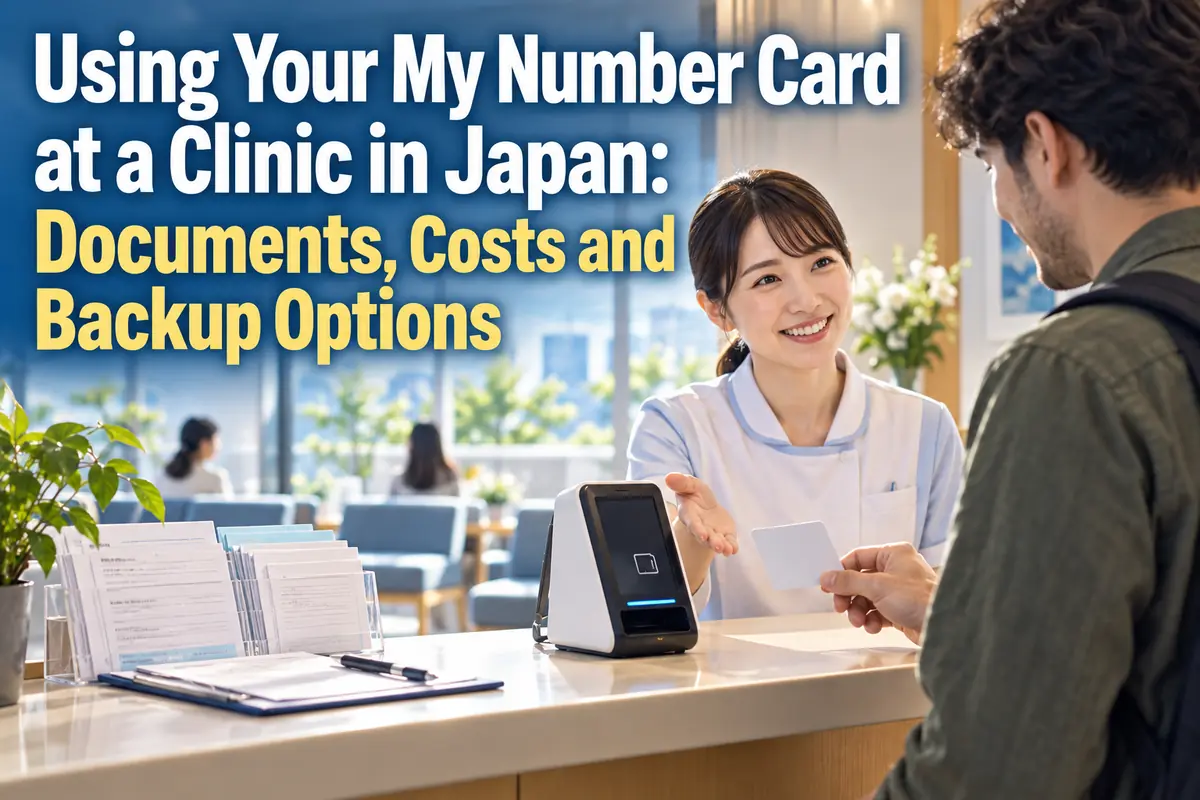
Using Your My Number Card at a Clinic in Japan: Documents, Costs and Backup Options
Bring either your My Number Card registered for health insurance use or a valid 資格確認書 (shikaku kakuninsho), an insurance eligibility certificate. You can receive insured treatment without a My Number Card if you have the eligibility certificate.
Do not rely on your old health insurance card. All old-style cards expired by December 1, 2025, and the temporary handling of accidentally presented expired cards ended on July 31, 2026. These dates matter if an old card is still in your wallet. MHLW’s current document guidance explains what to present now.
This guide is for foreign residents and families enrolled in Japanese public health insurance, particularly before a first clinic visit, after changing jobs, or when renewing a period of stay. Information was checked on October 8, 2026.
Here is what to check before you go:
- Which document you have: an eligibility certificate and an eligibility information notice serve different purposes.
- Whether your card is registered and your current insurance details are available.
- Whether the physical card or its electronic certificate is approaching expiry.
- What backup to bring if the clinic’s reader cannot verify your insurance.
Choose the right document before leaving home
The Japanese label is more useful than the document’s color or an English translation, because insurers use different formats.
My Number Card registered for insurance use
マイナ保険証 (Maina hokenshō) means a My Number Card registered for use as a health insurance card. You do not receive a separate plastic “My Number health insurance card.”
If registration is incomplete, you can register through Mynaportal, a Seven Bank ATM, or a participating clinic or pharmacy’s card reader. At the reader, an unregistered card leads to a registration screen. Checking in advance avoids having to complete this step while you are unwell. Digital Agency registration FAQ
資格確認書: the alternative you can use on its own
資格確認書 (shikaku kakuninsho) proves your insurance eligibility without a My Number Card.
For the time being, people without a card registered for insurance use receive this document free of charge without applying. People who need assistance and find card-based reception difficult can also apply through their insurer. A lost card or a card being renewed is another reason to ask the insurer about obtaining a certificate.
Its format and expiry date are set by the insurer, within the national rules. Check the date printed on yours; do not assume another family member’s certificate has the same deadline. MHLW eligibility certificate guidance
資格情報のお知らせ: useful backup, but not a standalone replacement
資格情報のお知らせ (shikaku jōhō no oshirase) is a notice of your insurance eligibility information.
Keep it with your My Number Card. If electronic verification fails, the two can be presented together. The notice alone is not the normal document for receiving insured treatment. A Mynaportal insurance-information screen or downloaded PDF can also support the physical card. MHLW reception FAQ
ここがポイント: 資格確認書 can be used on its own. 資格情報のお知らせ normally needs to be shown together with your My Number Card. Check the full Japanese heading before choosing what to carry.
Prepare insurance registration and enrollment separately
Registering your card for insurance use does not enroll you in an insurance plan.
The card is a way to check your existing coverage. If you have just arrived, started employment, left a job, or moved between municipalities, complete the relevant insurance procedures with your employer or municipality first.
Once card registration is complete, you generally do not repeat it when changing insurers. However, the new insurer still needs to process your enrollment and upload the new eligibility information. That update takes time. MHLW’s English guide, July 2025 edition
For example, after leaving a job, the same physical card may remain in your wallet while the insurance behind it changes. Before your next appointment, ask:
- Which insurer covers me on the appointment date?
- Have the new enrollment procedures been completed?
- What should I present if the new details are not yet available electronically?
If you can access Mynaportal, check the displayed insurer before the visit. If you cannot, contact your insurer rather than assuming a successful card registration proves current coverage.
At reception, follow the reader and ask for help early
At a clinic with online eligibility verification, the reader checks both your identity and insurance status.
The usual sequence is:
- Place your physical My Number Card in the reader as instructed.
- Verify your identity with facial recognition or the four-digit PIN.
- Read the choices about sharing medical information and select your response.
- Retrieve your card when reception is complete.
The PIN is the four-digit one used for user authentication, not the longer signing password. If facial recognition fails or you cannot operate the reader, ask the receptionist for assistance. MHLW’s English reception guide
A useful phrase is:
マイナ保険証の使い方を教えてください。
Maina hokenshō no tsukaikata o oshiete kudasai.
Please show me how to use my My Number health insurance card.
Do not assume that having the Mynaportal app means your phone is ready to replace the physical card. Smartphone reception requires setup and a facility with compatible equipment. Unless you have confirmed both, carrying the physical card is the simpler preparation. Digital Agency’s insurance-card overview
If the reader fails, ask about backup verification
A reader error does not automatically mean you have lost insurance coverage.
First tell reception that you are trying to use your registered card. Under MHLW’s fallback guidance, you can show the physical card together with either:
- Your Mynaportal insurance-information screen or downloaded PDF; or
- Your 資格情報のお知らせ.
If neither backup is available, staff may confirm information already held for a returning patient. For a first visit, the fallback process can include an insured-status declaration form. This procedure is intended to allow insured care at the usual patient share when electronic verification fails. MHLW reception FAQ
There is an important distinction: a broken reader and incomplete insurance enrollment are different problems. If the system has no current coverage because your insurer has not finished processing a change, contact that insurer and explain the situation to the clinic.
If reception asks for full payment, ask what documents are needed to resolve the insurance check, whether the clinic can adjust the bill later, and what deadline applies. Keep the receipt and any itemized statement. Do not assume the refund process or deadline is the same at every facility.
The card checks coverage; your insurance rules determine the bill
Using the card does not make all treatment free or change your underlying patient contribution.
MHLW’s multilingual brochure explains that insured patients generally pay between 10% and 30% of covered medical expenses, according to their applicable insurance rules. If your confirmed share is 30% and covered treatment totals ¥10,000, that share is ¥3,000. This is a calculation example, not a quote for a particular appointment. MHLW English brochure
When a large bill is expected
One benefit of online verification is that an eligible high-cost medical expense limit can be applied at reception without first obtaining a separate limit certificate. The applicable limit depends on your circumstances, including income. Digital Agency benefits FAQ
Before planned expensive treatment, ask the billing office what it can verify and which charges fall outside the limit. Do not treat the limit as a cap on every expense connected with a hospital stay. If you use an eligibility certificate instead, ask your insurer whether you need additional documentation to apply the limit at the counter.
Families should check local subsidy documents
A child’s municipal medical subsidy is a separate matter from national health insurance verification. Bring the local subsidy certificate unless your municipality and the specific clinic or pharmacy have confirmed that it can be verified through the card system. Electronic support varies by municipality and facility. MHLW reception FAQ
Check expiry before renewing your period of stay
Foreign residents with a fixed period of stay should check the physical card’s date as well as the electronic certificate’s date.
The electronic certificate usually has a five-year validity period, which can end before the physical card expires. For the physical card, an expired electronic certificate has a limited insurance-verification grace period: three months from the end of the month in which it expired. Medical-information sharing is unavailable during that period. Renew promptly at your municipality instead of planning around the grace period. Digital Agency renewal guidance
That electronic-certificate grace period should not be confused with an extension of an expired physical card.
Immigration renewal does not automatically extend the card
For residents whose card validity is tied to a fixed period of stay, receiving a new residence card does not automatically update the My Number Card.
Kashiwa City’s guidance, updated January 1, 2026, tells residents to bring their My Number Card and renewed residence card for the extension procedure. It also explains a special two-month card extension for people whose immigration renewal is still pending, provided they apply before the My Number Card expires. After immigration approval, another update is needed. Kashiwa City’s procedure
These details make early contact worthwhile. Ask your own municipality about:
- The office that handles card-validity changes;
- Whether an appointment is required;
- Proof accepted for a pending immigration application;
- Updating the electronic certificate at the same visit;
- Procedures for children or someone acting on your behalf.
Residents with permanent or other indefinite statuses should confirm their own card deadline rather than assuming the fixed-period rule applies.
Before your next appointment, check these three things
The most useful preparation is to confirm your current coverage, carry the right document, and keep a backup.
- Check the heading: 資格確認書 and 資格情報のお知らせ are different documents.
- Check the dates: inspect your card, electronic certificate, and any eligibility certificate before they expire.
- Check who can solve the problem: reception handles reader difficulties; your insurer handles coverage records; your municipality handles card and certificate renewal.
If you have recently changed jobs or renewed your period of stay, make these checks before the appointment day. In an emergency, seek urgent help and follow medical staff’s instructions rather than delaying care to finish card procedures.
参照リンク
- MHLW: Current documents for insurance eligibility verification
- Digital Agency: Health insurance card FAQ
- MHLW: Eligibility certificates for people not using a My Number health insurance card
- MHLW: My Number health insurance card reception FAQ
- MHLW: English guide, July 2025 edition
- Digital Agency: Using the My Number Card for health insurance
- MHLW: English health insurance card brochure
- Digital Agency: Card and electronic certificate renewal
- Kashiwa City: Card procedures when extending a period of stay