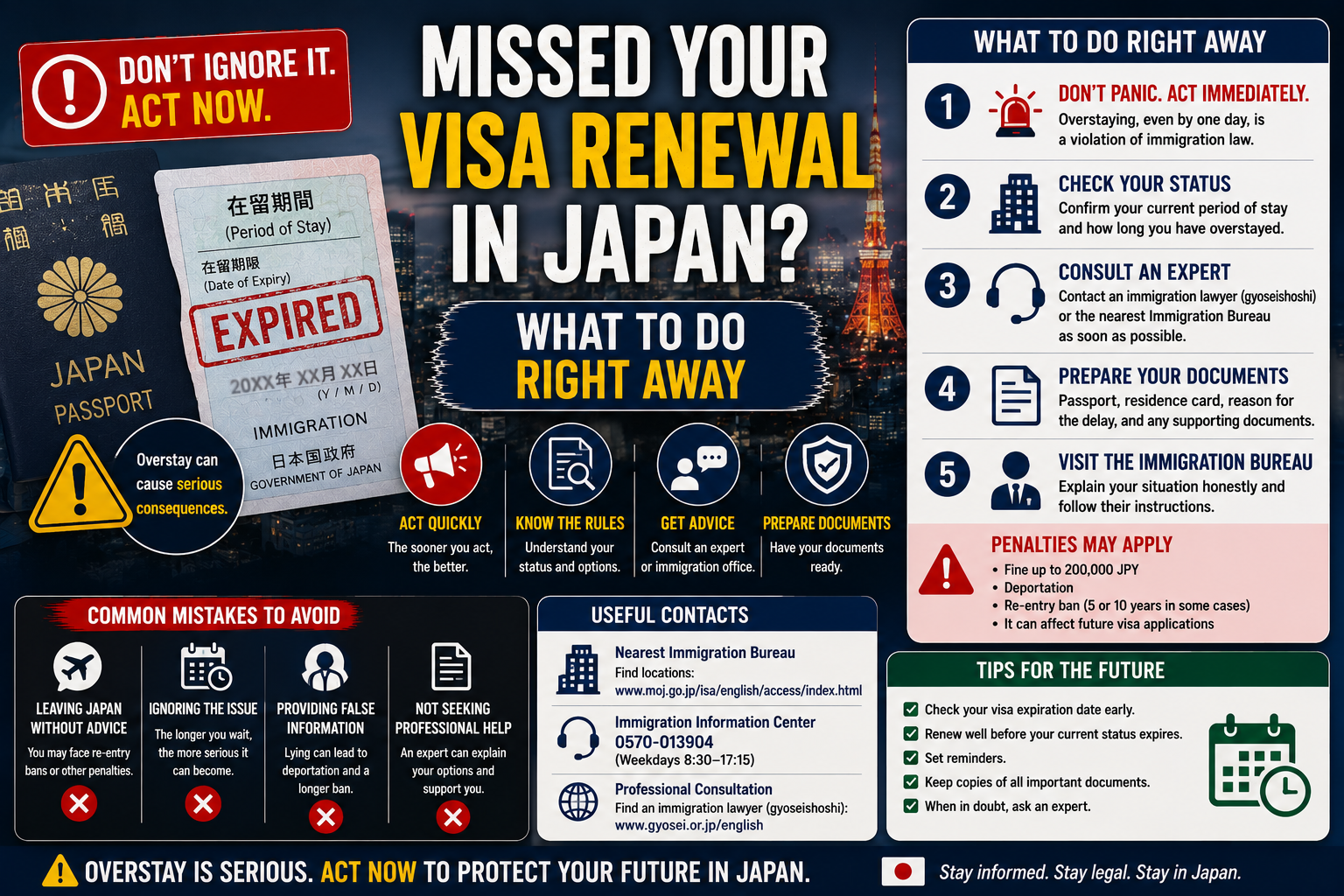
Missed Your Visa Renewal Deadline in Japan? What to Do Now
If you missed your visa renewal date in Japan, the most important point is simple: act immediately and contact Immigration the same day or the next business day. In Japan, the normal extension process must be filed before your current period of stay expires. If you filed in time, a special period may protect you while the application is being reviewed. If you did not file in time, that protection does not automatically apply.
This guide is for foreign workers, students, dependents, and long-term residents in Japan who realized too late that their period of stay has already expired or is about to expire. It explains what changes once you miss the deadline, what you should prepare first, and which current rules matter as of May 8, 2026.
- If your application was filed before the expiry date, you may still be covered by Japan’s special period.
- If you filed nothing before the expiry date, do not wait for your employer or school to fix it later.
- Go to the regional immigration bureau that handles your area, or contact ISA immediately.
- Do not assume you can keep working, studying, or traveling as usual after expiry.
First, check which situation you are in
Before you panic, separate these two cases. The next step is very different.
Case 1: You already applied before the expiry date
If you submitted an application for extension of period of stay or change of status of residence before your current stay period ended, Japan’s special period may let you remain in Japan under your previous status until one of these happens first:
- a decision is issued on your application
- two months pass after your original expiry date
This matters because many people see the date on the front of the residence card, think they are overstaying, and worry unnecessarily. If you applied on time, check your application record and the back of your residence card if you filed in person.
ここがポイント: The 2-month special period is not a general grace period for everyone. It applies when you filed the right application before your status expired.
Case 2: You did not apply before the expiry date
This is the harder case. Once the period of stay has expired, you are no longer in the normal renewal track. Japan’s immigration rules do not describe a routine late-renewal grace period for people who simply forgot.
That does not mean every case ends the same way. Immigration will look at the facts, including how late you are and why. But you should treat this as urgent from day one.
What to do immediately after you miss the deadline
Start with the steps that actually move your case forward.
1. Confirm the exact expiry date
Check:
- your residence card
- your passport if needed
- any application receipt, if you think something may already have been filed
Do not rely on memory. One-day mistakes matter here.
2. Contact Immigration right away
Use the Immigration Services Agency of Japan or your regional immigration bureau. If the office is open, contact them the same day. If you notice the problem at night, on a weekend, or during a holiday, prepare your documents and contact them on the next business day.
What to ask:
- whether your case should be handled as an extension application, another status procedure, or a separate consultation
- which office you must visit
- whether you need a reservation or can walk in
- what explanation documents you should bring
Regional handling can differ in practice because each bureau manages its own counters, reservation methods, and document flow.
3. Gather documents before you go
Bring the basics first, even if your full set is not ready yet.
- passport
- residence card
- copy of your current employment or school documents
- recent proof of continued activity in Japan
- proof related to the reason for the delay, if any
- contact details for your employer, school, or family sponsor
If there was a serious reason such as hospitalization or another unavoidable event, bring evidence. Immigration needs documents, not just a verbal explanation.
4. Tell your employer or school quickly
This is not only a paperwork issue. Your company or school may need to prepare supporting documents, confirm your current status, or pause internal processes until Immigration gives guidance.
For workers, this can affect payroll, work scheduling, and HR compliance. For students, it can affect enrollment support and any part-time work arrangements.
What matters most in a late case
The core question is usually not just, “Did you forget?” It is whether you still meet the conditions for your status and whether there is a clear, documented reason for Immigration to consider your case.
Your reason for the delay
A late case is stronger when the reason is concrete and provable.
Examples that may need evidence:
- hospitalization or serious illness
- emergency travel tied to a family crisis
- a major administrative error that you can document
- a situation where you believed an agent, employer, or school had filed, but they had not
A weak explanation is one that stays vague: “I was busy,” “I thought I had more time,” or “someone else was probably doing it.” If that is what happened, say it honestly, but do not expect that alone to solve the problem.
Your underlying eligibility
Even in a late case, Immigration will still look at the basics of your status.
For example:
- a work visa holder still needs the right job and supporting employer documents
- a student still needs enrollment-related proof
- a dependent still needs proof of the family relationship and sponsor situation
If your underlying situation changed before the expiry date, the problem may be larger than a missed renewal.
What not to do
Some mistakes make a bad situation worse very quickly.
Do not wait for a letter
Immigration is not likely to solve a missed renewal by sending you a reminder after the deadline. If you already know you missed it, take action before more days pass.
Do not assume the 2-month special period covers you
It only applies when the application was submitted before expiry. Many people misunderstand this point.
Do not keep treating your status as normal
If your period of stay has expired and no timely application was filed, do not assume your previous permission to work or stay continues unchanged. Ask Immigration what you may or may not do while the case is being handled.
Do not try a simple “border reset”
Leaving Japan and re-entering is not a normal fix for an overstay issue. It can create bigger immigration problems instead of solving the missed deadline.
Fees and current updates that matter
Even though the real issue is the missed deadline, cost and procedure updates still matter.
As of May 8, 2026:
- the standard fee for an approved extension of period of stay is 6,000 yen at an office
- the online fee is 5,500 yen
- these revised fees apply to applications accepted on or after April 1, 2025
Japan also continues to offer online residence applications for eligible users, including foreign nationals themselves in some cases, legal representatives, relatives, and approved institutional users. But if you have already missed the deadline, do not assume online filing is the best path without checking first. A late case may require direct guidance from the bureau handling your area.
National rule vs local office practice
The immigration rule is national. The way you reach the counter is not always the same.
Across Japan, these points can vary by bureau or branch office:
- reservation systems
- consultation flow
- document screening at the counter
- whether a support desk can help you prepare an online filing
That is why two people with similar problems may be told to come in different ways in Tokyo, Osaka, Nagoya, or another region.
If you need help in English or another language
If you are struggling to explain the issue in Japanese, use official support channels early.
Useful options include:
- the Foreign Residents Support Center (FRESC)
- the Foreign Residents Information Center
- your regional immigration bureau
FRESC is especially useful if you need help understanding which office to contact or how to start a residence-related consultation.
Common mistakes foreign residents make
These are the patterns that cause the most trouble.
- trusting an employer, school, or friend without checking whether the application was actually submitted
- confusing residence card expiry with passport expiry, or the other way around
- assuming there is an automatic grace period after the date passes
- delaying action because the overstay is only one or two days
- bringing no proof for the reason the filing was late
Even a short delay should be treated seriously.
The practical bottom line
If you missed your visa renewal deadline in Japan, the correct first move is not to search for a hidden grace period. It is to contact Immigration immediately, confirm your exact status, and prepare documents that explain both your delay and your continued eligibility.
The most important watchpoints are:
- whether anything was filed before the expiry date
- how many days have passed since expiry
- whether you can prove the reason for the delay
- whether you still fully qualify for your current status
If you handle those four points quickly, you give yourself the best chance to move from panic into a clear next step.
参照リンク
- Immigration Services Agency: Application for Extension of Period of Stay
- Immigration Services Agency: What Is the Special Period?
- Immigration Services Agency: Online Residence Application Procedures
- Immigration Services Agency: Online Procedures Available
- Immigration Services Agency: Revised Fees for Immigration Procedures
- Immigration Services Agency: Fees for Immigration Procedures Revised on April 1, 2025 (English PDF)
- Immigration Services Agency: Regional Immigration Services Bureaus
- Immigration Services Agency: Foreign Residents Support Center Contact Information
- Immigration Services Agency: Deportation Procedures