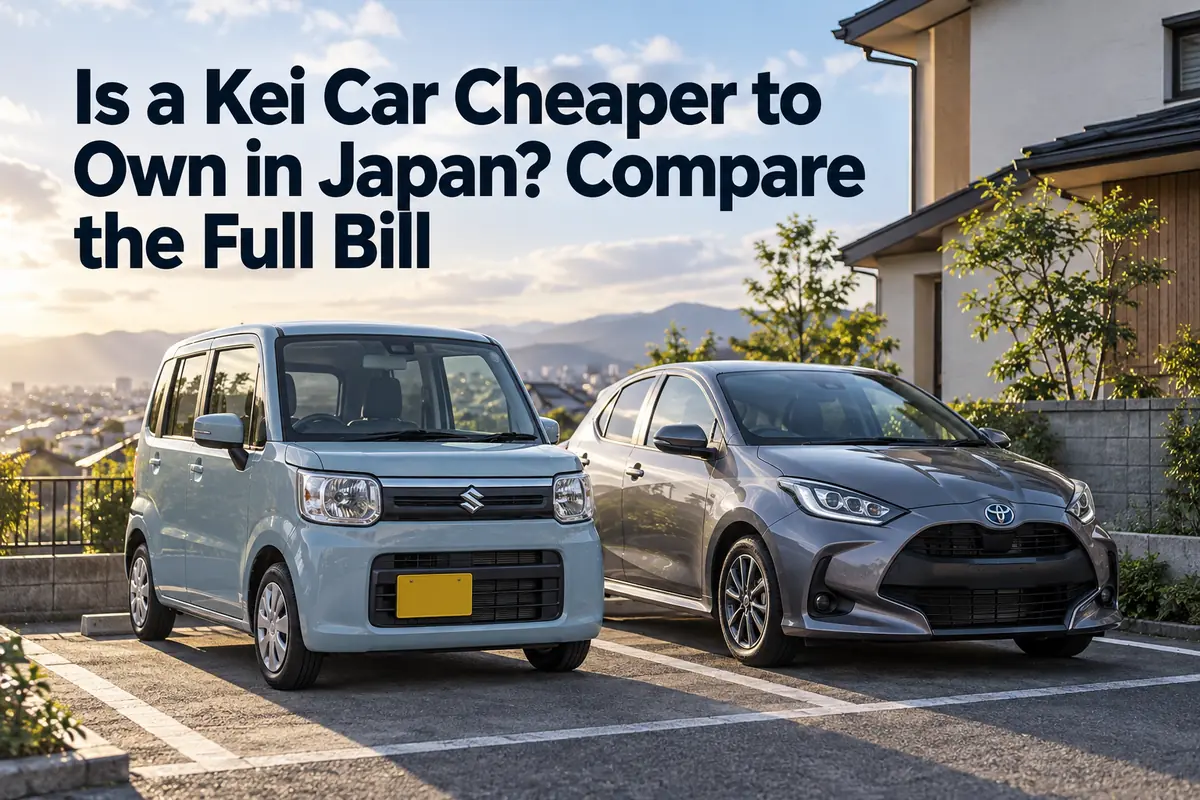
Is a Kei Car Cheaper to Own in Japan? Compare the Full Bill
A kei car usually has lower ownership taxes than a regular passenger car, but it does not automatically have the lowest total cost. Parking rent, purchase price, fuel consumption, repairs, and voluntary insurance can change the result. Compare two actual vehicles over the same ownership period before choosing.
For example, a standard private-use kei passenger car has an annual vehicle tax of ¥10,800, while a 1.0–1.5-liter regular passenger car first registered from October 2019 generally has a standard annual tax of ¥30,500. That ¥19,700 difference matters—but a parking contract costing ¥2,000 more each month would exceed it over a year.
This guide is for foreign residents buying a car for commuting, shopping, or family use. It focuses on private-use passenger cars, rather than commercial vans, trucks, or rental vehicles. Information was checked on October 8, 2026; an upcoming compulsory insurance change is explained below.
What you will learn:
- Where a kei car’s predictable savings come from.
- Why parking paperwork and parking rent are separate questions.
- How insurance, fuel, and used-car condition can reverse the comparison.
- What to request before signing a purchase agreement.
First, check whether the car fits your household
A kei car’s size limits are useful for tight spaces, but its passenger capacity can rule it out before costs enter the discussion.
A kei car—軽自動車, kei jidōsha—belongs to a regulated vehicle category. Four-wheel kei vehicles have maximum dimensions of 3.4 meters long, 1.48 meters wide, and 2 meters high; gasoline engine capacity is limited to 660 cc. Kei passenger cars generally seat no more than four people, including the driver. See the kei vehicle association’s explanation.
In this guide, “regular car” means a non-kei registered passenger car. That includes small hatchbacks, not just large vehicles.
Before comparing prices, check:
- Passengers: Use the seating capacity on the vehicle’s inspection certificate. A household needing five ordinary seating positions should look beyond kei passenger cars.
- Child seats and luggage: Check that your actual child seats, stroller, and shopping bags fit together.
- Parking access: Measure the entrance and usable space, not only the marked bay.
- Your usual journeys: Test-drive the shortlisted car and assess visibility, comfort, and acceleration on roads representative of your daily use.
Do not assume a tall kei car fits every mechanical parking system. The facility’s height, weight, width, and other restrictions apply to the individual vehicle.
Taxes give kei cars a clear advantage—but compare the right vehicles
The tax saving depends on the car’s registration date, weight, age, and eligibility for reductions.
Annual vehicle tax
The annual levy is separate from the weight tax paid at inspection.
Standard annual examples for private-use passenger cars, before special reductions or age-related increases, are:
- Kei passenger car first inspected from April 2015: ¥10,800.
- Regular car up to 1.0 liter, first registered from October 2019: ¥25,000.
- Regular car over 1.0 through 1.5 liters, first registered from October 2019: ¥30,500.
- Regular car over 1.5 through 2.0 liters, first registered from October 2019: ¥36,000.
The regular-car figures appear in the Tokyo Metropolitan Government’s tax guide. Tokyo is the source for these examples; confirm your bill with the prefecture where the vehicle is registered. Kei tax is handled by the municipality, with Yokohama’s official table showing the kei figures above.
Older cars need a separate check. A qualifying older private-use kei passenger car moves to ¥12,900 after 13 years; some vehicle types are excluded from the increase. Regular cars first registered before October 2019 also have different base rates.
Your purchase date does not reset the vehicle’s age. Ask for its original registration or first-inspection date.
Weight tax at inspection
Automobile weight tax—自動車重量税, jidōsha jūryōzei—is another part of ownership costs.
For a two-year private-use inspection period, ordinary non-eco examples below the age-related surcharge thresholds are:
- Kei car: ¥6,600.
- Regular passenger car weighing over 1.0 through 1.5 tonnes: ¥24,600.
That is an ¥18,000 difference per two-year period, equivalent to ¥9,000 annually for budgeting. Eco-car treatment and older-vehicle rates can change these amounts. The transport ministry’s current tax tables and vehicle-specific lookup services are the appropriate place to check the actual car.
For the 1.0–1.5-liter, over-1.0–1.5-tonne regular car described above, annual vehicle tax plus annualized weight tax is ¥28,700 higher than the standard kei example. This is a useful starting point—not a complete ownership estimate.
Parking rules do not guarantee cheaper parking
A kei car may have a different police procedure, but the parking operator decides the rent and vehicle restrictions.
Regular cars generally require a parking-space certificate—車庫証明, shako shōmei—where the certificate requirement applies. Kei cars use a parking-place notification in designated areas. There are geographical exceptions, so check the exact address rather than relying on a nationwide shortcut.
For example, Kanagawa Prefectural Police lists specific areas where kei notification is required, including Yokohama and Kawasaki, with some boundary exceptions. The police also explain parking-space conditions, including a location within 2 kilometers in a straight line of the vehicle’s base of use.
“No parking certificate required” does not mean “no parking space needed.” Secure a suitable place and check the local procedure before buying.
Prepare the parking documents early
Depending on the procedure, you may need:
- The police application or notification form.
- A location map and a layout drawing.
- Proof that you may use the space: a declaration for your own property, or the owner’s permission document for rented property.
A parking contract may be accepted instead of a permission document in some circumstances. Ask the police counter whether your contract contains the required details.
Separately, ask the parking manager about monthly rent, initial charges, cancellation notice, and charges for issuing documents. Confirm whether the price actually differs between the two cars.
An illustrative ¥15,000 monthly parking contract costs ¥180,000 annually. This is arithmetic, not a nationwide market estimate. If both cars use that same space at the same price, neither gains a parking-cost advantage.
Compulsory insurance barely separates the two categories
The compulsory insurance premium difference is small, and the scheduled November 2026 change makes a kei car slightly more expensive in the example below.
Compulsory liability insurance—自賠責保険, jibaiseki hoken—is required for both categories. It provides limited compensation for injury or death to other people; it does not cover damage to another car or repairs to your own vehicle. The General Insurance Association of Japan explains its scope.
For a 24-month policy in mainland Japan, excluding Okinawa and remote-island rate areas:
| Policy start date | Kei car | Regular private passenger car |
|---|---|---|
| Through October 31, 2026 | ¥17,540 | ¥17,650 |
| From November 1, 2026 | ¥18,660 | ¥18,560 |
The official premium schedule distinguishes rates by the insurance period’s start date. Paying for a policy in October does not necessarily qualify it for the earlier rates if coverage begins in November.
These examples use 24 months. A purchase or inspection may require a different duration, so request the premium for the actual period needed.
Voluntary insurance needs matching quotes
Voluntary motor insurance—任意保険, nin’i hoken—can cover risks outside compulsory insurance, depending on the policy.
Request quotes for both exact vehicles using the same drivers, use, limits, and deductibles. Otherwise, a lower premium may simply buy narrower cover.
Check:
- Who may drive, including your spouse or other household members.
- Driver age conditions.
- Commuting or business use.
- Liability limits and cover for occupants.
- Cover for your own vehicle and the amount you pay toward a claim.
Driver restrictions can affect whether a claim is covered, as the insurance association’s explanation of policy conditions shows. Foreign residents should also ask whether the insurer accepts any overseas claims-history evidence; do not assume an overseas discount transfers automatically.
Fuel and purchase price can reverse the tax saving
A car with lower tax can still cost more over your ownership period if it uses more fuel or costs more to buy.
Calculate fuel from your mileage
Use this formula:
Annual fuel cost = annual kilometers ÷ kilometers per liter × price per liter.
Consider an illustrative comparison—not measured results for particular models:
- Annual driving: 10,000 km.
- Petrol assumption: ¥180 per liter.
- Car A consumption: 18 km/L, giving about ¥100,000 annually.
- Car B consumption: 24 km/L, giving about ¥75,000 annually.
The ¥25,000 difference would absorb most of the ¥28,700 tax advantage in the earlier example if the regular car were Car B. At 5,000 km a year, the fuel difference would halve.
Use realistic consumption for each shortlisted vehicle. Engine size alone does not establish fuel economy, and a hybrid regular car may compare differently from a conventional petrol car.
Spread the purchase difference over your planned stay
A hypothetical kei car costing ¥300,000 more than a comparable regular car needs about 10.5 years of ¥28,700 annual tax savings to recover that difference, before fuel, insurance, repairs, financing, or resale are considered.
For someone expecting to leave Japan in three years, purchase price and likely resale proceeds may therefore matter more than a long-term tax advantage.
Compare the total payable purchase quote, then calculate:
- Purchase price and financing cost.
- Parking, fuel, and insurance over your planned ownership period.
- Taxes, inspections, maintenance, and likely repairs.
- Expected resale proceeds, using a conservative assumption.
Keep resale assumptions visible. They are estimates, not guaranteed money back.
Shaken is a package of costs, not one fixed fee
Ask for an itemized inspection quote because tax and compulsory insurance are only part of the bill.
Shaken—車検, shaken—is the periodic vehicle inspection. For ordinary new private-use passenger cars, including kei passenger cars, the first inspection period is normally three years, followed by two-year periods. Other vehicle uses and categories can have different schedules; the Kei Motor Vehicle Inspection Organization’s guide explains kei inspection basics.
A workshop quote may contain:
- Weight tax and compulsory insurance.
- Inspection and related statutory fees.
- Workshop labor and administrative charges.
- Maintenance, parts, and repairs.
Ask which repairs are necessary for the car to pass and which are recommendations. A cheap used car with an inspection due soon needs a different first-year budget from one sold with a fresh inspection.
Passing inspection also does not replace ongoing maintenance. The transport ministry’s maintenance guidance explains the owner’s responsibility to keep the vehicle in good condition.
One useful current change applies to both categories: since April 1, 2025, renewal inspection within two months before expiry can preserve the remaining validity period. The transport ministry’s announcement explains the expanded window. Book early enough to allow time for repairs.
Before buying, collect three quotes and a document checklist
The most useful comparison combines a dealer’s total price, an insurer’s matching cover, and a confirmed parking contract.
Follow this order:
- Confirm the parking space. Check fit, permission documents, monthly charges, and the police procedure for your address.
- Get the vehicle details. Request the inspection certificate information, first-registration date, inspection expiry, service records, and known repair needs.
- Request an itemized purchase quote. Ask the seller to identify taxes, registration charges, inspection work, and optional services rather than comparing advertised vehicle prices alone.
- Obtain insurance quotes before collection. Give each insurer the same driver and usage information. Confirm the start date and support language.
- Ask who completes each procedure. Establish whether the dealer handles registration, tax declarations, and parking paperwork, and what you must supply.
For kei procedures, the inspection organization’s rules allow address evidence such as a residence record—住民票, jūminhyō—issued within three months in relevant cases. Its application forms page also explains forms used for name and address changes and applications through an agent. Ask for the checklist for your particular transaction before ordering documents.
Regular-car registration has different requirements. Do not reuse a kei checklist without confirmation, especially for a private sale, financed vehicle, or move between registration areas.
If a problem arises, contact the office responsible for that part: the local police for parking paperwork, the municipality for kei tax, the prefectural tax office for regular-car tax, and the relevant registration or inspection office for vehicle records.
Choose the cheaper car that still does the job
A kei car is strongest financially when its lower taxes come without a higher purchase price, unsuitable passenger capacity, or costly repair needs.
A regular compact car deserves a serious comparison when it offers a lower total purchase price, better fuel economy for your mileage, or the space your household needs. Neither category provides a shortcut around checking the individual car.
Before signing, make sure you can answer four questions:
- Does this exact vehicle fit our passengers, luggage, and parking space?
- What is the complete purchase bill?
- What will parking, insurance, fuel, and inspections cost during our planned stay?
- Which costs are confirmed, and which still depend on repairs or resale?
For a policy starting from November 1, 2026, also make sure the compulsory insurance figure uses the new schedule. Then compare the total bill—not just the annual tax line.
参照リンク
- Sapporo District Kei Vehicle Association: Kei vehicle dimensions and capacity
- Tokyo Metropolitan Government: Metropolitan Tax Guide 2025
- Yokohama City: Light motor vehicle tax
- Ministry of Land, Infrastructure, Transport and Tourism: Automobile weight tax tables and lookup services
- Kanagawa Prefectural Police: Parking certificates and notifications
- General Insurance Association of Japan: Compulsory liability insurance explained
- General Insurance Rating Organization of Japan: Compulsory insurance premium schedules
- General Insurance Association of Japan: Voluntary insurance policy conditions
- Kei Motor Vehicle Inspection Organization: Inspection basics
- Ministry of Land, Infrastructure, Transport and Tourism: Vehicle maintenance
- Ministry of Land, Infrastructure, Transport and Tourism: Expanded inspection renewal window
- Kei Motor Vehicle Inspection Organization: Application forms and examples