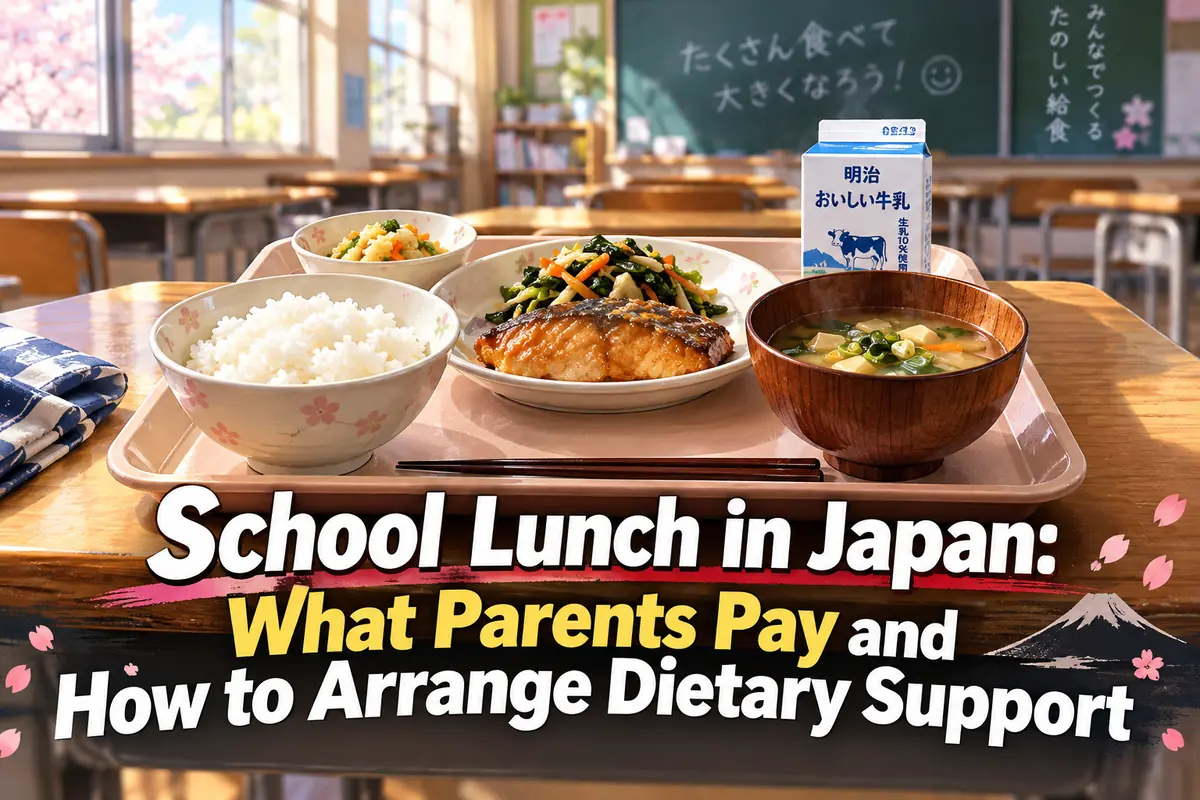
School Lunch in Japan: What Parents Pay and How to Arrange Dietary Support
School lunch in Japan does not have one nationwide price, and allergy support must be arranged with the school before your child starts eating it. A national program began reducing public elementary school lunch costs in April 2026, but some municipalities can still charge parents. Junior high school fees depend on local policy.
For foreign residents enrolling a child or moving between schools, the first task is to get three things confirmed: the current fee, the payment procedure, and any dietary arrangements. A lunch system that worked at your previous school may operate differently at the next one.
This guide reflects official information checked on October 8, 2026. It focuses on public elementary and junior high schools; private schools, international schools, kindergartens, and childcare facilities need separate checks.
- Costs: Check the municipality’s current school-year notice, rather than an older national average.
- Allergies: Request a meeting and the school’s medical documentation form early.
- Menus: Get both the monthly menu and detailed ingredient information when needed.
- Payment: Lunch fees may require registration separate from other school charges.
What changed in 2026—and why lunch may still cost money
The new national support reduces elementary school food costs, but it does not guarantee a zero bill everywhere.
Under MEXT’s program introduced in April 2026, the government supports municipalities providing meals at public elementary schools, including the elementary stages of compulsory education schools and special-needs schools.
For a full meal, the monthly benchmark is ¥5,200 per pupil, or ¥6,200 at special-needs elementary schools. Support covers 11 months. Different benchmarks apply to supplementary meals and milk-only provision.
These are funding benchmarks, not cash payments to parents or a universal lunch price. Municipalities may charge families for ingredient costs above the benchmark. Local funding can cover that difference instead.
Parents generally do not apply for this national support. However, a municipality offering separate assistance to children unable to eat school meals—for example, because of severe allergies—may require an application.
Elementary and junior high school can have different bills
Do not assume an elementary school subsidy continues unchanged when your child enters junior high school.
Yokohama illustrates the difference. Its fee notice updated October 7, 2026 lists:
- Public elementary school meals: ¥0 parental charge in fiscal 2026, with city support covering costs above the national benchmark.
- Public junior high school meals: ¥330 per full meal, including rice, side dishes, soup, and milk.
At ¥330, 20 meals would cost ¥6,600. That is a budgeting example, not a fixed monthly invoice: the actual number of meals and approved adjustments matter.
For another municipality, search its website for 学校給食費 (gakkō kyūshokuhi, school lunch fees) and 令和8年度 (Reiwa 8 nendo, fiscal 2026). Japan’s fiscal year runs from April through March, so calendar-year information alone can be misleading.
What children eat and why the menu matters
School lunch is part of food education, so families should expect a planned menu rather than assume children can choose meals individually.
MEXT’s English school lunch leaflet describes meals as a way to teach nutrition, food culture, cooperation, and good eating habits. A full meal combines a staple such as rice or bread, milk, and accompanying dishes. Children also participate in serving and clearing up.
The leaflet describes the underlying funding arrangement: school providers cover facilities and personnel, while parents primarily cover ingredients. Its explanation predates the 2026 cost-reduction program, so use current municipal notices for what families actually pay now.
Ask for the right menu document
The useful Japanese term is 献立表 (kondatehyō, menu sheet). For a child with dietary restrictions, also request the detailed ingredient and allergen information.
Check:
- Whether the document covers your child’s school and month.
- Whether ingredients in sauces, seasonings, and processed foods are included.
- How families are notified about ingredient changes.
- Who confirms which dishes your child can receive.
A dish name or photograph is not enough to establish that a meal meets a medical or religious restriction. Translation software can help you read a notice, but ask the school to confirm any ingredient you cannot identify confidently.
Menu websites can also change. Yokohama’s junior high menu notice says menus and allergy information moved to a separate school lunch portal from July 2026. An old bookmark may therefore stop showing current meals.
How to arrange food-allergy support
The essential step is a documented agreement between the family and school, based on medical information and what the kitchen can safely provide.
MEXT’s school lunch allergy guidance asks education boards, schools, and kitchens to establish their own policies and operating procedures. National guidance does not mean every school can prepare the same allergy meals.
Contact the school before the first lunch
Tell the school about the allergy during enrollment or transfer arrangements. Ask for a meeting with the relevant staff, which may include the class teacher, school health teacher, and staff responsible for meals.
Request the 学校生活管理指導表(アレルギー疾患用) (gakkō seikatsu kanri shidōhyō, school life management guidance form for allergic diseases).
MEXT’s guidance on this form explains that schools use it when school-based care or management is needed, and discuss arrangements with parents using the submitted information. Ask which version your school requires and how to have the medical sections completed.
For the meeting, prepare:
- The completed form and relevant medical instructions requested by the school.
- A clear list of diagnosed food allergies.
- Current emergency contacts.
- Information about prescribed emergency medication, if applicable.
- Questions about meal identification, serving, and staff responsibility.
Ask the school and clinician to confirm the emergency plan, including medication arrangements. If a serious reaction occurs, follow the emergency plan and seek emergency assistance immediately.
Understand the available options
An agreed arrangement might involve food prepared without the allergen, a substitute meal, or bringing part or all of lunch from home. The suitable option depends on the child’s medical needs and the school’s facilities and procedures.
Do not send your child with an informal instruction to “pick out the egg” or “avoid the sauce.” Confirm the actual meal plan with the school.
Yokohama’s current junior high school FAQ provides a useful local example: its allergy alternative menu replaces or excludes all nine ingredients covered by that service together. It does not create an individual menu for each child’s particular allergen. It also does not use child-led removal of allergens as its allergy response.
That illustrates why the question is not simply “Does the school offer allergy meals?” Ask whether its specific service fits your child’s needs.
Religious restrictions, vegetarian diets, and milk intolerance
Dietary restrictions need an early discussion even when they are not food allergies.
Explain the exact restriction. “No pork” and “no pork-derived ingredients” are different instructions; “vegetarian” also needs clarification about fish, stock, eggs, and dairy.
Ask whether the school can provide an appropriate meal, stop milk provision, or approve a home-packed lunch. Do not assume an allergy menu meets other dietary requirements.
In Yokohama’s junior high system, health restrictions such as lactose intolerance and religious food restrictions are discussed in a school meeting. Its FAQ describes options including stopping lunch provision and bringing lunch from home, or stopping milk. It does not promise a specially designed menu for each restriction.
Elsewhere, confirm both the arrangement and its financial consequences. In particular, ask whether leaving individual dishes uneaten changes the charge. It may not.
How to set up payment and handle missed meals
Use the school’s current payment instructions, because registration, collection dates, and reductions are local matters.
Look for these terms in enrollment paperwork:
- 給食費 (kyūshokuhi): school lunch fee.
- 口座振替 (kōza furikae): automatic bank debit.
- 納付書 (nōfusho): payment slip.
- 就学援助 (shūgaku enjo): assistance with school expenses.
Check whether lunch needs separate bank registration
Yokohama normally collects chargeable lunch fees by bank debit, registered separately from other school payments. Setup can take one to two months. Its usual debit date is the 29th, moving to the next business day when necessary.
If a debit fails, the city sends a payment slip rather than making another automatic attempt. These details are specific to Yokohama, but they show why registering one school payment account may not complete every payment procedure.
At your school, confirm the first collection date and what to do while registration is pending.
Absence does not automatically mean a refund
Ask about cancellation and reduction rules before a planned long absence. Reporting that your child will miss school is not necessarily the same as stopping a meal charge.
Useful questions include:
- How much notice is needed to stop meals?
- Are single-day absences treated differently from longer absences?
- What happens during hospitalization or a school transfer?
- If home-packed lunch is approved, which charges stop and from what date?
If payment is difficult, ask about shūgaku enjo rather than letting invoices accumulate. Yokohama’s junior high FAQ directs families seeking lunch-fee assistance to the notice distributed by their school. Eligibility and applications should be checked locally.
What to prepare before your child starts
Leave the enrollment meeting with a confirmed lunch arrangement and a short list of items to bring.
Ask the school which utensils, cloths, masks, or serving clothes are required, how they should be labeled, and whether anything must be washed at home. Treat the school’s list as the authority; buying a standard “school lunch set” first may leave you with unnecessary items.
Also confirm the first lunch date. Lunch is not necessarily served on every school day, and shortened schedules, trips, and holidays need separate planning. Yokohama, for example, lists 188 elementary school meals as its annual standard, subject to each school’s annual plan.
For families who need language help, request interpretation or translated information when booking the meeting. Bring the original notices so staff can point to the exact form, deadline, or menu entry.
Common mistakes to avoid
Most avoidable problems come from assuming that a headline or a previous school’s arrangements apply to your child’s current school.
- “School lunch is free now.” Check the school stage, municipality, and current fiscal year.
- “My child had allergy support before.” Arrange a new meeting after a transfer and confirm the receiving school’s procedures.
- “The menu looks suitable.” Check detailed ingredients and the agreed meal plan.
- “I registered school payments already.” Verify whether lunch fees need a separate procedure.
- “My child did not eat it, so there is no charge.” Ask about approved cancellations and reductions.
- “No lunch fee means no lunch preparation.” Check supplies and days when school lunch is unavailable.
Your final check before the first meal
Before your child eats their first school lunch, confirm four practical details with the school.
- The amount your household pays and the first payment date, if applicable.
- The current menu source and contact person for ingredient questions.
- The approved dietary plan, required documents, and emergency arrangements where relevant.
- The first serving day, required supplies, and procedure for stopping meals.
If an allergy arrangement is still unresolved, ask the school to agree on an interim lunch plan before the first meal. That decision should be made by the adults responsible for the child’s care, rather than left for the child to negotiate at lunchtime.
参照リンク
- MEXT: School lunch cost reduction from April 2026
- Yokohama: School lunch fees and payment procedures
- MEXT: Japanese School Lunch and Shokuiku—English leaflet
- Yokohama: Junior high menu publication notice
- MEXT: Food-allergy guidance for school lunches
- MEXT: Allergy management forms and school arrangements
- Yokohama: Junior high school lunch FAQ
- Yokohama: Elementary school lunch overview