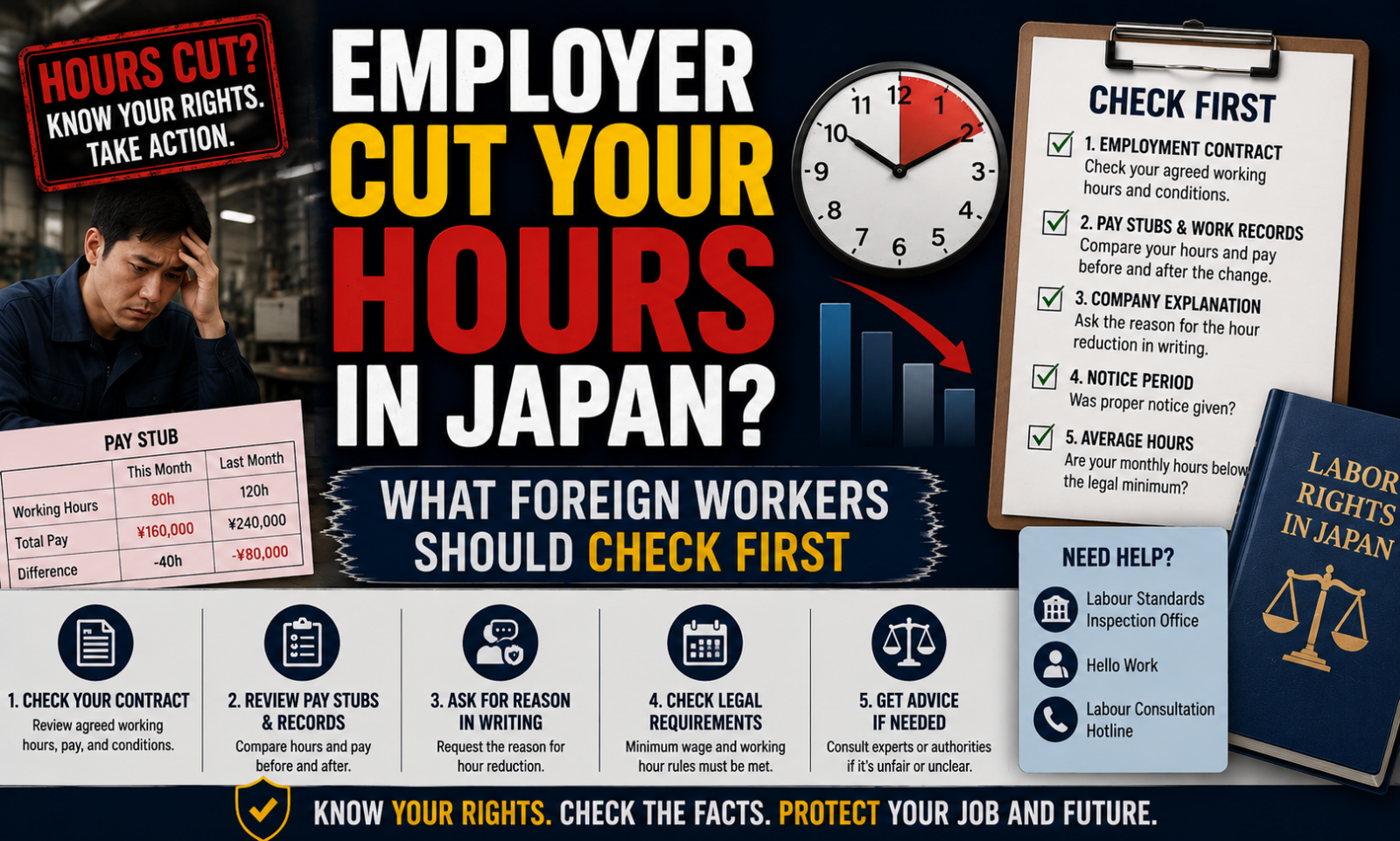
Employer Cut Your Hours in Japan? What Foreign Workers Should Check First
If your employer suddenly cuts your hours in Japan, do not assume it is automatically legal just because the company changed the schedule. Your first job is to check what your contract, work rules, and written hiring notice actually say about your hours, shifts, pay, and contract term.
This matters most for foreign workers on company-sponsored visas, part-time staff, shift workers, and fixed-term employees. A sudden drop in hours can affect your pay right away, and in some cases it can also create problems for visa status, social insurance, and job hunting.
- Check whether your hours were fixed in writing or only set by shift later
- Save evidence now: contract, work rules, shift screenshots, payslips, chat messages
- Ask the company for a written explanation before signing any new terms
- If the cut is severe, contact a Labour Bureau help line or Hello Work quickly
Who this guide is for
This guide is for workers in Japan who were told:
- their weekly hours will be reduced
- their shifts were removed without a clear reason
- they must accept lower pay or fewer days
- they should sign a new contract with shorter hours
It is especially important if you are on a work visa such as Engineer/Specialist in Humanities/International Services, Skilled Labor, Specified Skilled Worker, or another status tied to your job activity.
Start with the main question: was your working time actually agreed?
In Japan, the Ministry of Health, Labour and Welfare says an employer generally cannot change working conditions unilaterally without the worker’s agreement. That point matters because a large cut in hours is often a cut in wages too.
Check these documents first
Look for:
- your employment contract
- the written notice of working conditions
- the company work rules
- your latest shift notices
- your last three to six payslips
The most important items are:
- scheduled working days
- start and end times
- whether overtime is expected
- hourly wage or monthly salary
- contract period
- workplace and job description
ここがポイント: If your employer is reducing your hours, the first issue is not the new schedule. It is whether the company is trying to change an agreed working condition without proper agreement.
Fixed hours and shift work are not the same
This is where many workers get stuck.
If your contract says fixed weekly hours
If your contract says something like 5 days a week or 30 hours a week, a sudden reduction is more serious. The company may be trying to change a core contract term, not just next week’s rota.
That gives you a stronger basis to ask:
- What rule allows this change?
- Is this temporary or permanent?
- From what date?
- What happens to my wages?
- Do you want me to sign a revised contract?
If you work on a shift basis
The MHLW separately warns employers about shift-based work because some contracts do not fix exact workdays or hours until each schedule is issued. In those cases, your rights can depend heavily on:
- what minimum hours or days were promised when you were hired
- how far in advance shifts are usually fixed
- whether the company has a written rule for changing shifts
- whether past practice shows a stable pattern, such as 4 shifts every week
That does not mean the employer can do anything. It means you need the paperwork and past schedule records to show what was really promised in practice.
What to do in the first 48 hours
A calm, documented response is better than an argument at the workplace.
1. Collect proof before anything disappears
Save copies or screenshots of:
- your contract and offer letter
- written working conditions notice
- shifts before and after the cut
- messages from your manager
- payslips showing your normal hours and pay
- any notice asking you to sign a new agreement
2. Ask for the reason in writing
Use a short message such as:
“My hours were reduced from 30 hours a week to 12. Please confirm whether this is temporary or permanent, from what date, and whether my contract terms are being changed.”
This matters because later disputes often turn on dates and wording, not memory.
3. Do not sign a new agreement immediately
If the company asks you to sign a revised contract, read it carefully first. Signing can make it harder to argue later that you never agreed.
4. Check your payslip and next payday
Look for:
- missing scheduled hours
- unpaid training or standby time
- lower transport allowance if that affects your commute support
- unexplained deductions
If the company stops giving you work altogether
A full schedule cut is different from a normal shift adjustment.
The MHLW says that if a company suspends work for reasons attributable to the employer, it must generally pay a leave allowance of at least 60% of the worker’s average wage for scheduled workdays.
This does not apply in every case. The real issue is why you were told not to work.
Examples where you should ask direct questions:
- “Am I being put on leave, or are my contract hours being changed?”
- “Will leave allowance be paid?”
- “Which scheduled workdays are affected?”
- “Is this because of business conditions, store closure, or performance?”
If the company says there is “no shift” but you were normally scheduled on a regular pattern, that distinction can matter a lot.
What if you are on a work visa?
A cut in hours is mainly a labor issue at first, but it can become an immigration issue if it turns into resignation, termination, or a long period without the work activity tied to your status.
If you quit or are dismissed and join a new employer
The Immigration Services Agency says many mid- to long-term residents with work-related statuses must notify immigration within 14 days after events such as leaving a company or joining a new one.
If your hours are cut but you still work for the same employer
The ISA Q&A says a mere contract-content change does not itself trigger the affiliated organization notification when the employer has not changed. But if the situation turns into resignation, transfer to another company, or a real change of affiliated organization, the notification issue returns immediately.
For visa safety, do not wait until your next renewal if your work situation has clearly changed.
Money problems that often follow a sudden cut
The biggest immediate risk is simple: lower hours mean lower cash flow.
Check these practical points:
- rent due date versus next payday
- whether commuter pass costs still make sense
- whether your health insurance and pension are still being deducted the same way
- whether you need part-time side work and, if so, whether your visa permits it
If the cut leads to resignation or dismissal, check Hello Work quickly. The MHLW’s employment insurance page currently points users to multilingual guidance, including English videos for basic allowance procedures, and its main employment insurance page shows the latest posted daily benefit update from July 22, 2025 for amounts effective August 1, 2025.
That does not mean everyone qualifies. It means you should not assume there is no support.
Common mistakes foreign workers make
Waiting too long to document the change
Managers change, chat messages disappear, and schedules get overwritten. Save records early.
Confusing a schedule change with a contract change
A one-week adjustment and a permanent reduction are not the same thing. Ask which one the company is doing.
Resigning too quickly
n Some workers resign in frustration before checking whether the employer was required to pay leave allowance, whether unpaid wages remain, or whether Hello Work benefits may depend on how the separation is recorded.
Ignoring visa paperwork
If you change employers, the 14-day immigration notification rule can become a separate problem even if the labor dispute itself is still unresolved.
Current rule changes worth knowing
A useful recent change is the April 1, 2024 update to labor-condition notices. The MHLW says written notices now include additional items for fixed-term workers, including renewal-limit information when there is a cap and the scope of changes to workplace and duties.
Why that matters here: when your employer suddenly cuts hours or changes your role, newer written notices may give you clearer evidence than older ones did.
As of the MHLW foreign-worker consultation page updated for April 2026, English phone advice on working conditions is available at 0570-001-701, Monday to Friday, 10:00 a.m. to 3:00 p.m. except noon to 1:00 p.m. The separate Labour Standards Advice Hotline also remains available at 0120-811-610 during its posted hours.
When to escalate
Contact official support soon if:
- your pay dropped sharply without explanation
- you were removed from nearly all shifts
- you were asked to sign a worse contract immediately
- the company stopped giving you work and mentioned no compensation
- you may lose your visa basis because the job is ending
Start with:
- your prefectural Labour Bureau or Comprehensive Labor Consultation Corner
- the foreign worker telephone consultation service
- Hello Work if job loss or unemployment benefits are becoming relevant
- an immigration consultation point if your status of residence may be affected
Final takeaway
If your employer suddenly cuts your hours in Japan, the practical question is simple: was this a lawful schedule adjustment, or an improper change to agreed working conditions? The answer usually sits in your written terms, your past shifts, and the employer’s explanation.
Do not rely on verbal promises. Save the records, ask for the reason in writing, and move fast if the cut turns into no work, no pay, or a visa risk.
参照リンク
- MHLW: Rules on labor contracts and changing working conditions
- MHLW: What working conditions must be shown in writing
- MHLW: Guidance on shift-based work
- MHLW: Wage rules and leave allowance
- MHLW: Counseling services and hotlines in foreign languages
- MHLW: Labour Standards Advice Hotline
- Immigration Services Agency: Notification about affiliated organizations Q&A
- MHLW: Employment insurance system
- MHLW: Basic allowance guidance with English resources