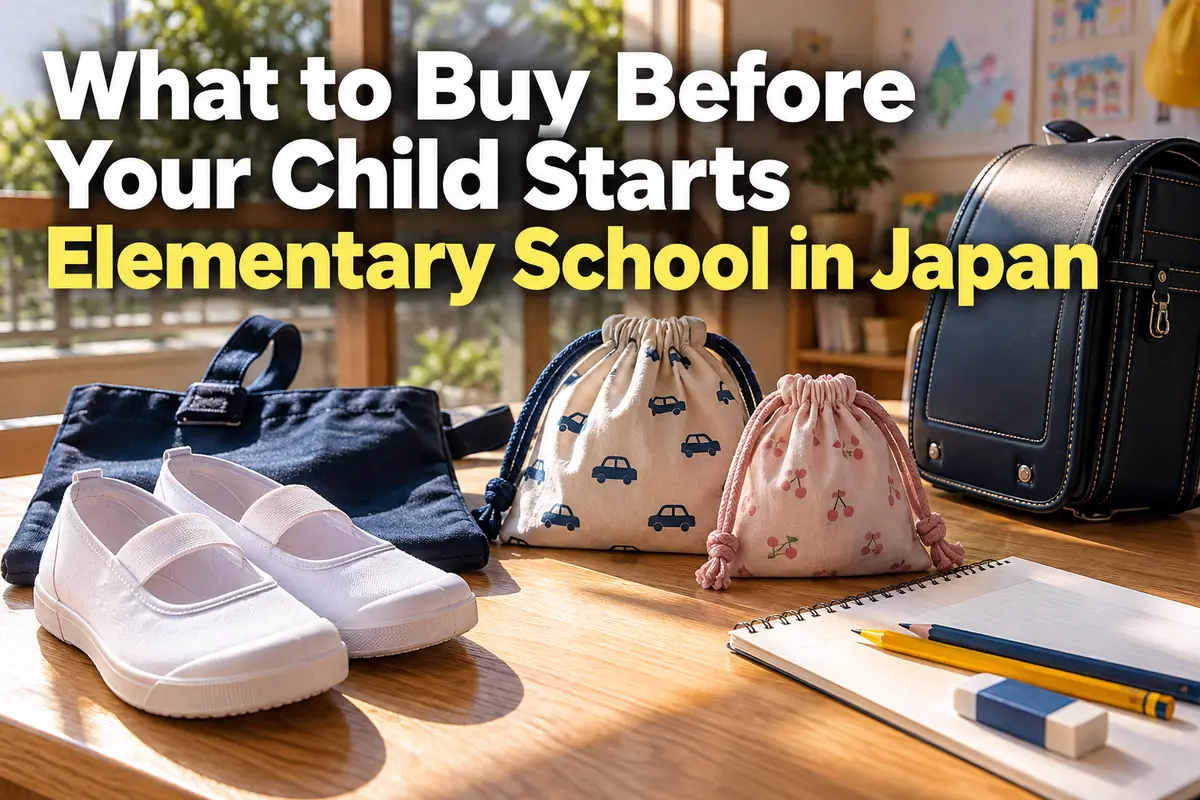
What to Buy Before Your Child Starts Elementary School in Japan
Get your child’s school supply list before buying shoes, bags, or stationery. Indoor shoes, separate bags, and named belongings appear in official school guides, but the exact designs, sizes, and purchase arrangements depend on the school.
For foreign families preparing for first grade or transferring into a Japanese public elementary school, the biggest avoidable expense is buying something twice. A shop’s “school starter set” may include materials the school orders itself—or miss the particular bag or notebook your child needs.
This guide explains:
- Which items to check on the school’s list.
- How to confirm shoe, bag, and name-label requirements.
- What to buy yourself, what to order through school, and what to postpone.
- How to ask about costs, existing supplies, and financial assistance.
The official information below was checked on October 8, 2026. Older school handbooks are used as examples, not as shopping instructions for the coming school year.
Start with the school’s list, not a ready-made shopping set
Your child’s own school should confirm the items and deadlines that apply to your family.
Ask for the current preparation list when arranging entry or attending the school’s information session. Useful words include:
- 持ち物 — mochimono: things to bring.
- 学用品 — gakuyōhin: school supplies.
- 入学準備 — nyūgaku junbi: preparation for starting school.
- 一括購入 — ikkatsu kōnyū: a group purchase arranged through the school.
- 記名 — kimei: writing a name on an item.
Make three groups on your copy of the list: “buy ourselves,” “order through school,” and “wait for instructions.” Add the required date beside each item. Something needed for the first lesson may have a different deadline from something needed for the entrance ceremony.
If your child is transferring during the year, bring photos of the supplies they already own. Ask the teacher which can continue to be used and which need replacing.
A useful question is:
学用品の準備リストをください。学校で一括購入するものはどれですか?
Gakuyōhin no junbi risuto o kudasai. Gakkō de ikkatsu kōnyū suru mono wa dore desu ka?
Please give me the school supply preparation list. Which items are purchased together through the school?
Use this checklist to identify items, then confirm the details
A checklist helps you understand the Japanese names; it does not establish a nationwide requirement.
Yokohama’s English school-life guide illustrates initial supplies and separates them from items needed only in certain cases, subjects, or activities. That distinction is useful: a recorder or swimming set does not belong in every child’s first-day bag.
Shoes and bags
Check whether the school requests:
- 上履き — uwabaki: indoor shoes.
- 上履き袋 — uwabaki-bukuro: a bag for indoor shoes.
- ランドセル — randoseru: the structured backpack associated with elementary school.
- 手提げ袋 — tesage-bukuro: a hand-carried bag.
- 体育着袋 — taiikugi-bukuro: a bag for PE clothes.
Classroom and daily-use items
Look for these terms on the list:
- 筆箱 — fudebako: pencil case.
- 鉛筆 — enpitsu: pencils.
- 消しゴム — keshigomu: eraser.
- 下敷き — shitajiki: a writing sheet placed under paper.
- 連絡帳 — renrakuchō: a home–school communication notebook.
- 道具箱 — dōgubako: a box for classroom supplies.
- 雑巾 — zōkin: a cleaning cloth.
Items to check separately
Ask when PE clothes, a red-and-white cap, or a 防災頭巾 — bōsai zukin, a protective disaster hood, will be needed. Also check instructions for lunch-related belongings.
Wait for subject-specific instructions before buying musical instruments, paint materials, calligraphy tools, sewing supplies, or swimming equipment. Grade, lesson plans, and school arrangements affect what is needed.
Indoor shoes: confirm the style before choosing the size
Buy indoor shoes only after checking the school’s design and labeling instructions.
Do not assume that any shoe sold as uwabaki will be accepted. Ask about the style, permitted colors, and whether any other footwear is needed for PE. Then have your child try the approved type on and practice putting it on independently.
The March 2023 Ushioda Elementary School guide, for example, tells pupils to keep indoor shoes inside the building and write their full name in hiragana on the front and heel. It also describes a borrowing procedure for forgotten shoes. These are that school’s published instructions, not a rule for every school in Japan.
Before paying, confirm:
- The approved shoe style and any color restrictions.
- Where and how to write the child’s name.
- Whether the shoe bag needs a handle or another particular feature.
- When shoes come home for cleaning.
- What to do if shoes are forgotten or no longer fit.
A practical preparation step is to let your child identify their own shoes among similar pairs. A readable name matters more than an elaborate decoration.
Bags and labels: measurements matter more than matching designs
Choose bags to fit the required contents and storage arrangements, then label them as instructed.
Before ordering or sewing a bag, ask for its dimensions, handle requirements, and intended contents. “A large bag” is not a useful measurement. A classroom supply box may fit into one tote but not another.
Check whether a backpack you already own is acceptable
An expensive new randoseru should not be your first purchase without confirmation.
Yōkōdai Third Elementary School’s 2025 handbook accepts a randoseru or an alternative and advises families to keep using suitable items they already have. It also specifies a tote large enough for its classroom supply box.
That example gives you a concrete question to ask: “Can my child use this backpack and these existing bags?” Another school may give a different answer.
Confirm the name format before ordering stickers
Ask whether labels should use hiragana, katakana, Roman letters, or another format. For a child whose name is recorded differently across languages, show the teacher the proposed spelling before ordering a large pack of personalized labels.
Also check whether the label needs a grade or class. If that information is not yet available, leave space rather than guessing.
The Yōkōdai handbook asks families to name all belongings and places names inside certain bags for security. Label position therefore deserves its own check; it is not simply a choice between a sticker and a marker.
For your home checklist, include:
- Both shoes and their bag.
- Each pencil and other separate stationery items requested by the school.
- Clothing and removable belongings.
- Containers and any lids that could become separated.
Ask whether writing directly on the item is sufficient. Purchased name stickers are a convenient option, but the important question is whether the school can identify the owner.
Stationery: match the specification, not just the item name
A notebook or pencil can be the wrong purchase even when its general category is correct.
The Ushioda guide specifies B or 2B pencils, does not permit mechanical pencils, and gives notebook layouts by grade. It also says initial notebooks are supplied at the start of the school year, with families replacing them later according to the specified format.
Use this as a reminder to check details rather than as a shopping list for another school.
Before buying stationery, ask about:
- Pencil hardness and quantity.
- Pencil-case size and permitted features.
- Notebook subject, grid size, line arrangement, and orientation.
- Whether initial notebooks or classroom materials are school purchases.
- Whether scissors, glue, or other tools have specific requirements.
Photograph an approved notebook cover before buying replacements. Matching the printed layout is more reliable than asking a shop for “a first-grade notebook.”
ここがポイント: Treat the school list as a specification. Confirm the size, layout, name format, and purchase route before buying a substitute.
Budget in stages rather than relying on one national total
Your useful budget is the school’s confirmed order amount plus the items your family must purchase separately.
MEXT’s English guide for foreign families explains that public elementary and junior high school tuition and textbooks are free, while school supplies can involve family payments. Free textbooks do not mean every classroom item is supplied free of charge.
Separate school orders from shop purchases
As a dated local example, the Yōkōdai handbook lists a ¥4,400 group-purchase total for its 2025 entrants. That is a particular school’s listed package—not a national fee or a complete starting-school budget.
Ask your school for the current amount and what it includes. Then record separate purchases, replacement needs, and any items required later in the year.
A simple budget sheet can have four lines:
- School order: confirmed total, order deadline, and payment date.
- Family purchases: shoes, bags, and other items not included in the order.
- Later purchases: materials needed when a particular subject or activity begins.
- Replacements: growing feet, worn items, and used-up stationery.
Avoid counting an item twice. If a classroom box is in the school order, buying a second box from a store may add cost without helping your child.
Ask about assistance before assuming you must manage alone
MEXT explains that municipal boards of education can provide assistance for school supplies when a family is found to need it.
Ask the school or municipality about 就学援助 — shūgaku enjo, school expense assistance. Confirm eligibility, application documents, deadlines, payment timing, and whether support is available for preparation before entry. Do not assume that assistance will arrive before a shop or school payment is due.
What the latest national update means for your shopping list
A national effort to reduce supply costs does not automatically change your child’s required purchases.
On July 17, 2026, MEXT published examples of measures to reduce parents’ costs for supplementary materials and school supplies. The publication shares examples of action by schools and education boards; it is not a universal free starter pack.
For families, the useful follow-up is specific: ask whether the school’s latest list has changed, whether existing items can be reused, and whether some materials are supplied or purchased together.
For April 2027 entry, request the list for that intake. A handbook labeled 令和7年度, fiscal or school year 2025, remains an older example even if it is still online.
Avoid these mistakes before the first day
Most preparation problems can be prevented by resolving a few details before purchasing.
- Buying everything illustrated in a general guide: distinguish first-day supplies from later subject and activity items.
- Ordering personalized labels too early: confirm the name spelling, script, and any class information first.
- Using another school’s list: requirements can differ even within the same municipality.
- Assuming every bag must be handmade: ask whether a shop-bought bag meeting the specifications is acceptable.
- Replacing all existing belongings: show the school what your child already owns.
- Missing the group-order deadline: confirm the form, payment method, and collection arrangements.
- Preparing only the items: let your child practice opening bags, finding supplies, and changing shoes.
If an approved item is difficult to obtain, send the school a photo of the alternative and ask before buying it. For a disability, difficulty using a bag or shoe fastening, or another practical need, explain the problem and discuss a suitable arrangement with the teacher.
Before you pay, confirm these five details
A short final check is more useful than another large shopping trip.
- Is this the current list for my child’s school and grade?
- Which items are purchased through school?
- Are existing bags and supplies acceptable?
- Are the shoe style, bag measurements, and name format confirmed?
- What must arrive by the first day, and what can wait?
Keep the list, order receipt, and any written approval for alternatives together. Your next step is to resolve the unchecked items with the school—not to fill every possible gap at the store.