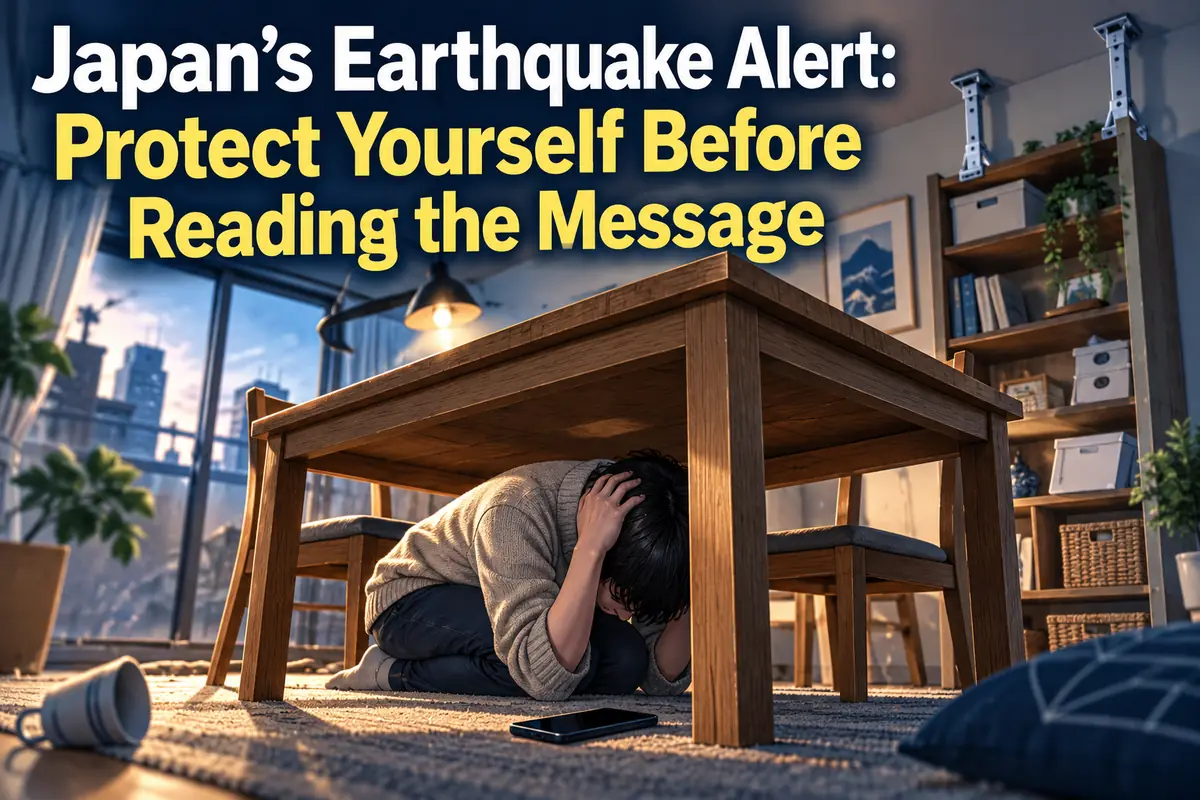
Japan’s Earthquake Alert: Protect Yourself Before Reading the Message
When you hear an earthquake early warning in Japan, protect your head and move into nearby cover immediately. Indoors, shelter under a sturdy table if one is within reach. Do not rush outside or spend those first seconds translating your phone screen.
The alert means an earthquake has already started and strong shaking is expected. It does not predict an earthquake hours ahead. You may have only seconds—and near the earthquake’s source, shaking can arrive before the warning.
This guide is for foreign residents, students, workers and families who need to recognize the alert and respond at home, on public transport or outdoors. Visitors can use the same immediate safety actions.
- Alert or shaking: protect yourself immediately. You do not need to wait for both.
- Your response depends on where you are: take cover indoors, hold on aboard transport, and avoid falling objects outdoors.
- An earthquake alert is different from a tsunami warning. Coastal evacuation may be necessary after strong or prolonged shaking.
- Prepare phone settings, safe spots and family arrangements before an emergency.
System details and guidance were checked against official sources on October 8, 2026. This is general preparedness guidance; during an emergency, prioritize immediate safety and instructions from public authorities and facility staff.
What the alert actually means
An earthquake early warning is a rapid estimate of approaching shaking, made after instruments detect an earthquake.
Its Japanese name is 緊急地震速報 — kinkyū jishin sokuhō, meaning “earthquake early warning.” The Japan Meteorological Agency, or JMA, analyzes seismic observations to estimate where strong shaking will occur and how soon it will arrive. Alerts reach the public through channels including television, radio and mobile phones. JMA explains the system here.
The practical distinction is simple: an earthquake has begun somewhere, but its stronger shaking may not yet have reached you. That short gap is time to protect yourself, not time to pack or start a journey.
Why an alert can arrive late—or without strong shaking
Detection, calculation and transmission all take time. Close to the earthquake’s source, there may be no useful advance warning. Estimates also have uncertainty: actual shaking can differ from the initial forecast, and closely spaced earthquakes can complicate calculations.
JMA describes these technical limits. They explain two important situations:
- You feel shaking before your phone sounds: protect yourself immediately. The phone is not the starting signal.
- Your phone sounds but your location barely shakes: the estimate or conditions at your location may differ from what occurred elsewhere. Continue to treat future alerts seriously.
A silent phone is not evidence that an earthquake is harmless.
Why your area receives a warning
Public warnings concern expected shaking in an area, rather than a precise forecast for your apartment or classroom.
Under JMA’s current criteria, a public warning is issued when the estimated maximum seismic intensity is at least 5 lower, or the estimated maximum long-period ground-motion class is at least 3. The warning targets areas expected to experience seismic intensity 4 or higher, or long-period ground-motion class 3 or higher. These are national criteria, not separate rules set by each municipality. JMA’s warning criteria explain the distinction.
“Shindo” is different from magnitude
震度 — shindo, or seismic intensity, describes shaking at a particular location. Magnitude describes the size of the earthquake itself.
Japan’s intensity scale has ten levels: 0, 1, 2, 3, 4, 5 lower, 5 upper, 6 lower, 6 upper and 7. The split levels may appear as 5弱 (5 lower) and 5強 (5 upper). Two places can experience different intensities from the same earthquake because of their distance from the source and local ground conditions. JMA’s earthquake information explains why location matters.
For your immediate response, you do not need to calculate what a number means. Take protective action when warned or when shaking starts.
The change that matters in tall buildings
Since February 1, 2023, JMA has included predicted long-period ground motion in the public warning criteria. This is slower shaking that can cause substantial swaying in tall buildings, including places away from the earthquake’s source.
That matters to residents of high-rise apartments and people working on upper floors: ordinary ground-level intensity alone does not describe every shaking hazard they may face. The added criterion is explained in JMA’s announcement.
Do not wait for a different alert tone or stronger wording before taking cover.
What to do in the first seconds
Use the nearest protective action that fits your surroundings; do not spend the warning period trying to reach a distant “better” place.
JMA gives situation-specific instructions, also summarized in its English safety leaflet.
At home, in a classroom or at a desk
Protect your head and take shelter under a sturdy table. Avoid rushing outdoors. Do not put yourself at risk trying to extinguish a flame while shaking is imminent or underway.
Decide on a nearby protective spot in advance. A warning is a poor time to discover that the space under your desk is full of storage boxes.
In a shop or another crowded building
Follow staff instructions and avoid running toward the exit. A sudden crowd movement can add danger before you even reach the door.
On a train or bus
Hold a strap or handrail firmly. Protect yourself where you are and follow the operator’s instructions.
In an elevator
Stop at the nearest floor and get out immediately when the doors open. The aim is to leave the elevator before it becomes stranded.
While driving
Switch on your hazard lights, reduce speed gradually and avoid sudden braking. If strong shaking begins, stop safely on the left side of the road.
Outside
Watch for falling signs, broken glass and collapsing concrete-block walls. Near slopes or cliffs, consider the danger of falling rocks and landslides.
The same street can contain both a clear space and a hazardous wall. Look at the objects immediately around you rather than assuming that being outdoors is automatically safer.
After shaking: when you should evacuate
Taking cover during shaking and evacuating afterward are different decisions, and tsunami danger can make evacuation urgent.
An earthquake early warning concerns shaking. A tsunami warning concerns dangerous waves. Do not interpret the first as confirmation that a tsunami will occur—or that it will not.
Near the coast or a river connected to the sea
If you experience strong shaking, or weak shaking that lasts a long time, start evacuating to higher ground or a designated tsunami evacuation building as soon as you can move safely. Do not wait for your phone to display a tsunami warning: waves can arrive before a warning when the earthquake source is nearby.
A major tsunami warning or tsunami warning requires people in coastal and river areas at risk to evacuate immediately. A tsunami advisory also requires people to leave the water and move away from the coast. Keep away until the relevant warning or advisory is lifted; waves can arrive repeatedly. JMA’s tsunami guidance explains these actions.
Inland, at school or in an apartment building
An earthquake alert alone is not an instruction to run to a shelter. Once shaking stops, assess immediate hazards and follow current building, school, workplace and municipal instructions.
Your municipality determines local evacuation destinations and routes. Your building or workplace may have its own assembly arrangements. Ask about both before an earthquake, particularly if you need help using stairs or moving with children.
A designated tsunami evacuation building and a place intended for a longer shelter stay serve different purposes. Check the hazard each destination is meant to protect you from; do not choose a place only because you recognize the word “shelter.”
Prepare your phone without relying on it alone
Check alert reception before you need it, and keep another way to obtain information.
A native emergency alert and an app notification are different delivery methods. Do not assume every imported phone, roaming arrangement or device setting receives and presents alerts in the same way.
Before settling into a new home or starting a trip:
- Check your phone’s emergency-alert settings and the guidance for your handset and mobile provider.
- Learn the earthquake warning sound using the examples linked from JMA’s response page.
- Set up a multilingual disaster-information app and review its notification and location settings.
- Save your municipality’s disaster information and local evacuation map for easy access.
- Agree on a family contact method and meeting arrangements before networks become busy.
The Safety tips app listed by JNTO provides earthquake early warnings, tsunami warnings and other weather alerts in English and other languages. It also includes an evacuation flowchart and useful phrases for foreign visitors and residents.
Use it to improve access to information. Do not wait for it to confirm shaking you can already feel.
Preparation at home matters as much as notification
JMA also recommends securing furniture and improving earthquake resistance. An alert cannot stop an unsecured cabinet from falling.
For a rental home, ask the landlord or building manager how to secure furniture appropriately and where the building’s emergency information is available. For a school or workplace, ask where you should protect yourself and what happens after the shaking stops.
You do not need documents to take immediate protective action. Avoid letting a plan to retrieve a passport, residence card or emergency bag delay taking cover or urgent tsunami evacuation.
Mistakes that waste the warning period
The most costly mistake is using the available seconds to gather information instead of protecting yourself.
- Translating the whole message first: recognize the earthquake alert, take cover, then read details when safe.
- Waiting to see whether shaking becomes strong: a warning gives you a chance to act before movement makes that harder.
- Running outside automatically: falling glass, signs and walls can make the route dangerous.
- Crossing the room to turn off the stove: do not expose yourself to imminent shaking to deal with a flame.
- Treating one mild outcome as proof that alerts are unreliable: a regional estimate cannot describe every room exactly.
- Waiting for a tsunami notification after strong coastal shaking: begin evacuation without waiting for the message.
These are not actions to memorize as one long sequence. Choose the few that apply to your usual places: your bed, desk, commute and nearest coastal area.
What your family should decide today
The most useful preparation is knowing what each person will do before they can contact everyone else.
Make three decisions together:
- At home: identify nearby protective spots and secure furniture that could fall into them.
- Away from home: confirm school and workplace procedures, including who gives instructions and where people assemble.
- Near the sea: identify a tsunami-safe destination and a route before visiting or moving there.
Then practice one response to the warning sound. Put the phone down, protect your head and take nearby cover. Those few seconds should already have a purpose when the real alert arrives.
参照リンク
- JMA: Earthquake Early Warnings
- JMA: Technical limitations of earthquake early warnings
- JMA: Public warning and forecast criteria
- JMA: Earthquake information and seismic intensity
- JMA: Addition of long-period ground motion to warning criteria
- JMA: What to do when you receive an earthquake early warning
- JMA: Earthquake Early Warning—Dos & Don’ts, English leaflet
- JMA: Tsunami warnings and evacuation guidance
- JNTO: Safety tips multilingual disaster-information app