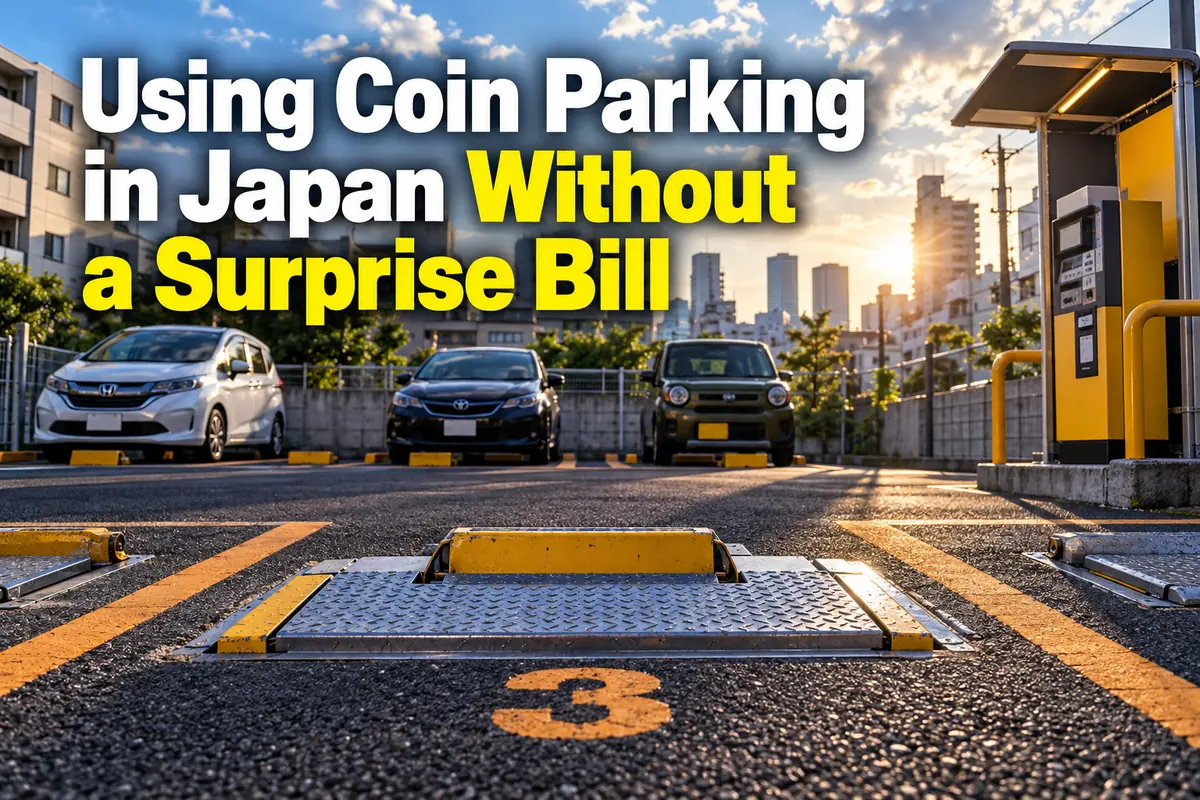
Using Coin Parking in Japan Without a Surprise Bill
Read the time limit attached to the maximum charge before you park. A sign advertising “maximum ¥1,000” may cover 24 hours after entry, only the entry date, or just an overnight period. It does not automatically mean ¥1,000 for your whole stay.
Then check how to pay. Japan’s coin parking lots can use numbered spaces, entrance tickets, or vehicle-number recognition. Some accept cards or phone payments; others require cash. The name “coin parking” does not tell you which payment methods are available.
This guide is for foreign residents, visiting families, and rental-car drivers using short-stay parking for shopping, appointments, or overnight visits.
- Match the advertised cap to your actual arrival and departure times.
- Check whether the cap repeats and whether it applies to your space.
- Identify the payment system before leaving the car.
- Complete payment and confirm that any plate or barrier has released before driving out.
Official information checked on October 8, 2026. Prices below are teaching examples, not quotes for a particular parking lot.
Read the small conditions before comparing prices
The cheapest large number on the sign is useful only if its conditions match your visit.
Start with these labels:
- 通常料金 — tsūjō ryōkin: regular charge.
- 最大料金 — saidai ryōkin: maximum charge for a defined period.
- 入庫 — nyūko: vehicle entry.
- 出庫 — shukko: vehicle exit.
- 平日 — heijitsu: weekdays.
- 土日祝 — do-nichi-shuku: Saturdays, Sundays, and public holidays.
- 全日 — zenjitsu: all days.
Photograph the entire rate board, including the conditions below the large prices. Record your arrival time too. These give you something concrete to check if the amount on the machine differs from your estimate.
Understand the charging unit
A line reading 30分 200円 means ¥200 per 30-minute charging unit. It does not mean ¥200 per hour.
For a simple example where each started 30-minute unit is charged:
- 30 minutes costs ¥200.
- 60 minutes costs ¥400.
- 70 minutes costs ¥600 because a third unit has started.
Check the lot’s charging rules rather than assuming unused minutes are deducted. Also look for separate daytime and nighttime rates. If your stay crosses a rate-change time, one hourly rate may not describe the whole visit.
Check the space as well as the sign
Look for space numbers beside special rates. A cheaper cap may apply only to selected bays.
For a short appointment, the regular charging unit can matter more than the maximum. For a long visit, the cap’s coverage becomes the main question. Compare the cost of your planned stay, not just the largest number printed on each board.
A maximum charge has a clock—and sometimes an expiry
A cap limits charges within its stated period; it does not necessarily limit charges after that period ends.
The Consumer Affairs Agency’s guidance on parking-price displays warns about non-repeating caps, entry-time restrictions, and conditions that are difficult to notice. If repetition is unclear, contact the number on the sign before a long stay.
“24 hours after entry” starts when you arrive
入庫後24時間最大 means a maximum for the 24 hours following entry.
If you arrive at 15:00 on Monday, that period ends at 15:00 on Tuesday. Read the separate wording about what happens next; the phrase alone is not enough to plan several days of parking.
Useful wording includes:
- 繰り返し適用 — kurikaeshi tekiyō: repeated application.
- 初回のみ — shokai nomi: first application only.
- 1回限り — ikkai kagiri: one time only.
“Until midnight today” is a calendar-day cap
当日24時まで means until midnight on the entry date.
An arrival at 21:00 therefore leaves only three hours in that period. It does not give you 24 hours from arrival. Read the next day’s terms separately.
An overnight maximum covers the stated overnight window
A maximum shown for 20:00–08:00 covers that window under the posted conditions. Parking before 20:00 or after 08:00 can add charges outside it.
Also check whether eligibility depends on entering during a particular period. “Nighttime maximum” and “maximum available only to vehicles entering at night” can produce different bills.
Worked example: the cap repeats—or it does not
Assume a fictional lot charges ¥200 per 30 minutes, with a ¥1,000 maximum for the first 24 hours. You remain for 26 hours, and the regular rate stays unchanged.
- If the cap repeats every 24 hours: the first period costs ¥1,000, and the next two hours cost ¥800. Total: ¥1,800.
- If the cap applies only once: the same 26-hour stay also costs ¥1,800, because the extra two hours have not yet reached another ¥1,000 cap.
The difference becomes clear at 30 hours:
- With a repeating cap, the second period reaches its ¥1,000 limit. Total: ¥2,000.
- With a first-use-only cap, six extra hours cost ¥2,400. Total: ¥3,400.
This is why a brief overrun may hide the importance of repetition, while a longer stay exposes it.
Identify the payment system before walking away
The correct payment procedure depends on how the lot records your car.
Numbered spaces with a locking plate
A metal plate, also called a flap, rises beneath the parked vehicle. Note the number painted or posted at your space.
When leaving:
- Enter the parking-space number at the payment machine.
- Check the number and displayed amount.
- Follow the payment instructions.
- Confirm that the plate has fully lowered.
- Leave promptly.
These steps follow Mitsui Repark’s instructions for flap-type parking. Do not drive over a raised plate or assume payment has released it without checking.
Entrance-ticket systems
Take the parking ticket at the entrance and keep it accessible. At a ticket-based exit machine, insert it and follow the payment instructions before passing through the opened barrier.
Some facilities have a separate payment machine before the exit. Follow that facility’s instructions about retaining or reinserting the ticket.
Vehicle-number recognition
Some lots have no locking plates because cameras recognize vehicle numbers. Repark identifies this system in its parking-information guide.
Follow the posted process for finding your vehicle. If the screen offers several matches, check the vehicle details carefully before paying. An open driveway does not tell you whether payment is complete.
Advance-payment lots
前払い — maebarai means payment in advance.
For Repark’s prepaid system, drivers enter the vehicle number and intended parking duration, buy a ticket, and display it on the dashboard where it is visible through the windshield. Other systems can differ, so read the instructions when you arrive rather than returning later expecting normal exit payment.
Prepare a payment method the actual machine accepts
Payment options belong to the individual lot, even when several lots share an operator’s name.
Times’ current payment guide lists credit cards, electronic money, QR payments, smartphone payment, and cash, while noting that availability varies by location. Some locations do not accept cash.
Before parking, check the machine or the official lot listing for:
- Accepted card and electronic-money logos.
- Supported QR-payment services.
- Whether cash is accepted and which denominations the machine takes.
- Any app or web-payment instructions.
Do not assume that a transport IC card accepted on trains will work here. Likewise, having a credit card is not enough if the machine does not support it. Where cash is accepted, carrying coins and ¥1,000 notes gives you an additional option; confirm the denomination labels.
Match these machine labels to the task
Button layouts vary, but these words help you follow the screen:
- 駐車位置番号 — chūsha ichi bangō: parking-space number.
- 車両ナンバー — sharyō nanbā: vehicle number.
- 精算 — seisan: settle the parking charge.
- 確認 — kakunin: confirm.
- 取消 — torikeshi: cancel.
- 領収書 — ryōshūsho: receipt.
- 駐車券 — chūshaken: parking ticket.
- サービス券 — sābisu-ken: parking discount or validation ticket.
If you need a receipt for work expenses, find the receipt instruction before finishing payment. If a shop provides parking validation, ask which lot it covers and how to apply it; do not assume every nearby parking machine accepts it.
Overnight parking needs three separate checks
A useful overnight lot must have suitable prices, accessible exit hours, and permission for the length of your stay.
These are separate conditions. A repeating maximum does not grant unlimited parking, and a 24-hour pricing period does not promise that the gate is accessible around the clock.
Mitsui Repark’s FAQ states that parking is generally limited to 48 hours and asks drivers expecting to exceed that period to contact the posted call center when entering. This is an operator rule, not a nationwide 48-hour rule.
Before leaving a car overnight or longer, confirm:
- The maximum’s period and repetition terms.
- The lot’s maximum permitted stay.
- The hours when entry and exit are possible.
- The applicable weekday, weekend, holiday, or special-date conditions.
Repark also notes that some parking inside commercial facilities has restricted operating hours. For an early departure, check exit access explicitly.
Check vehicle fit and reserved spaces
Height, width, weight, and ground-clearance restrictions depend on the facility and equipment. Use the vehicle specifications supplied by your rental company or vehicle documents when checking a restrictive lot.
Watch for 月極 — tsukigime, meaning monthly-contract parking. An empty monthly space is not necessarily available for hourly use. Likewise, do not use spaces marked for car sharing or other reserved purposes. Repark’s posted-use terms distinguish these from hourly bays.
Rates and equipment vary by operator and individual site throughout Japan. There is no single national coin-parking tariff, and a price you paid in one city—or on another street—does not establish the next lot’s price.
If payment goes wrong, keep the car still and preserve the details
The posted support number is the first contact for a machine problem or an unexplained charge.
Have the parking-lot name, space or vehicle number, entry time, and payment details ready. Photograph the display and retain tickets or receipts so you can explain the problem accurately.
The plate has not lowered
Do not move the car or force the plate down. Repark’s terms instruct drivers to contact the posted emergency number when a plate does not lower normally.
A plate already raised before entry is also a reason to avoid that bay and seek help.
You paid for the wrong space
Check the number before confirming payment. Repark’s FAQ says payments made for the wrong parking-space number are not refunded. Contact support if you make a mistake, but do not assume your own car has been released.
You paid, then stayed too long
Leave promptly after payment. Repark says its locking plates generally rise again after five minutes if the vehicle has not departed, with exceptions at some lots. That timing is not a universal grace period.
Finish errands before settling the charge rather than paying and then leaving the car for another visit.
The machine issues a paper instead of your change
Keep any 預り証 or 預り書 it issues. This can record money owed back to you, rather than serve as an ordinary receipt. Follow the operator’s refund instructions; Times provides a refund-request process for this situation.
Before your next visit, check the lot—not an old price photo
Current payment options and rates need checking at the location you intend to use.
The operator pages checked for this guide describe several payment systems, including cashless and smartphone options. They do not establish one system or price for every lot. Use the official listing to plan, then read the on-site conditions before committing to the space.
For your next shopping trip, appointment, or overnight visit, save four details:
- Your expected departure time.
- The exact period covered by the maximum charge.
- Your parking-space number or the vehicle details needed for payment.
- The lot’s support number.
If you cannot work out what happens after midnight or after the first 24 hours, clarify it before leaving the car. That is the point where a small advertised maximum can stop describing your bill.