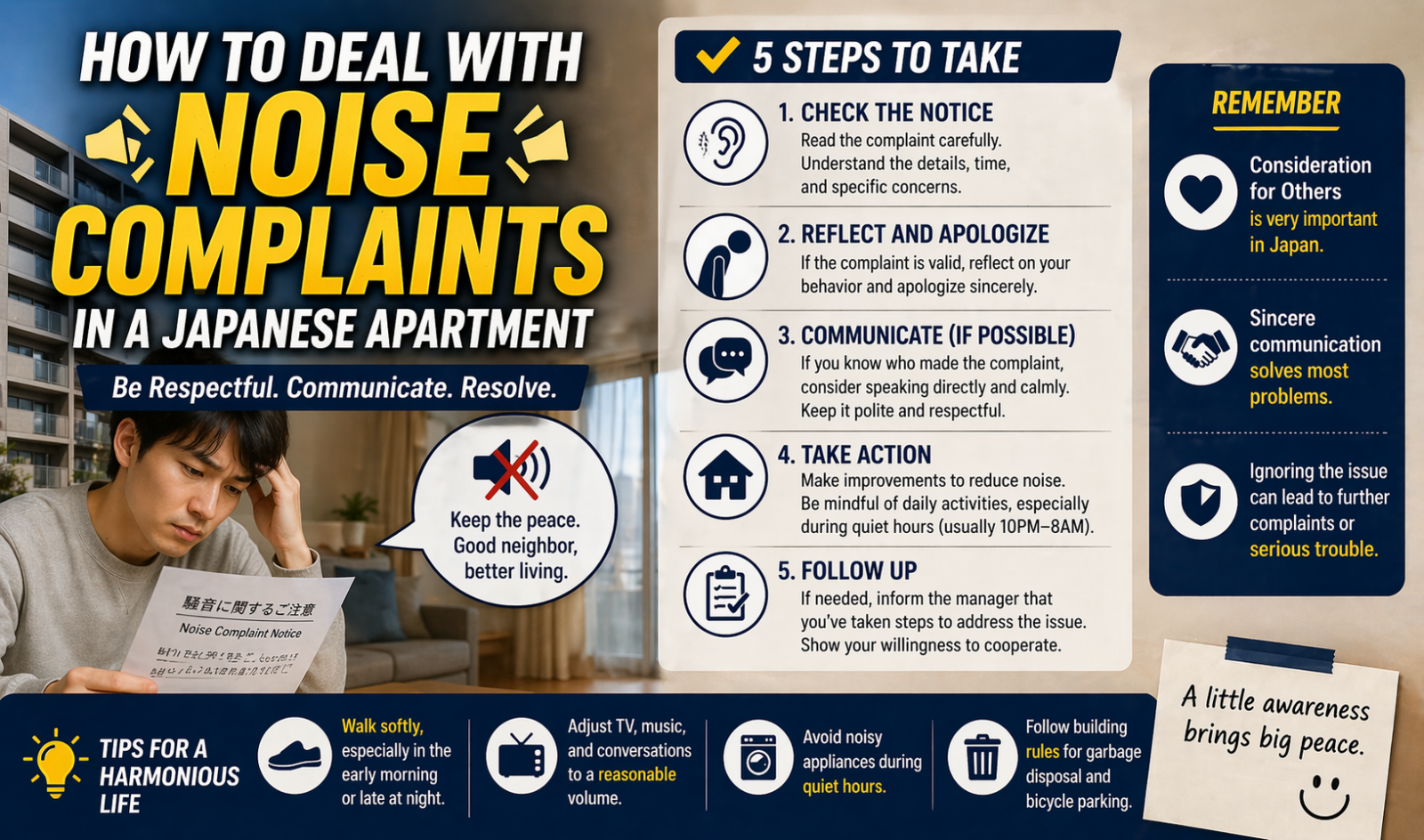
How to Deal With Noise Complaints in a Japanese Apartment
If you get a noise complaint in a Japanese apartment, the safest move is usually simple: lower the noise right away, answer calmly, and move the conversation to the building manager or landlord. In Japan, ordinary apartment noise is often treated first as a lease or building-rule problem, not as a criminal case.
This guide is for students, workers, couples, and long-term residents who rent in Japan. It matters when you receive a warning note, a message from the management company, or an angry knock from a neighbor and you are not sure what the next step should be.
- First response: stop the noise and avoid arguing on the spot
- Main contact: building management company, landlord, or housing office
- Important limit: household noise is often not covered by a simple nationwide legal ban
- Escalation point: use
#9110for non-emergency police consultation,110only for urgent danger
The basic rule in Japan
The first thing to understand is that Japan does not have one simple nationwide rule that says all apartment noise after a certain hour is illegal. In practice, the issue usually depends on three layers:
- Your lease and building rules
- The management company or landlord’s judgment
- The seriousness of the behavior and whether it becomes harassment, threats, or a safety issue
A current local example shows how this works. Yokohama City says ordinary living noise such as footsteps, musical instruments, pet sounds, and outdoor AC unit noise is not generally subject to legal regulation, and people should try to resolve it through discussion or through the management company or condominium association.
That matches how many apartment disputes are handled across Japan: first as a housing and neighbor-relations issue, not as a police case.
ここがポイント: A noise complaint in Japan is usually handled through building rules and management first. It becomes a police matter only when there is danger, intimidation, trespassing, or another clear public-safety problem.
What your landlord or manager can rely on
Japan’s Ministry of Land, Infrastructure, Transport and Tourism publishes a standard rental housing contract and restoration guidelines. They are not mandatory for every property, but they strongly shape how many rental disputes are handled.
Under that model contract, tenants are not allowed to do things such as:
- Use TVs or stereos at very high volume
- Play piano or similar instruments loudly
- Use the property in ways that seriously break the contract or make continued tenancy difficult
That matters because a complaint is not just a social problem. If loud noise continues after warnings, the landlord may treat it as a lease violation.
At the same time, the same MLIT framework is also useful for tenants. A landlord cannot automatically take your deposit just because someone complained. MLIT’s restoration guideline says tenants pay for damage caused by their own fault or use beyond normal living, while normal wear is part of the rent. A complaint by itself is not the same as proven damage.
What to do the moment you receive a complaint
Keep the first response short and practical.
1. Stop the sound first
Do this before you explain anything.
Typical sources in Japanese apartments include:
- Footsteps and jumping
- Laundry or vacuuming late at night
- TV, speakers, games, or online calls
- Doors, drawers, and chairs hitting the floor
- Bath, water, and drainage sounds in older buildings
- Pet noise
Tokyo’s environmental guidance notes that daily-life noise often comes from appliances, plumbing, door movement, audio devices, voices, and footsteps. In other words, the problem may be more ordinary than you think.
2. Do not argue in the hallway
If a neighbor comes to your door angry, keep it brief.
You can say:
- “I’m sorry. I’ll keep it down.”
- “I understand. I’ll check the source now.”
- “If needed, please contact the building manager too.”
This is usually better than debating whether the noise was “reasonable.” Even if you are right, a hallway argument can turn a small complaint into a building-wide problem.
3. Check your lease and house rules
Look for:
- Quiet-hour rules
- Musical instrument rules
- Guest rules
- Pet rules
- Use of washing machines or balconies at night
- Rules for common areas and doors
Some buildings are far stricter than others. A reinforced concrete building and an older wooden apartment can have very different standards in practice.
4. Reply in writing if management contacted you
If the complaint came through email, an app, or a paper notice, reply in writing. Keep it factual.
A useful structure is:
- Acknowledge the complaint
- Say what you checked
- Explain what change you made
- Ask them to contact you again if the issue continues
That gives you a record. If the dispute grows later, written records help much more than memory.
If you think the complaint is unfair
Sometimes the problem is real. Sometimes the walls are thin. Sometimes the complaint is exaggerated or aimed at the wrong room.
If you think the complaint is unfair, do not ignore it. Instead:
- Keep a log of dates, times, and what you were actually doing
- Save notices, emails, and messages
- Ask management what specific sound was reported
- Ask whether multiple complaints were received or just one
- Explain building conditions if relevant, such as thin walls or pipe noise you do not control
A smartphone decibel app can help you understand your room, but it will not settle the dispute by itself. Tokyo’s guidance points out that daily-life noise is not judged only by a number because time, place, and the type of sound all matter.
If you need to reduce noise quickly
These small changes often solve the problem faster than long explanations:
Floor and furniture
- Wear soft slippers indoors
- Add rugs or mats under desks, beds, and chairs
- Put felt pads on chair and table legs
- Avoid heel walking inside
Audio and voice
- Move speakers away from shared walls
- Use headphones at night
- Lower bass, not only volume
- Keep late-night calls away from the wall facing a neighbor
Doors and daily movement
- Close entrance doors gently
- Do not run the washing machine late if the building is old
- Avoid vacuuming early morning or late night
- Be careful with bath water and drainage in very late hours
These are not just courtesy points. Tokyo’s environmental guidance specifically describes sound transmission through walls, gaps, and building structures, which is why a small layout change can matter.
If you are the one making a complaint
In Japan, the usual order is:
- Contact the management company or landlord first
- Give specific times and types of noise
- Avoid direct confrontation if emotions are already high
That approach matters especially for foreign residents who may worry about language mistakes. A management company can deliver the warning in Japanese and keep the issue from becoming personal.
If you live in a condominium you own, the building management association may also be involved. In a rental, the management company or landlord is usually the first channel.
When police or outside help make sense
Most apartment noise complaints do not start with the police. But some situations go beyond ordinary living noise.
Use 110 if there is immediate danger, violence, forced entry, stalking, or a serious threat.
Use #9110 for non-emergency police consultation if the situation involves:
- Repeated intimidation n- Threatening visits or calls
- Harassment after a complaint
- Fear that the dispute may escalate
The National Police Agency says urgent incidents should go to 110, while non-emergency safety concerns can be taken to the local police or #9110.
If the problem is more about your contract, management response, or an unfair demand, Consumer Affairs Agency guidance points people to 188, the national consumer hotline, which connects them to a local consumer affairs center.
If you are in Tokyo, the Tokyo Metropolitan Government also provides foreign-language tenant-landlord dispute guidance and points readers to advice centers. That is especially useful if you need English support.
Common mistakes that make things worse
- Ignoring the first warning note because it feels passive-aggressive
- Assuming daytime noise can never be a problem
- Arguing directly with the neighbor in front of other residents
- Making counter-complaints without keeping records
- Saying “this building is noisy anyway” instead of changing anything
- Treating every complaint as discrimination before checking the facts
- Calling
110for an ordinary building dispute with no immediate danger
The biggest mistake is letting a manageable issue turn into a lease problem. Once the manager believes you are uncooperative, the complaint stops being only about sound.
Current status in 2026
As of April 23, 2026, the official guidance still points in the same direction:
- MLIT guidance still centers on lease terms, building rules, and dispute prevention
- Municipal guidance such as Yokohama’s still says ordinary household noise is generally not handled through a simple legal regulation
- Police guidance still separates emergencies (
110) from non-emergency consultation (#9110) - Consumer contract disputes still go through local consumer centers via
188
So the practical answer has not changed much: document the problem, use management first, and escalate only when the issue becomes a safety or contract dispute.
Final takeaway
If you receive a noise complaint in a Japanese apartment, do not try to win the argument in the first five minutes. Lower the noise, move the issue into writing, and use the management company as the main channel.
If the complaint is valid, small behavior changes usually solve it.
If the complaint is unfair, records and calm written replies protect you better than an emotional explanation.
If the dispute starts to feel threatening, switch from building management to #9110, and use 110 only when there is immediate danger.
参照リンク
- MLIT: Standard Rental Housing Contract
- MLIT: Guidelines on Restoration and Rental Housing Disputes
- National Police Agency: Opinions, Consultations and Information
- Consumer Affairs Agency: Consumer Hotline 188
- Tokyo Metropolitan Government: Daily-Life Noise Guidance
- Tokyo Metropolitan Government: Foreign-Language Tenant-Landlord Dispute Guidelines
- City of Yokohama: Is There Legal Regulation for Neighborhood Living Noise?