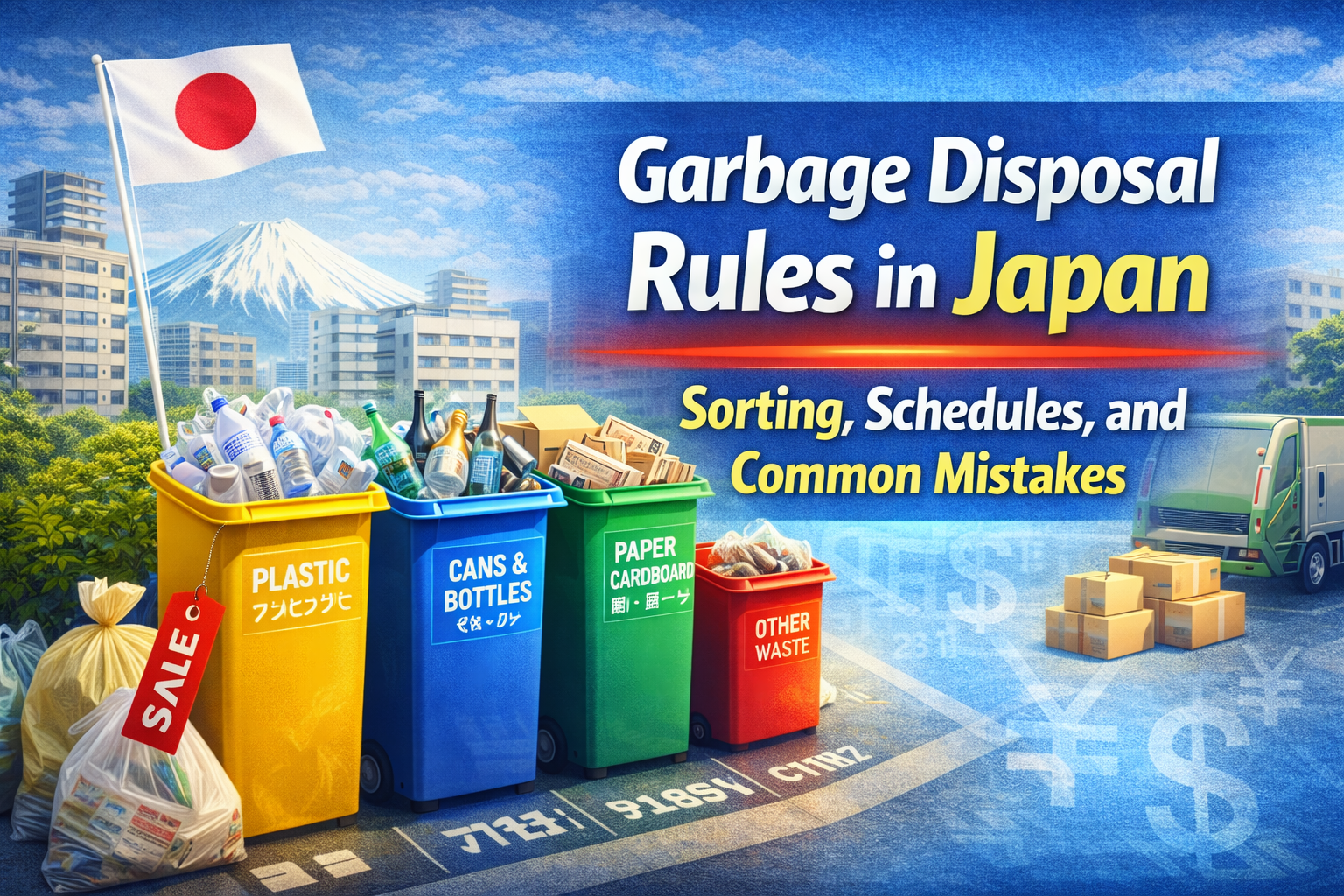
Garbage Disposal Rules in Japan: Sorting, Schedules, and Common Mistakes
The safest rule is simple: follow the garbage guide for your exact city, ward, or apartment building. Japan does not have one nationwide household trash schedule. The national framework says municipal waste is handled by municipalities, so your local government decides the categories, collection days, bags, and pickup points.
For foreigners living in Japan, this matters from the first week after moving in. A bag placed on the wrong day, in the wrong bag, or with mixed recyclables may be left behind with a warning sticker. In apartments, repeated mistakes can also create problems with the building manager or neighbors.
Quick orientation:
- Check your city or ward website before relying on a generic Japan guide.
- Separate everyday trash into burnable, non-burnable, recyclables, and large-sized waste, then confirm the local details.
- Put trash out at the designated place and time, usually on the morning of collection day.
- Large furniture and major appliances need separate procedures and usually require fees.
Who This Guide Is For
This guide is for people who have just moved to Japan, students in rented apartments, workers in company housing, long-term residents moving to a new ward, and travelers staying in private rentals.
It is especially useful when:
- You move into a new apartment or share house.
- Your building has no English instructions posted.
- You need to throw away a suitcase, futon, bicycle, appliance, or furniture.
- You are confused because a rule from one city does not match another city.
The main point: do not copy rules from a previous address. A plastic tray, a metal spoon, or a PET bottle label can be treated differently depending on the municipality.
The Basic Categories Most Residents See
Most municipalities use a version of the same broad categories. The exact names and examples vary, but these are the categories to learn first.
Burnable Garbage
Burnable garbage is usually the most frequent collection. In many areas it includes kitchen scraps, used tissues, dirty paper, small pieces of wood, leather, rubber, and some dirty plastics.
In Shibuya City, for example, burnable trash is collected twice a week and should be placed in a container or transparent or semi-transparent bag so the contents can be seen. Shibuya lists kitchen scraps, scrap paper, non-washable plastic items, rubber and leather items, and clothing as examples.
Practical tips:
- Drain food waste before throwing it away.
- Tie bags tightly, especially in summer.
- Do not assume all plastic is burnable. Check your city’s plastic rules.
Non-Burnable Garbage
Non-burnable garbage often includes small metal items, glass, ceramics, light bulbs, and small appliances. It is usually collected less often than burnable garbage.
Shibuya City collects non-burnable trash once a month and treats metal, glass, and ceramics under 30 cm on each side as non-burnable examples. Sharp items such as broken glass, needles, and knives should be wrapped in paper and marked “キケン” or “dangerous.”
This category is where many newcomers make mistakes. Batteries, spray cans, lighters, and fluorescent tubes may have separate handling rules. Some cities collect them as resources; others ask residents to put them out on a special day.
Recyclable Resources
Recyclables usually include paper, cardboard, bottles, cans, PET bottles, and sometimes plastic containers and packaging.
For PET bottles, the common routine is:
- Remove the cap and label.
- Rinse the bottle.
- Crush it if your municipality asks you to.
- Put caps and labels in the category your city specifies.
Shibuya City says PET bottles should have caps and labels removed, be rinsed, and be crushed flat before disposal. Bottles that contained oil, cosmetics, or paint are not treated as recyclable PET bottles there.
Paper is also easy to get wrong. Newspapers, magazines, and cardboard are often tied by type rather than placed in a plastic bag. Wet or food-stained paper may not be recyclable.
Large-Sized Waste
Large items are usually called sodai gomi, or large-sized waste. This includes items such as furniture, futons, bicycles, ski boards, and some household electrical appliances.
In many Tokyo wards, a common threshold is around 30 cm. Shibuya City treats furniture and other items larger than about 30 cm square as large-sized waste. Residents must apply in advance, buy a paid disposal ticket or sticker, attach it to the item, and place the item at the instructed location.
Do not leave a chair, mattress, or bicycle at the normal collection point without booking. It may not be collected.
Here is the key point: regular trash rules are local, but large items almost always need advance action. Book first, pay if required, then put the item out only on the assigned date.
Schedules, Bags, and Collection Points
Sorting is only half of the system. Timing and place matter just as much.
Collection Days Are Address-Specific
Your collection schedule may differ from the next neighborhood. Some areas divide routes by block, apartment building, or local collection point.
Shibuya City tells residents to put garbage out by 8:00 a.m. on the designated collection day, or by 7:30 a.m. in downtown areas. The city also says collection days vary by local community and should be checked on signs at the collection site or through the waste collection office, landlord, or neighbors.
That is a useful model for any city:
- Look for a sign at the collection point.
- Ask your landlord, management company, dorm office, or city hall.
- Search your municipality website for “garbage,” “waste,” “recycling,” or “English.”
- Save a photo of the collection calendar on your phone.
Bag Rules Differ by Municipality
Some places allow transparent or semi-transparent bags. Others require city-designated paid bags.
Kyoto City is a clear example of a stricter bag system. Kyoto guidance explains that household garbage and recyclable refuse must be placed in specially designated bags, which can be bought at convenience stores and supermarkets. Garbage in the wrong bags may not be collected.
Inagi City in Tokyo also uses designated collection bags with listed prices by size and category. Its official English page says garbage placed in bags other than the city’s designated collection bags cannot be collected.
So before buying a large pack of trash bags, check whether your area requires:
- Any transparent or semi-transparent bag.
- A city-designated paid bag.
- Separate bags by category.
- No bag for tied paper or cardboard.
Apartment Buildings May Add Their Own Rules
Some apartment buildings have a private garbage room with posted rules. Others use a street-side neighborhood collection point.
A building may also have private collection arrangements that differ from the city’s regular pickup. If your apartment instructions conflict with a general city guide, ask the building manager or landlord before putting trash out.
Items That Need Special Care
Some items should not be treated as ordinary burnable or non-burnable garbage. These are the ones that most often cause trouble.
Major Home Appliances
Air conditioners, televisions, refrigerators, freezers, washing machines, and clothes dryers are not ordinary large-sized waste. They are covered by Japan’s Home Appliance Recycling system.
METI explains that consumers pay collection and recycling costs, retailers collect certain used appliances, and manufacturers recycle them. In practice, you usually dispose of these items by:
- Asking the shop where you bought the item.
- Asking the shop where you are buying a replacement.
- Using the official local appliance recycling reception route if retailer pickup is not possible.
Fees vary by appliance, manufacturer, collection method, and transport charge. Check the retailer or local government before arranging disposal.
PCs and Small Electronics
Computers are often handled through manufacturer recycling or a local small-electronics collection system. Do not put a laptop or desktop PC out as regular trash unless your municipality clearly says it accepts that item in a specific way.
Small appliances such as hair dryers, rice cookers, and lamps may be non-burnable, small-electronics recycling, or large-sized waste depending on size and city rules.
Spray Cans, Gas Canisters, and Lighters
These can cause fires or injuries if handled badly. Many municipalities require residents to use up the contents before disposal. Some cities collect spray cans as resources; others treat them separately.
Do not rely on old advice about puncturing spray cans. Some municipalities now tell residents not to make holes. Follow the local instruction.
Broken Glass, Knives, and Needles
Wrap sharp items in paper and mark them clearly. Shibuya City specifically tells residents to mark sharp objects as “キケン” when putting them out. This protects collection workers, not just your own household.
Regional Differences to Expect
Japan’s national government sets the broad legal framework, but household garbage is local. The Ministry of the Environment explains that municipal waste disposal is the responsibility of municipalities. That is why the same item can be handled differently in Tokyo, Yokohama, Kyoto, Sapporo, Fukuoka, or a small town.
Here are practical examples of local differences:
- Shibuya City collects burnable trash twice a week, non-burnable trash once a month, and recyclable resources once a week.
- Kyoto City uses designated paid bags for household garbage and recyclable refuse.
- Inagi City lists different designated bag prices for burnable, non-combustible, and plastic waste.
- Yokohama City’s official garbage search page notes that plastic garbage separation and disposal changed in all 18 wards as of April 1, 2025.
That Yokohama change is a good reminder for 2026: even if you learned the rules before, your city may update them. Check the latest municipal page when you move or when you see a new notice at the collection point.
Common Mistakes and How to Avoid Them
Most mistakes are not about bad intentions. They happen because people follow a general rule instead of the local rule.
Common problems:
- Putting trash out the night before when the area requires morning disposal.
- Using black or opaque bags where visible bags are required.
- Mixing PET bottles, caps, labels, cans, and glass bottles together.
- Throwing cardboard into burnable garbage instead of tying it for recycling.
- Leaving furniture at the collection point without booking large-sized waste pickup.
- Treating a TV, refrigerator, washing machine, dryer, or air conditioner as ordinary bulky waste.
- Forgetting to rinse food containers before putting them out as recyclables.
- Moving to a new city and continuing to use the previous city’s rules.
A simple weekly routine helps:
- Keep one place for burnable trash.
- Keep a separate bag or box for PET bottles, cans, bottles, and clean containers.
- Flatten cardboard as soon as packages arrive.
- Save the local collection calendar on your phone.
- For anything unusual, search the city’s item dictionary before disposal.
How to Find the Correct Rule for Your Address
Use official local sources first. Many municipalities provide English pages, PDFs, apps, or searchable item dictionaries.
Good search terms include:
- “[city name] garbage English”
- “[ward name] recycling English”
- “[city name] garbage separation guide”
- “[city name] oversized garbage”
- “[city name] waste sorting app”
Yokohama’s “Mictionary” is an example of a city-run search tool. It lets residents search by item name and also notes local updates, such as the April 2025 change to plastic garbage rules.
If you cannot find English information, try these steps:
- Use your city’s Japanese page with browser translation.
- Ask the city hall counter for a multilingual garbage guide.
- Ask your real estate agent, school office, company HR team, or building manager.
- Look for posters near the apartment garbage room or collection station.
Beginner FAQ
Can I put trash out anytime if my apartment has a garbage room?
Sometimes, but not always. Some buildings allow 24-hour use of a garbage room. Others ask residents to follow city collection days. Check the posted building rules.
What happens if I make a mistake?
The bag may be left uncollected with a notice. If that happens, take it back, correct the problem, and put it out on the next proper collection day.
Are public trash cans common in Japan?
No. Public trash cans are limited in many places. Travelers and residents often carry small trash until they reach home, a station bin, a convenience store bin that accepts that type of waste, or a hotel room.
Do I need to wash recyclables perfectly?
Usually no, but they should be empty and reasonably clean. If a plastic container or PET bottle is too dirty to clean, your municipality may tell you to put it in burnable garbage instead.
Can I throw away a bicycle as normal trash?
Usually no. A bicycle is commonly treated as large-sized waste and needs booking and a fee. If the bicycle is parked illegally and removed by the city, that is a separate issue from disposal.
Practical Takeaway
Garbage disposal in Japan becomes manageable once you stop looking for one national answer. Start with your exact address, learn the four basic categories, and check special rules before throwing away anything large, sharp, flammable, electronic, or expensive to recycle.
Before your next trash day, confirm these five points:
- The collection day for each category.
- The correct collection point.
- The required bag type.
- The cutoff time in the morning.
- The procedure for large items and appliances.
That small check prevents the most common problem: a bag left behind because it followed “Japan rules” but not your city’s rules.
References
- Ministry of the Environment, Government of Japan: Waste Disposal and Recycling Measures
- Shibuya City: Garbage and Recycling
- Yokohama City: Mictionary Garbage Separation Search
- METI: Act on Recycling of Specified Home Appliances
- METI and Ministry of the Environment: How to Recycle Appliances Properly
- Kyoto University: Trash Collection
- Kyoto City: Fiscal Year 2025 Household Waste Collection Notice
- Inagi City: Types and Prices of Designated Collection Bags