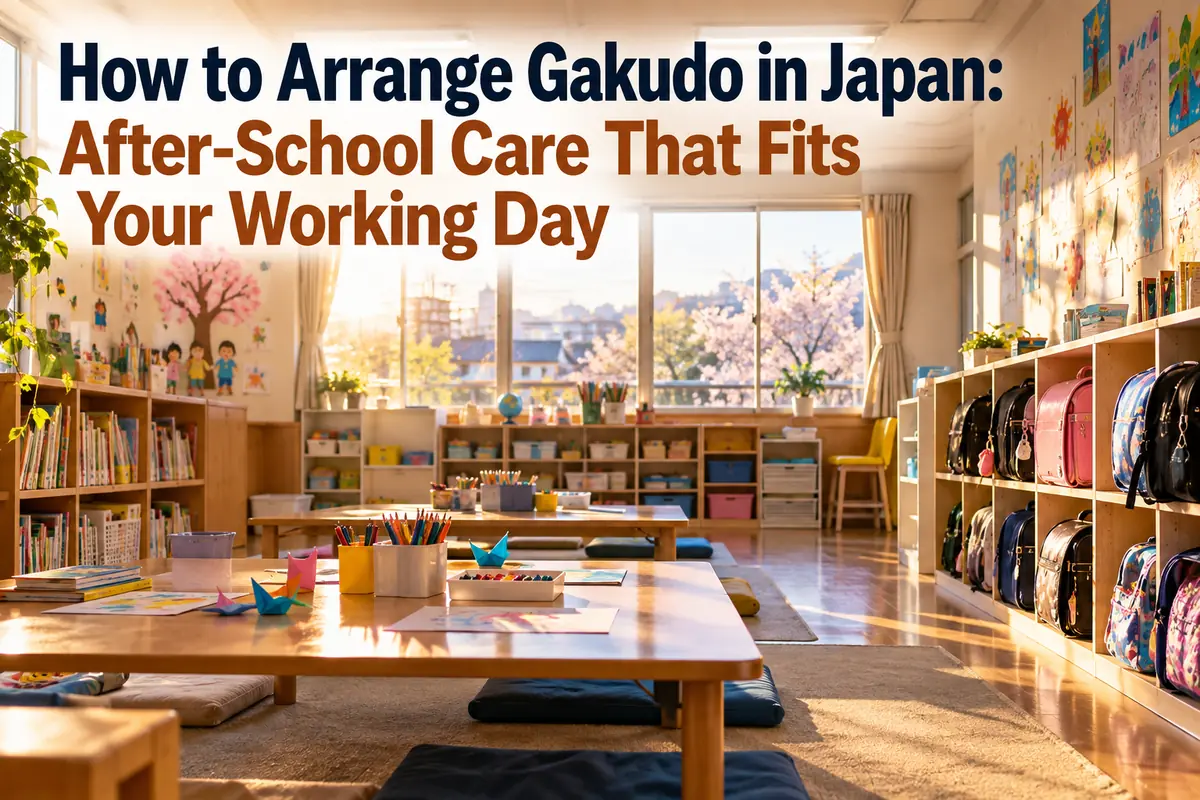
How to Arrange Gakudo in Japan: After-School Care That Fits Your Working Day
Gakudo provides after-school care for elementary-age children whose parents cannot care for them during those hours because of work or other accepted reasons. You apply separately from school enrollment, and your municipality or club decides eligibility, fees, hours, and deadlines.
The most important check is whether the service covers your whole working day—including travel time, school holidays, and pickup. A place that closes at 5 p.m. will leave a gap if you cannot arrive until 6 p.m.
This guide is for foreign resident families preparing for first grade, returning to work, moving, or arranging care during school breaks.
- Eligibility: check the child’s grade, address, and each caregiver’s circumstances.
- Hours: compare ordinary school days with Saturdays and school holidays.
- Costs: include extensions, snacks, insurance, and lunches where applicable.
- Applications: obtain the correct year’s forms and proof of your need for care.
Information checked on October 8, 2026. Local examples below illustrate differences; they are not nationwide prices or admission rules.
What gakudo provides—and what to check before choosing a club
Gakudo is a place for children to spend time after lessons when care at home is unavailable.
Useful names to recognize include:
- 学童保育 — gakudō hoiku: commonly used name for after-school care.
- 学童クラブ — gakudō kurabu: after-school club.
- 放課後児童クラブ — hōkago jidō kurabu: the term used in national government information.
The Children and Families Agency describes the national program as providing play and a place for daily life for elementary-school children whose guardians are away during the day because of work or similar reasons. Clubs may use school rooms or children’s centers. The agency also identifies waiting lists as an ongoing problem, so meeting eligibility conditions does not establish a nationwide guarantee of a place. See its official program overview.
A play program may offer less coverage than you need
A service located at your child’s school may have several registration categories. Some provide short recreational sessions; others provide longer care for eligible households.
For example, Yokohama’s Kids Clubs distinguish free Wakuwaku, Category 1, normally available until 4 p.m. on school days, from paid Sukusuku, Categories 2A and 2B, serving children who need care. The paid categories run until 5 p.m. or 7 p.m. respectively. The free category has much more limited school-holiday access. These distinctions appear in the city’s hours and fees FAQ.
Ask a direct question: “Does this registration category cover every day and hour my child needs?” The building’s closing time alone does not answer that.
Ask about learning support separately
Do not assume that after-school care includes tutoring or English-speaking staff. For example, Shinjuku’s regular-use handbook says its clubs do not provide academic instruction, although they accommodate children who want to do homework.
If your child needs help understanding instructions, ask how staff will communicate about arrival, leaving, illness, and emergencies. Request a visit before the first day where possible.
Who qualifies: household circumstances matter as well as grade
Eligibility depends on the local definition of a household that needs care, not simply on whether a parent has a job.
Before applying, ask the municipality or club to confirm:
- Which grades are accepted and whether older children face different admission conditions.
- Whether eligibility follows your home address, school, or school catchment area.
- Minimum working days and hours, including how commuting time is counted.
- How both parents’ circumstances—and any other caregivers at home—are assessed.
- Which reasons besides employment qualify.
A concrete local example: Shinjuku
For its 2026 fiscal-year regular service, Shinjuku requires residence in the ward and a qualifying need for care on at least three days between Monday and Saturday. Its stated absence requirement is at least four hours within noon to 6 p.m., including commuting time.
Eligible children through grade 3 can use the service even when the stated capacity is exceeded; the same provision extends through grade 6 for children with disabilities or other specified conditions. Other children in grades 4–6 are admitted according to priority when space is available. These are Shinjuku-specific conditions, explained on its 2026 regular-use page.
Self-employment, study, illness, and caregiving
Different reasons require different evidence. Shinjuku’s eligibility and document flowchart includes employment, illness, disability, study or vocational training, and nursing or caregiving, with conditions attached to each.
For employment, its document requirements distinguish between:
- Fixed schedules: an employment certificate.
- Irregular schedules: an employment certificate plus recent employer-issued shift records.
- Self-employment and certain contract-work arrangements: additional statements and evidence that the business is operating.
It also requires documents from each workplace when a parent has multiple jobs. Co-resident grandparents under 70 may need their circumstances checked.
These examples show why one generic employment letter may be insufficient. Ask which local form applies to your actual working arrangement.
Working from home and childcare leave
Do not decide for yourself that working from home makes you eligible—or ineligible. Ask how your municipality assesses your hours and ability to care for your child while working.
Similarly, check what happens during childcare leave, job changes, or reduced hours. These changes can affect the need for care, supporting documents, or continued registration. Explain your expected schedule before committing to a start date.
Hours: check the beginning of the day as carefully as pickup
A club can cover the afternoon yet leave a morning gap during school holidays.
Write down the earliest time you must leave home and the latest time you can reach the club. Then compare those times with four separate schedules:
- Ordinary school days.
- Days when lessons end early or lunch is not served.
- School holidays and substitute school holidays.
- Saturdays, public holidays, and year-end closures.
How local schedules differ
Shinjuku’s 2026 regular service provides basic care until 6 p.m. on school days, with extension until 7 p.m. On Saturdays and specified school-free days, basic hours are 9 a.m.–6 p.m.; extensions cover 8–9 a.m. and 6–7 p.m. Extension registration is separate. Its regular-use handbook explains the arrangements.
Yokohama’s paid Kids Club categories open at 8 a.m. on school holidays other than Saturdays, but at 8:30 a.m. on Saturdays. A parent leaving home at 7:30 a.m. therefore needs another arrangement before opening, even with an evening care place.
Confirm the route and who collects your child
Ask whether your child must travel from school independently, whether an adult must collect them, and whether leaving alone is permitted at particular times.
At clubs operated by Yokohama Youth, children leaving after the designated group departure time need pickup by a guardian or an authorized substitute. Substitute collectors must be registered in advance and present identification. The operator’s use guide explains these conditions.
A 7 p.m. closing time should be treated as a deadline to complete pickup. Build some room into your commute and register a backup collector if the club permits it.
Fees: compare the total bill for the hours you actually need
There is no single national gakudo fee, and a low basic charge may exclude costs your family will regularly incur.
Ask for a written breakdown of:
- Monthly care fees and any seasonal increases.
- Morning and evening extensions.
- Snacks and lunches.
- Insurance and activity materials.
- Any initial charges, where applicable.
Yokohama Kids Club examples
The city lists these monthly care fees:
- Category 2A, until 5 p.m.: ¥2,000, rising to ¥2,500 in July and August, plus snacks.
- Category 2B, until 7 p.m.: ¥5,000, rising to ¥5,500 in July and August, plus snacks.
- Category 2A extension until 7 p.m.: ¥400 per use.
The city lists annual insurance at ¥800 or less. Exact arrangements should be checked with the operator; these amounts apply to the Kids Club categories, not every after-school club in Yokohama.
When extensions change the cheaper option
Using the published care charges, ten Category 2A extensions in an ordinary month would cost:
¥2,000 + (10 × ¥400) = ¥6,000 before snacks and other charges.
Category 2B’s ordinary monthly care charge is ¥5,000. On care fees alone, eight extensions would bring Category 2A to ¥5,200, above Category 2B.
This is an illustrative calculation, not an enrollment recommendation. Confirm whether extensions are available as needed and how changes between categories work. If late pickup is routine, compare the longer-hours category first.
Reductions, absence, and withdrawal
Ask about 減免 — genmen, meaning fee reduction or exemption. Approval may require a separate application and supporting documents.
Shinjuku offers exemptions for specified households, including resident-tax-exempt households, and requires a fresh exemption application each year. Its regular-use page also warns that charges continue during a long absence without the required suspension notice.
Yokohama Youth likewise states that its paid monthly fee is charged even when the child does not attend that month. A holiday trip is therefore a reason to check suspension or withdrawal rules—not to assume that attendance determines the bill.
How to apply: start with the correct year and service category
A complete application needs both a request for a place and evidence explaining why care is needed.
1. Find the responsible office or club
Search your municipality’s website for 学童クラブ or 放課後児童クラブ. Ask which club serves your address and whether applications go to the municipality, an operator, or the club itself.
Confirm the service category before downloading forms. Regular use, holiday-only use, and extensions may have separate procedures.
2. Check the year and desired start date
Japanese fiscal years run from April through March. 令和8年度 — Reiwa 8 fiscal year means April 2026–March 2027.
An application window shown on a current service page may already have passed. For example, Shinjuku’s main application window for April 2026 entry ran from November 5 to December 5, 2025. Later applications follow a separate schedule.
For April 2027 entry, obtain the 2027 fiscal-year instructions when available. Do not reuse the previous year’s deadlines.
3. Prepare the locally required documents
Use the official checklist rather than treating the following as a universal submission list:
- 利用申請書 — riyō shinseisho: application for use.
- 就労証明書 — shūrō shōmeisho: employment certificate.
- Shift records or business evidence, if requested.
- Study, medical, disability, or caregiving evidence for the relevant application reason.
- Extension and fee-reduction forms, where needed.
Ask whether evidence is required for each guardian, whether documents have an issue-date limit, and whether a foreign-language document needs translation. Request employer paperwork early enough to correct missing information before the deadline.
4. Confirm submission and the decision process
Check whether the deadline is based on receipt, whether an interview is required, and how missing documents are handled.
Ask when you will receive a decision, what happens if your preferred club is full, and whether an alternative category or club can meet your needs. Keep a copy of everything submitted.
5. Arrange the first day after approval
Confirm the actual start date, payment procedure, attendance-reporting method, pickup permissions, and required belongings. Ask whether an introduction meeting or shorter first session is available.
If you need Japanese-language help, request interpretation or plain-language instructions from the municipality. Do not assume the club can provide an interpreter immediately.
School holidays: arrange lunch and backup care separately
A holiday care place does not automatically include lunch or cover every school closure.
Ask what happens when school lunch is unavailable. Check whether you should send a packed lunch, whether delivery is available, and whether food restrictions can be accommodated.
Current example: Yokohama’s holiday lunch service
Yokohama now offers ordered lunches delivered to Kids Clubs and after-school clubs during designated holiday periods. Its official lunch service information lists winter 2026 ordering from December 1, with the service period scheduled for December 26, 2026–January 6, 2027.
Orders normally close at 9 a.m. six days before delivery, and cancellation closes at 9 a.m. two days before delivery. Payment is cashless. Provider holidays, club closures, and events can exclude particular dates.
Lunch ordering is a separate task from care registration. Check the menu and allergy information before ordering; an ingredient listing does not establish that a meal is suitable for every child.
Illness, class closures, and severe weather
Ask the club for its own rules on illness, infection-related class closures, weather warnings, and emergency pickup.
For example, Yokohama Youth excludes children in an infection-related closed class, grade, or school even when the individual child feels well. Shinjuku’s handbook also explains that parents may need to collect a child who becomes unwell and that it cannot provide completely allergen-free meals.
Tell staff about support needs and food allergies before care begins. For medical care or other substantial support, ask how much preparation time is required.
Common mistakes that leave families without the care they expected
Most avoidable gaps come from assuming that one registration, notification, or fee covers everything.
- Treating school enrollment as a gakudo application: confirm the separate care procedure.
- Choosing by closing time alone: check your category’s permitted hours and extension approval.
- Ignoring holiday mornings: compare opening time with when you leave for work.
- Notifying only the school about absence: ask how to notify the club directly.
- Assuming lunch is included: check packed-lunch and ordering arrangements.
- Assuming nonattendance stops fees: confirm suspension and withdrawal requirements.
- Reusing an old application: check the fiscal year and current document checklist.
For communication, one useful request is: “Please show me how to report absence, change pickup, and receive emergency messages.” Have the club demonstrate the app or form you will actually use.
Before committing to a working schedule, confirm these five points
Your care plan is ready only when approval, hours, travel, meals, and emergency arrangements fit together.
Ask the club or municipal office:
- Can my child use this service, and what evidence do you need?
- What is the deadline for our intended start date?
- What hours are approved on school days, holidays, and Saturdays?
- What will we pay with our expected extensions and extras?
- Who can collect my child if I am delayed or an emergency occurs?
Before your child’s first day, save the club’s direct contact number, confirm the route, and check the first week for days without school lunch. Those details determine whether the place you secured will cover the care you need.
参照リンク
- Children and Families Agency: After-school children’s clubs
- Yokohama City: Kids Club opening hours and fees
- Shinjuku City: Fiscal-year 2026 regular gakudo use
- Shinjuku City: Eligibility and required-document flowchart
- Shinjuku City: Fiscal-year 2026 regular-use handbook
- Yokohama Youth: Kids Club use guide
- Yokohama City: Holiday lunch service information and schedule