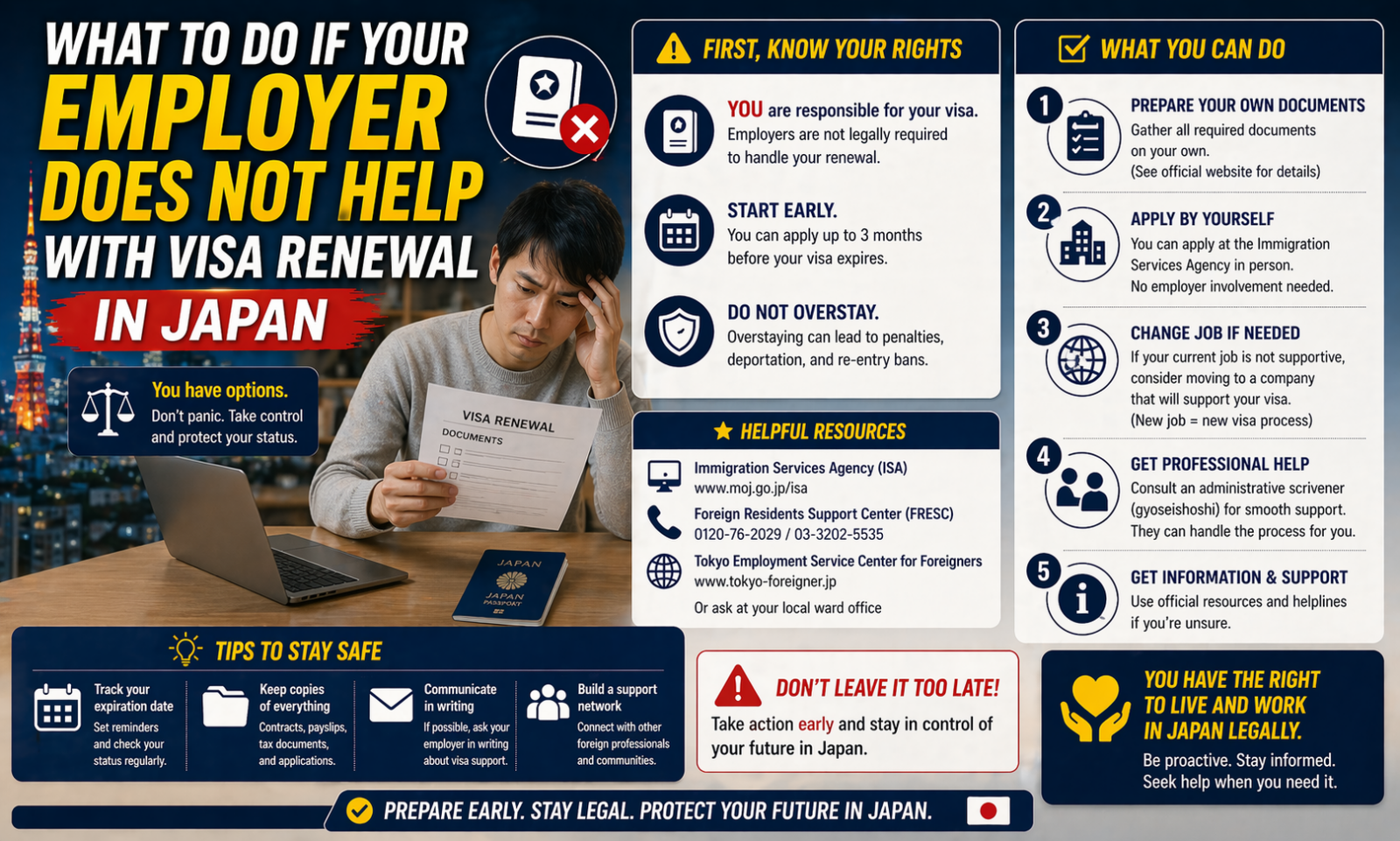
What to Do If Your Employer Does Not Help With Visa Renewal in Japan
If your employer will not help with your visa renewal, you can usually still apply yourself.
In Japan, an extension of stay is your application, not your employer’s property. A company can act as an approved intermediary, but the Immigration Services Agency also accepts applications from the foreign resident personally. What matters most is applying before your current period of stay ends and submitting documents that show you still meet the conditions of your status.
- Main answer: You do not need your employer to file the application for you.
- Best timing: Apply from about 3 months before expiry if your current period of stay is 6 months or longer.
- If your card expires while the case is pending: You can usually stay and keep your previous activities during the special period, up to the decision date or 2 months after expiry, whichever comes first.
- Current cost: As of April 2025, the fee is 6,000 yen for a counter application or 5,500 yen for an online application when the extension is approved.
Who this guide is for
This guide is for workers in Japan on a work-related status of residence, especially people whose company refuses to prepare documents, delays responses, or says visa renewal is “your problem.”
It matters most when:
- your residence card expiry date is getting close
- HR will not act as your application intermediary
- your manager will not issue routine employment documents quickly
- you changed jobs recently and are unsure which company must provide documents
ここがポイント: An unhelpful employer is a problem, but it does not automatically block your extension application. Missing the deadline is usually the bigger risk.
What you should do first
Start with the deadline, not the office politics.
1. Check your expiry date and count backward
The Immigration Services Agency says extension applications must be filed before the current period of stay expires. If your current stay is 6 months or longer, the usual window opens about 3 months before expiry.
That means you should not wait for endless internal approvals from HR if the date is already close.
2. Confirm your status-specific document list
The exact documents depend on your status of residence. For many workers, the most common status is Engineer/Specialist in Humanities/International Services. On that status page, ISA shows that required documents differ by the category of the organization and by your situation, such as whether you changed jobs.
This matters because some employers think “renewal” always needs the same company package. It does not. The required set changes depending on your case.
3. Decide who will submit
ISA says these applications can be filed by:
- the applicant personally
- a legal representative
- an approved application intermediary, such as certain company staff
- a lawyer or certified administrative scrivener who has filed the proper notice with immigration
So if your employer refuses to act, that usually removes one route, not the whole process.
What documents can you gather without employer help?
Start with the items you control directly.
Usually under your control
- application form
- passport
- residence card
- photo, if required for your case
- your municipal tax certificate and tax payment certificate
- copies of your employment contract, renewal contract, or written working conditions if you have them
- recent payslips, withholding slip, or other proof that you are actually working and being paid
For many work-status renewals, municipal tax documents are especially important because they show income and tax payment status in Japan.
Often requested from the employer side
Depending on your status and employer category, immigration may also look for materials linked to the company or the job itself, such as:
- proof of the employer’s category
- documents showing your job content
- documents connected to a recent transfer or job change
- newer company-side declarations in some categories
For Engineer/Specialist in Humanities/International Services, ISA’s current page says that from April 15, 2026, category 3 or 4 cases need extra attached documents, including a declaration about the representative of the organization. It also says language-ability proof may be required for jobs that mainly use language skills in face-to-face work, though this is generally not required at extension stage if you have continued in the same type of duties.
If the employer will not give documents
Move in this order:
- ask in writing for the specific document by name and keep the record
- gather substitute proof you already have, such as your contract, payslips, and tax documents
- contact the Foreign Residents Support Information Center or FRESC and ask what to submit in your exact status and category
- if the case is complex, use a lawyer or certified administrative scrivener who handles immigration filings
If a document is missing because the employer refuses to cooperate, the safest approach is to confirm acceptable substitutes with immigration before you assume the file is complete.
If you changed jobs or left the company
This is where many people mix up two separate issues: renewal and notification.
If you changed employer, left a company, or joined a new one, you may also have a duty to notify immigration about your affiliated organization. For the statuses covered by the affiliated-organization notification rules, ISA says the notice must be filed within 14 days of events such as leaving a company or joining a new one.
That notice is separate from the extension application.
If you are still employed by the same company
Your case is usually simpler. The main issue is collecting enough documents to prove the job and income continue.
If you already moved to a new employer
Your first renewal after a job change can require more scrutiny. For the common Engineer/Specialist in Humanities/International Services status, ISA specifically notes extra materials for the first extension after moving to a category 3 or 4 company.
If you no longer have a valid job contract
Your position is weaker. A work status is tied to activities based on a contract or qualifying employment relationship. If that relationship has ended and there is no replacement arrangement yet, you should treat the case as urgent and get case-specific guidance from immigration or a qualified professional.
Costs, timing, and what happens after filing
A delayed employer often creates panic because people think the residence card date is the last safe day to act. It is not, as long as you file in time.
Current official fees
- 6,000 yen for an in-person extension application, payable if permission is granted
- 5,500 yen for an online extension application, payable if permission is granted
These revised fees apply to applications accepted on or after April 1, 2025.
Standard processing time
ISA lists the standard processing period for extension of stay as 2 weeks to 1 month.
Actual cases can take longer if documents are missing or if immigration asks for additional materials.
Special period after filing
If you file your extension application before expiry and immigration has not decided by the expiry date, ISA says you can usually remain in Japan and continue your previous activities during the special period until:
- the decision is issued, or
- 2 months pass after your original expiry date,
whichever comes first.
That rule can protect you from an employer’s delay, but only if you submitted the application on time.
Common mistakes to avoid
Waiting for HR until the last week
If the filing window is already open, delay can be more dangerous than an incomplete first conversation with HR.
Assuming the company must “sponsor” the renewal in the same way as the first visa
For an extension of stay inside Japan, the resident is the applicant. Company cooperation helps, but it is not the same as saying the company owns the process.
Forgetting the 14-day affiliated-organization notice
If you changed jobs, a missing notification can create trouble later even if your new job itself is legitimate.
Using the wrong document list
Do not copy a friend’s checklist. The required papers depend on your exact status, employer category, and whether you changed jobs.
Treating this article as final legal advice
Visa cases turn on details. Use official instructions and confirm your exact document list with ISA when anything in your work situation changed.
Latest points to watch in 2026
Two current details matter for readers filing now:
- Fee structure: The higher in-person fee and slightly lower online fee have applied since April 1, 2025.
- Common work-visa document changes: For Engineer/Specialist in Humanities/International Services, ISA added extra required documents for category 3 or 4 cases from April 15, 2026, with special attention to representative declarations and some language-heavy jobs.
If your employer is uncooperative, those updates matter because they affect how much you can prepare alone and when professional help becomes worth the cost.
Practical takeaway
If your employer does not help with visa renewal in Japan, the fastest safe move is usually this: file on time, use the correct status-specific checklist, and do not confuse company refusal with loss of your right to apply.
The next thing to check is simple: are you still in the same job, did you change employer, or did the contract already end? That one fact changes the document path more than the company’s attitude does.
参照リンク
- Immigration Services Agency of Japan: Extension of Period of Stay
- Immigration Services Agency of Japan: What is the special period?
- Immigration Services Agency of Japan: Application Intermediary System
- Immigration Services Agency of Japan: Engineer / Specialist in Humanities / International Services
- Immigration Services Agency of Japan: Notifications concerning affiliated organizations Q&A
- Immigration Services Agency of Japan: Revision of fees for residence procedures
- Immigration Services Agency of Japan: Foreign Residents Support Information Center and FRESC
- Immigration Services Agency of Japan: Support for Foreign Residents