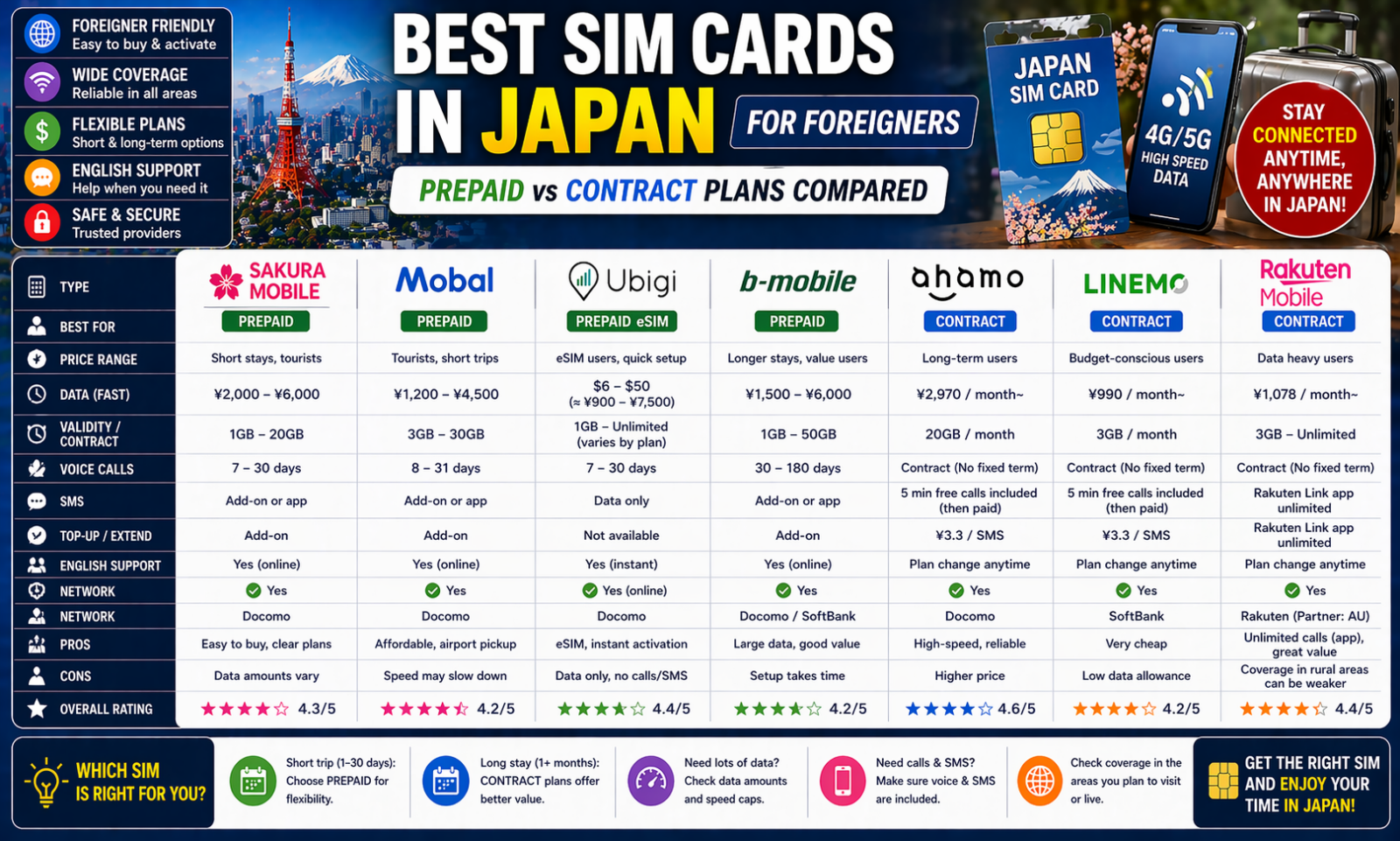
Best SIM Cards in Japan for Foreigners: Prepaid vs Contract Plans Compared
If you are choosing a SIM card in Japan, the fastest answer is this: prepaid is usually best for short stays and data-only use, while a contract or monthly plan is better once you need a Japanese phone number, SMS, or a plan you can keep using month after month.
That matters quickly in real life. A tourist can live on data and messaging apps. A student, worker, or long-term resident often cannot. Apartment applications, delivery services, job contact, and some account setups still work more smoothly with a Japanese number.
- Short stay: choose prepaid or a travel eSIM/SIM if you mainly need maps, chat apps, and browsing.
- Long stay: choose a monthly or contract-style plan if you need a Japanese number and stable ongoing service.
- Lowest monthly cost: budget MVNOs such as IIJmio are usually cheaper, but setup is less foreigner-friendly.
- Easiest English support: providers such as Mobal and Sakura Mobile are simpler, but usually cost more.
This guide is for travelers, students, workers, and new residents who need a practical choice, not a telecom deep dive. Prices and signup rules below were checked against official provider pages on April 21, 2026.
Prepaid vs contract: which one should you actually choose?
The main difference is not just price. It is whether you need a phone number and whether you can meet the signup requirements.
Prepaid works best when
- You are in Japan for a few days, a few weeks, or one semester without needing a local number.
- You mostly use WhatsApp, LINE, Google Maps, translation apps, and email.
- You want to avoid address checks, resident-card checks, or credit-card screening.
- You want to pick up a SIM at the airport or activate an eSIM before arrival.
Prepaid plans are usually easier, but many are data only. That means no normal Japanese voice calls and often no SMS verification.
Contract or monthly plans work best when
- You are staying long enough that prepaid becomes expensive.
- You need a Japanese phone number.
- You want to keep the same line for work, school, banking, or deliveries.
- You are ready to complete identity verification and payment setup.
Monthly plans are often cheaper per GB, especially from MVNOs. The trade-off is paperwork, payment restrictions, and sometimes limited English support.
ここがポイント: If you need a Japanese number, do not assume a prepaid travel SIM will solve it. Many prepaid options in Japan are data-only.
Best choices by situation
A good plan depends more on your stay length and paperwork than on raw speed claims.
| Best for | Type | Why it stands out | Main catch |
|---|---|---|---|
| Short trips | Sakura Mobile Travel SIM | Data-only travel SIM from 3,500 yen, English support, pickup options | No phone number |
| Foreign visitors who want a major-carrier prepaid option | SoftBank Prepaid SIM for Travel | Official prepaid service for foreign visitors | Data-only, passport required |
| New residents who want English support and a Japanese number | Mobal | Long-term plans with a real Japanese number, no contract, cancel anytime | Usually not the cheapest per GB |
| Budget-conscious residents | IIJmio | Very low monthly pricing, including voice and eSIM options | Credit card and ID checks can be stricter, support is more Japan-oriented |
| Heavy data users | Rakuten Mobile | Unlimited-data positioning, free domestic calls via app, eSIM activation | You still need full identity verification and coverage can vary by area |
| Residents who want English help but more standard monthly plans | Sakura Mobile Monthly | Voice plus data from 2,980 yen per month, overseas cards accepted | Activation fee and monthly cost are higher than budget MVNOs |
Best prepaid pick for tourists: Sakura Mobile Travel SIM
Sakura Mobile’s travel SIM is straightforward if you want fast setup and English support. Its official travel SIM page says the service is data-only and starts from 3,500 JPY before tax. That is useful for travelers who do not want a contract and only need internet.
This is a good fit if you will use app-based calling and messaging. It is a poor fit if you need a Japanese mobile number for forms or SMS.
Best official prepaid option from a major carrier: SoftBank Prepaid SIM for Travel
SoftBank’s official prepaid travel SIM is also clearly aimed at foreign visitors. Its English page states that it is a prepaid data-only SIM service for foreign visitors in Japan. SoftBank also says you need:
- a SIM-free device with a camera
- your original passport
- to be at least 18 years old
That makes it easy to understand, but limited. It is good when you want a known brand and simple visitor use. It is not a replacement for a resident phone plan.
Best for long-term residents who want English support: Mobal
Mobal is one of the easiest options to understand in English. Its long-term SIM page lists:
- Voice Lite from 990 JPY/month
- Voice+Data from 1,650 JPY/month
- a real Japanese phone number
- no contract and the ability to cancel anytime
That combination matters for people who have just arrived and need a working Japanese number quickly.
Mobal is especially practical if you want a low-friction first plan. For voice-capable pickup, Mobal’s support page says you must be 18 or older and present your original passport.
Best budget contract-style choice: IIJmio
IIJmio is where the price gap becomes obvious. Its official pricing page shows voice plans starting at:
- 850 JPY for 2GB
- 950 JPY for 5GB
- 1,400 JPY for 10GB
- 1,600 JPY for 15GB
- 2,000 JPY for 25GB
Its data eSIM on the docomo network starts even lower, at 440 JPY for 2GB.
For many residents, this is the value play. But IIJmio is less forgiving about setup. Its official application guidance says payment is credit card only, debit cards are not accepted, and overseas-issued cards may not work.
Best if you use a lot of data: Rakuten Mobile
Rakuten Mobile is the plan to look at if you expect heavy usage and want fewer worries about monthly data caps. Its official English page promotes:
- unlimited data across its nationwide network
- free domestic calls through the Rakuten Link app
- free overseas data up to 2GB per month in more than 100 countries and regions
- 3-minute activation for some eSIM applications
- no contract admin fees for up to four lines
This makes Rakuten attractive for workers, students, and anyone who streams a lot or uses tethering often. The question is not only price. It is whether coverage is strong where you live, study, or commute.
What the real cost difference looks like
The biggest mistake is comparing only the monthly sticker price.
Prepaid costs more per month, but saves hassle
A travel SIM can be the right financial choice if you only need service for a short period. You may pay more per GB, but you avoid:
- activation fees on resident plans
- ID checks tied to your Japan address
- payment-method problems
- cancellation steps later
For example, Sakura’s travel SIM starts at 3,500 yen, while SoftBank’s travel prepaid sells extra 500MB for 31 days at 1,650 yen. Those numbers are manageable for a short stay, but they stop looking cheap if you keep topping up for months.
Monthly plans usually win after the first month or two
Once you are staying longer, resident plans usually make more sense. The catch is that some of them add setup costs.
Sakura Mobile’s monthly pricing page, for example, lists:
- Voice + Data from 2,980 JPY/month
- Data-only from 2,480 JPY/month
- 5,500 JPY activation fee
That upfront fee changes the math. A plan that looks cheap per month can still cost more than a prepaid SIM during your first few weeks.
Rules and signup hurdles that matter to foreigners
This is where many people choose the wrong plan.
Identity documents differ by provider
Rakuten Mobile’s identity verification page says foreign nationals can use:
- residence card
- special permanent resident certificate
It also says the address must be listed and match the application.
IIJmio’s current identity-check guidance says accepted online documents include:
- My Number card
- driver’s license
- residence card
- special permanent resident certificate
For foreigners, the important point is simple: a resident plan usually expects resident-style ID. A tourist passport alone is often not enough for the cheaper monthly options.
Payment method can block a cheap plan
A low monthly price does not help if you cannot pass payment screening.
Sakura Mobile says it accepts credit and debit cards issued outside Japan. That is a real advantage for new arrivals.
IIJmio is more restrictive. Its official pages say payment is credit card only, debit cards are not accepted, and some overseas-issued cards may fail.
English support is part of the price
Many foreigners end up paying extra for support, not for mobile data.
That is why Mobal and Sakura Mobile remain popular even when their raw price is higher than IIJmio. If you need help in English with setup, pickup, APN settings, cancellation, or compatibility, that support has value.
Common mistakes to avoid
Buying a travel SIM when you really need SMS
A data-only SIM is enough for maps and messaging apps. It is not enough if a service sends a code to a Japanese number.
Choosing the cheapest plan before checking your card and ID
A cheap monthly plan can waste time if your card is rejected or your ID address does not match your application.
Forgetting activation fees
Monthly plans can look inexpensive until you add the one-time fee.
Ignoring network and phone compatibility
Sakura Mobile notes that your phone must be unlocked. That is especially important for phones bought in the United States, where carrier locks are still common.
Latest points to watch in 2026
A few current details matter more than they did a year ago.
IIJmio changed online identity verification rules in 2026
IIJmio’s support pages note that its online identity verification documents changed on January 27, 2026. If you used older guides, they may now be wrong.
Rakuten keeps pushing fast eSIM signup
Rakuten’s English application guide still highlights fast eSIM activation for eligible devices. If you want to avoid waiting for a physical SIM, this is one of the clearest official options.
Provider promotions change faster than base plan logic
Campaigns move all the time. The more stable decision is still this:
- short stay and no local number needed: prepaid
- long stay and local number needed: monthly or contract
- lowest price: budget MVNO
- easiest setup in English: foreigner-focused providers
Bottom line
For most people, the best choice is not one universal “best SIM card.” It is the plan that matches your stay length and paperwork.
- Choose prepaid if you are visiting Japan briefly and can live without a Japanese number.
- Choose Mobal or Sakura Mobile monthly if you want easier English support and a smoother first setup.
- Choose IIJmio if price matters most and you already have the right ID, address, and credit card.
- Choose Rakuten Mobile if you want a long-term plan built around heavy data use and app-based calling.
Before you order, check three things in this order: whether your phone is unlocked, whether you need SMS or a real Japanese number, and whether your card and ID will pass the provider’s screening. That step will save you more trouble than chasing a 300-yen difference.
参照リンク
- Mobal Japan SIM Card
- Mobal Support: Collection Point Information
- Sakura Mobile Travel SIM
- Sakura Mobile Monthly Plans
- Sakura Mobile Monthly Pricing
- Sakura Mobile Home Page
- SoftBank Prepaid SIM for Travel
- Rakuten Mobile: Rakuten SAIKYO Plan
- Rakuten Mobile: Step-by-Step Application Guide
- Rakuten Mobile: Identity Verification Documents
- IIJmio GigaPlan Monthly Fees
- IIJmio Application Guidance
- IIJmio Accepted Identity Documents
- IIJmio Payment Methods