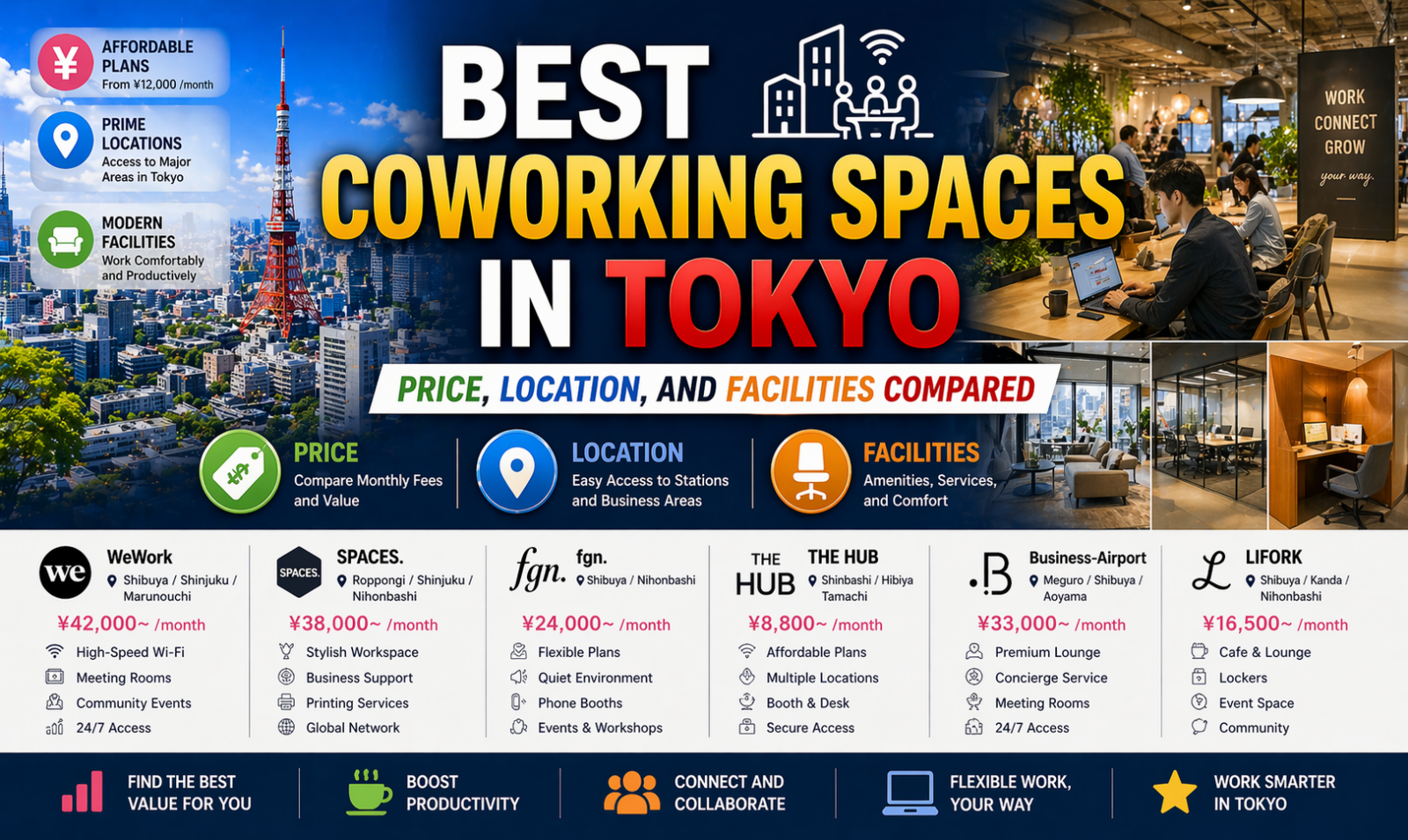
Best Coworking Spaces in Tokyo: Price, Location, and Facilities Compared
If you need one quick answer, Tokyo does not have one single best coworking space. The best choice depends on how often you work there and where in the city you need to be.
For low-cost flexible use, BasisPoint is hard to beat. For a polished business setting near Marunouchi, Regus or The Executive Centre make more sense. If you mostly want a Shibuya drop-in desk with long hours, SHARE LOUNGE is the easier pick.
- Best budget option: BasisPoint
- Best for Shibuya drop-ins: SHARE LOUNGE
- Best value monthly base in central Tokyo: fabbit Ginza
- Best for multi-location business access: Regus
- Best premium client-facing option: The Executive Centre
This guide is for remote workers, freelancers, founders, students, and business travelers who need a practical Tokyo workspace comparison. Prices and plan details below were checked on official pages on April 21, 2026. Actual availability, campaigns, and taxes or contract terms can still change.
Quick comparison
| Space | Best for | Public price checked | Where it works best | Standout facilities |
|---|---|---|---|---|
| BasisPoint | Cheap flexible work | ¥330 for first 30 min, ¥3,300 daily cap, monthly from ¥9,350 | Shimbashi, Jimbocho, Ikebukuro, Nishi-Shinjuku and more | Free drinks, meeting rooms, box seats, some private booths |
| SHARE LOUNGE Shibuya | Short drop-ins in Shibuya | ¥1,870 per 60 min, app discount available | Right by Shibuya Scramble Crossing | Fast Wi-Fi, power, drinks and snacks, easy reservation app |
| fabbit Ginza | 24-hour monthly base | ¥2,200 day pass, ¥22,000 monthly free-seat plan | Ginza / Kyobashi / Ginza-itchome area | Phone booth, free drinks, lockers, meeting room, inter-branch use |
| Regus Tokyo | Business travel and multiple centers | Day coworking from ¥3,900, hourly from ¥488, access plan from ¥1,050 per day equivalent | Marunouchi, Shibuya, Shinjuku and many more | Reception, secure Wi-Fi, kitchens, lounges, meeting spaces |
| The Executive Centre | Premium meetings and polished environment | City Pass from ¥54,000/month, Global Pass from ¥63,000/month | Marunouchi, Nagatacho, Shibuya, Jingumae | Phone booths, business lounge, barista service, networking events |
ここがポイント: If you will work in Tokyo for only a few scattered days, pay-as-you-go spaces usually win. If you need a desk 8 to 10 days a month or more, a monthly plan often becomes the better deal.
Which space is best for most people?
For most foreign residents and long-stay visitors, BasisPoint is the safest starting point.
It has the clearest low-risk pricing, multiple Tokyo locations, and a pricing structure that works whether you need 30 minutes, one day, or a regular monthly base. The official site lists drop-in use from ¥330 for the first 30 minutes, a ¥3,300 daily cap, and monthly coworking from ¥9,350. Its Shimbashi Ginza-guchi branch is also just 1 minute from JR Shimbashi Station, which matters if you are moving around the city for meetings.
That does not make it the best for every case. It makes it the easiest recommendation when you do not yet know your Tokyo work pattern.
Best picks by need
1. BasisPoint: best overall for budget and flexibility
BasisPoint is strong because it keeps the commitment low.
You can start with a short session, see whether the noise level and seating style fit your work, and only then decide if you need a monthly plan. The network includes practical locations such as Shimbashi, Jimbocho, Ikebukuro, and Nishi-Shinjuku.
What stands out:
- Low public entry price for first-time users
- Day cap that is easier to understand than many package plans
- Free drinks, Wi-Fi, power, meeting rooms, and box seats
- Good spread of commuter-friendly branches
Best for:
- Freelancers
- Students
- Workers who need a backup desk outside home
- People testing Tokyo coworking before committing
2. SHARE LOUNGE Shibuya: best for occasional Shibuya work sessions
If your priority is one convenient desk in Shibuya, SHARE LOUNGE is one of the easiest choices.
The SHIBUYA TSUTAYA location lists ¥1,870 for 60 minutes on the standard plan, with a discount through its app. It also allows reservations through the app and supports walk-ins when seats are available. This is useful if you work between appointments, want a half-day base near Shibuya Station, or need a place before an evening train.
This is not the cheapest option for long sessions. After several hours, it becomes expensive compared with a day-capped coworking space. But for short, well-located use, it is very efficient.
Best for:
- Business travelers staying around Shibuya
- Creators and remote workers who need central access
- People who want a simple drop-in option without a monthly contract
3. fabbit Ginza: best value if you want a central monthly base
fabbit Ginza sits in a part of Tokyo that is easy for client meetings and cross-city travel. The official page says it is within 3 minutes of Takaracho and Ginza-itchome stations and 5 minutes from Kyobashi.
Its pricing is straightforward: ¥2,200 for a day pass and ¥22,000 per month for the free-seat plan. Monthly users get 24-hour access, which is the key difference from many cheaper daytime-only spaces.
Facilities on the official page include:
- Wi-Fi and power
- Free drinks
- Phone booth
- Lockers
- Meeting room
- Open lounge space
This makes fabbit a strong middle option. It is not as cheap as BasisPoint for light use, and not as premium as The Executive Centre, but it balances cost and business practicality well.
4. Regus Tokyo: best if you move between districts often
Regus works best when network access matters more than community feel.
The official Tokyo coworking page lists public starting prices at ¥3,900 per day for day coworking, ¥488 per hour for hourly coworking, and ¥1,050 per day equivalent for a coworking access plan. Regus also says there is no minimum term for hourly or day use, and it has centers across Tokyo including Marunouchi, Shibuya, and Shinjuku.
Why that matters:
- You can work near the meeting you already have that day
- It is easier for team members to meet in different districts
- The facilities are built for business use rather than cafe-style lounging
Regus also lists common inclusions such as reception, secure high-speed Wi-Fi, printing, kitchens, breakout spaces, and meeting areas. Some centers add showers, bike storage, parking, or fitness facilities.
5. The Executive Centre: best premium option for meetings and image
The Executive Centre is the expensive end of this list, but the official Tokyo page makes clear what you are paying for: central business district addresses, private phone booths, business lounge access, barista service, and networking events.
Public pricing starts at ¥54,000 per month for a City Pass and ¥63,000 per month for a Global Pass. Tokyo locations include JP Tower in Marunouchi, Sanno Park Tower in Nagatacho, Cerulean Tower in Shibuya, and Jingumae Tower Building.
This is the better fit when:
- You meet clients regularly
- You care about presentation and quiet call space
- You want a polished office feel, not just a desk
For cost-sensitive users, though, it is usually too much.
How to choose without wasting money
Start with your real weekly pattern, not the photos.
Choose a pay-as-you-go space if:
- You need a desk fewer than 8 days a month
- You are still testing neighborhoods
- You mostly work from home and only need a backup space
- Your schedule changes often
Choose a monthly plan if:
- You need regular weekday access
- You take many video calls and need a predictable setup
- You want 24-hour access or locker options
- You meet clients and want a more professional environment
Pick the neighborhood first if:
- You spend most days in one part of Tokyo
- You want to avoid long train transfers before work
- You often work before or after in-person meetings
In Tokyo, a cheaper desk in the wrong district can cost more once you add extra commuting time and train fares.
Common mistakes foreigners make
Assuming every coworking space works like a cafe
Many spaces have separate rules for calls, phone booths, guests, and meeting rooms. A low headline price may only cover open seating.
Comparing day passes without checking hours
A daytime-only pass and a 24-hour monthly plan are not close substitutes. fabbit, for example, gives monthly free-seat members 24-hour access, while its day pass is limited to weekday reception hours.
Ignoring reservation systems
SHARE LOUNGE pushes app booking. Some Regus centers strongly recommend advance booking for day or hourly hot desks. If you just walk in at peak time, availability can be the real problem, not price.
Treating Tokyo as one market
Tokyo coworking prices change by area. Shibuya and Marunouchi usually cost more than outer districts. The trade-off is better station access and easier client meetings.
Latest practical update to check before booking
As of April 21, 2026, the public information on official pages shows a wide spread:
- Budget flexible use starts around ¥330 per 30 minutes at BasisPoint
- Fast Shibuya drop-ins sit around ¥1,870 per hour at SHARE LOUNGE
- Central day passes are around ¥2,200 at fabbit Ginza
- Business-network options start around ¥3,900 per day at Regus
- Premium monthly memberships begin at ¥54,000 at The Executive Centre
The next thing to verify is not just price. Check these before you pay:
- Whether tax is already included
- Whether the branch has phone booths or only open seating
- Whether meeting rooms cost extra
- Whether your plan includes multi-location access
- Whether walk-ins are allowed on the day you need it
Final takeaway
If you want the simplest low-risk starting point, choose BasisPoint. If you need Shibuya convenience for short work blocks, choose SHARE LOUNGE. If you want a more serious monthly base without jumping to premium pricing, fabbit Ginza is the strongest middle option. For people who move between Tokyo districts or need a polished business setup, Regus and The Executive Centre justify their higher prices.
Before you book, check one last thing: whether the branch matches your actual work style. In Tokyo, the biggest difference is often not the desk. It is whether you need silence, calls, late hours, or fast station access.
参照リンク
- BasisPoint official site
- BasisPoint store list
- BasisPoint 30-day plan
- fabbit Ginza official page
- Regus Tokyo coworking official page
- Regus Marunouchi Tekko Building official page
- The Executive Centre Tokyo coworking official page
- SHIBUYA TSUTAYA SHARE LOUNGE official page
- Shibuya Sakura Stage SHARE LOUNGE page