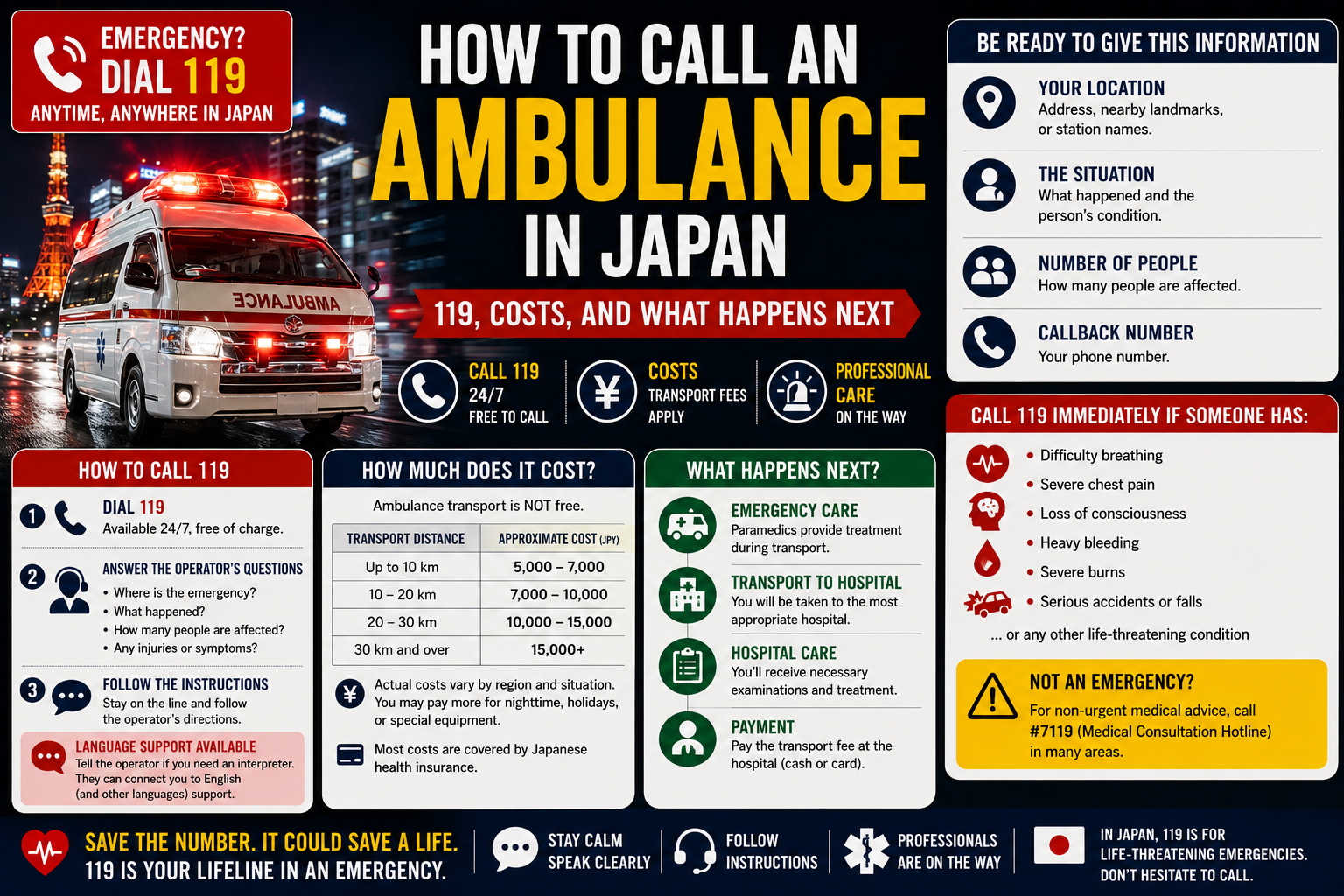
How to Call an Ambulance in Japan: 119, Costs, and What Happens Next
If you need an ambulance in Japan, call 119 right away and say it is a medical emergency. The ambulance dispatch itself is generally public emergency service, but hospital treatment, tests, and medicine are not free.
This matters for tourists, students, workers, and long-term residents alike. In a real emergency, the most useful thing is not perfect Japanese. It is knowing the number, what the dispatcher will ask, and what happens after the ambulance arrives.
- Call 119 for an ambulance anywhere in Japan.
- Say your location first. If you do not know the address, give a nearby building, station, or intersection.
- Do not wait if the condition looks serious. Trouble breathing, chest pain, stroke signs, unconsciousness, heavy bleeding, or seizures are ambulance cases.
- The ride is not the end of the cost. Treatment at the hospital and medicine can still be expensive, especially without insurance.
Who this guide is for
This guide is for foreign residents and visitors in Japan who want a simple, practical emergency plan.
It matters most when:
- you live alone and worry about what to say on the phone
- you are traveling and do not know local clinics or hospitals
- you have children, an older family member, or a chronic condition
- you are unsure how Japan handles ambulance calls compared with your home country
Call 119 first and keep it simple
When you call 119, the dispatcher will ask questions needed to send an ambulance. The Fire and Disaster Management Agency says that if the situation is serious, the ambulance may be dispatched before all questions are finished.
Start with the essentials:
- say it is a medical emergency
- give the address or nearest landmark
- explain what happened and the main symptoms
- give the patient’s age or approximate age
- give your name and phone number
If you are using a mobile phone, keep it on after the call. The crew may call back if they cannot find you.
If a Japanese speaker is nearby, ask for help. That is normal, and official guidance for foreign users suggests doing exactly that when possible.
Useful phrase:
- “Please call an ambulance.”
- Japanese: 救急車を呼んでください。
What counts as an ambulance-level emergency
Japan’s official ambulance guide and health guidance both make the same basic point: if the condition looks urgent, do not hesitate to call.
Typical red-flag situations include:
- sudden trouble breathing
- chest pain or pressure that lasts several minutes
- signs of stroke such as facial drooping, slurred speech, or sudden weakness on one side
- unconsciousness or very abnormal behavior
- convulsions or seizures that do not stop
- major bleeding
- serious burns
- a hard fall, traffic crash, or near drowning
- a baby under 3 months old who looks clearly unwell
ここがポイント: In Japan, the biggest mistake is often waiting too long because you are worried about language, cost, or “causing trouble.” If the condition is severe, call 119 first.
What it costs in practice
The ambulance dispatch itself is part of the public emergency system. A city-level English guide from Yokohama states that the emergency call is free, and national guidance makes clear that ambulance service is available to anyone in Japan.
But the medical side is different. After you arrive at the hospital, you may be charged for:
- the doctor’s examination
- tests such as blood work or imaging
- treatment and procedures
- medicine from the hospital or a pharmacy
For foreign visitors, JNTO warns that people without suitable travel insurance may be billed the full amount. For residents, costs depend on your insurance status and the treatment you receive.
If you can, have these ready:
- health insurance card, My Number health insurance card, or qualification confirmation document
- cash or a payment card
- a list of medicines you take
- allergy information
Do not assume every clinic accepts cards. Major hospitals are more likely to, but smaller facilities may still prefer cash.
What happens after the ambulance arrives
The crew will check the patient, ask questions, and decide where to transport them. This is important for foreign readers because you usually cannot choose the hospital yourself. JNTO’s official guide states this clearly.
In practice, that means:
- the crew chooses a hospital that can accept the case
- the destination may depend on severity, time of day, and hospital capacity
- you may be treated before long explanations if the case is urgent
If you are conscious, answer short questions directly. If you are helping someone else, be ready to explain:
- when symptoms started
- whether there was a fall, crash, or choking episode
- known illnesses
- regular medicine
- allergies
If you are not sure whether to call an ambulance
Not every sudden illness needs 119. Japan also has consultation tools for the cases in between.
In Tokyo: #7119
Tokyo Fire Department runs #7119 as a 24/7 emergency consultation line. Doctors, nurses, and experienced emergency staff advise whether you should call an ambulance or go to a hospital yourself. Tokyo also provides an English web version of its emergency consultation guide.
This is useful if:
- the symptom is worrying but not obviously life-threatening
- you need help deciding between self-transport and ambulance
- it is late at night and regular clinics are closed
Outside Tokyo: check your local area
#7119 is not identical everywhere in Japan. The Fire and Disaster Management Agency says the service is available in many regions, but not nationwide in a uniform way.
That means you should:
- check your prefecture or city fire department website before you need it
- save the local emergency consultation number if your area publishes one
- use national tools when local phone advice is unclear
Nationwide tool: Q-suke
The Fire and Disaster Management Agency also provides the Q-suke emergency self-check app. It asks about symptoms and then shows guidance such as:
- call an ambulance now
- see a medical institution as soon as possible
- monitor the condition carefully
It also links onward to hospital search tools.
Language support and how to find care after the ambulance
Language help in Japan is real, but it is uneven.
What is national:
119for ambulance and fire emergencies- official ambulance-use guides from the Fire and Disaster Management Agency in multiple languages
- the national Medical Information Net search service, which can filter by foreign language support and opening hours
What varies by area:
- how much multilingual support the local 119 system can offer
- which hospitals can accept foreign-language communication
- which after-hours clinics are available nearby
For visitors, JNTO’s Japan Visitor Hotline is open 24 hours a day, 365 days a year in English, Chinese, and Korean. It can support emergencies and point users toward medical institutions, but JNTO says it generally does not provide three-way interpretation or make reservations on your behalf.
Latest update that matters as of May 8, 2026
A recent change is My Number-based ambulance support, often called MyNa Ambulance.
According to the Fire and Disaster Management Agency:
- the system started nationwide on October 1, 2025
- in fiscal 2026, it covers about 99% of fire departments and about 97% of ambulance teams, excluding some remote islands
- from April 2026, use with a smartphone-based My Number health insurance setup is also being introduced
Why this matters:
- if you use your My Number card as health insurance, crews may be able to confirm medical information faster
- this can help with hospital selection and treatment decisions
- the crew will normally ask for the patient’s consent first
- if the patient is unconscious and life or bodily safety must be protected, the crew may access the information without consent
This is mainly relevant for residents and longer-term stayers, not short-term tourists who do not use Japan’s health insurance system.
Common mistakes to avoid
A few mistakes cause real problems in Japan’s ambulance system.
- Waiting too long because you are afraid your Japanese is not good enough.
- Calling a taxi first even though the patient has breathing trouble, stroke signs, or heavy bleeding.
- Forgetting to explain the exact location or nearest landmark.
- Assuming the ambulance means the hospital will be free.
- Assuming you can choose any hospital you want.
- Not keeping your phone available after the 119 call.
- Not carrying insurance details or a medicine list if you have a chronic condition.
Practical takeaway
If you remember only a few things, remember these:
- 119 is the number for an ambulance in Japan.
- Call first when the situation is severe.
- Say your location clearly and keep your phone on.
- The ambulance ride is emergency transport, but hospital care still costs money.
- If you live in Japan, carrying your My Number health insurance card or equivalent document is now more useful than before.
The best check to do today is simple: save 119, look up your local after-hours consultation option, and confirm where your insurance information is kept. That small preparation matters much more than trying to remember everything once an emergency has already started.
参照リンク
- Fire and Disaster Management Agency: Guide for Ambulance Services
- Fire and Disaster Management Agency: Guide for Foreign Visitors Using Ambulance Services
- Fire and Disaster Management Agency: Q-suke Emergency Self-Check App
- Fire and Disaster Management Agency: About
#7119 - Fire and Disaster Management Agency: MyNa Ambulance
- Ministry of Health, Labour and Welfare: Appropriate Use of Ambulances
- Medical Information Net (MHLW)
- Tokyo Fire Department:
#7119Emergency Consultation Center and Tokyo Emergency Guide - Japan National Tourism Organization: Guide for When You Are Feeling Ill
- Yokohama City: Dial 119