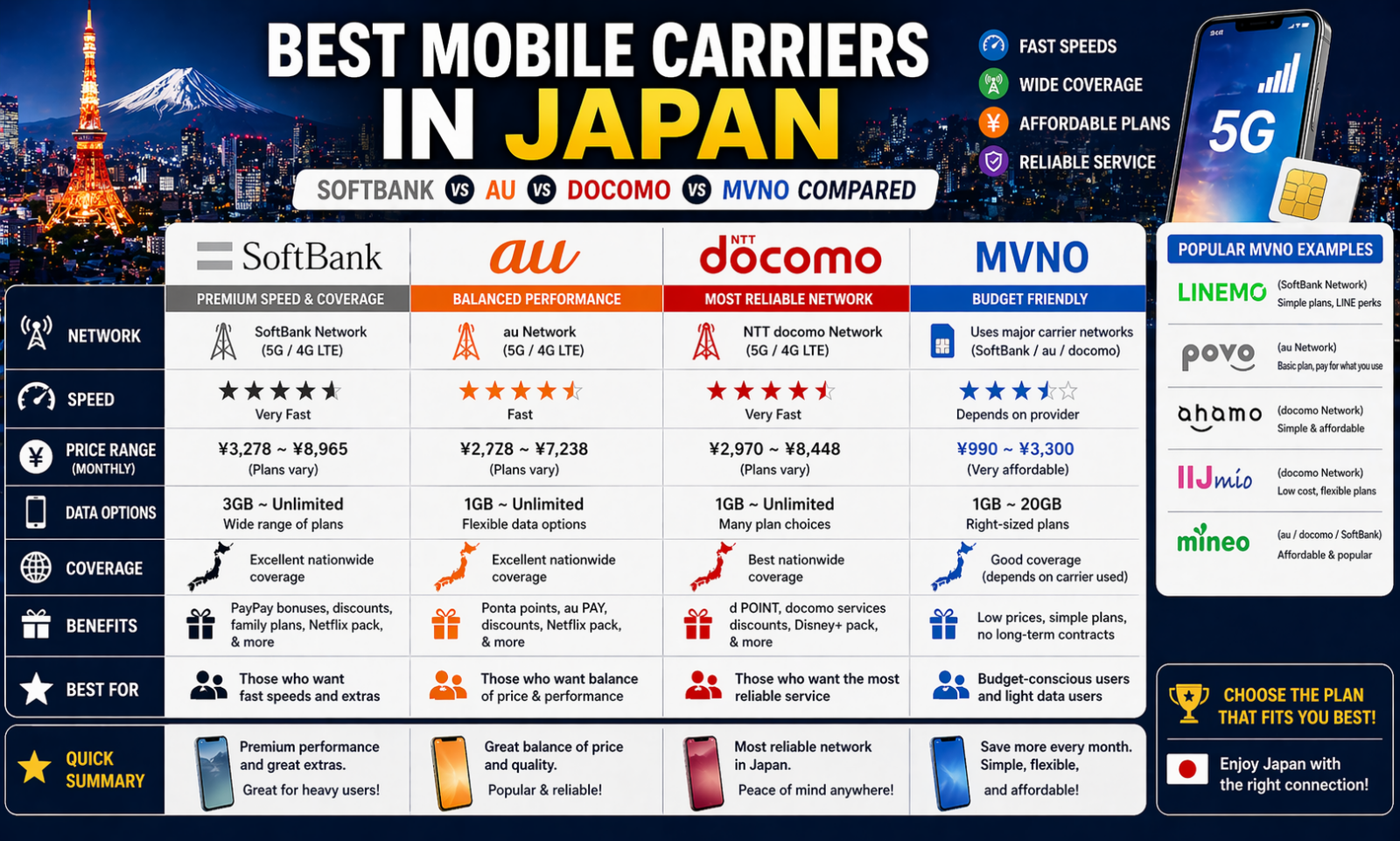
Best Mobile Carriers in Japan: SoftBank vs AU vs Docomo vs MVNO Compared
If you want the short answer, Docomo or au are the safest picks for most foreign residents who care about coverage and easier in-person support, while MVNOs are usually the cheapest if you can manage your plan online and do not need much hand-holding. SoftBank can be a good fit too, but as of April 21, 2026, its lineup is in the middle of a plan transition, so you need to check whether you are signing up under the current plans or the new ones announced for later in 2026.
This guide is for students, workers, and long-term residents choosing a main phone line in Japan. If you only need a short stay travel SIM, this is not the right comparison.
- Best overall for reliability: Docomo or au
- Best for low monthly cost: MVNOs such as mineo, IIJmio, and low-cost brands like UQ mobile or Y!mobile
- Best for heavy data users: Docomo MAX, au unlimited plans, or SoftBank’s unlimited tier
- Best for online-only simplicity: ahamo
ここがポイント: In Japan, the cheapest plan on the ad is often not the real price you will pay. Family discounts, home internet bundles, and card-payment discounts change the math a lot.
First, know the four groups you are comparing
Before comparing prices, separate the market into four buckets.
1. The big three MNOs: Docomo, au, SoftBank
These are the main network owners. They usually make the most sense if you:
- live outside central Tokyo or Osaka and care about broader coverage
- want a physical shop you can visit
- plan to bundle home internet, family lines, or credit-card discounts
- use a lot of data every month
They are usually the most expensive at sticker price.
2. Online sub-brands: ahamo, UQ mobile, Y!mobile
These are often the sweet spot for foreign residents.
They are cheaper than the big three, simpler to compare, and still have stronger mainstream support than many tiny budget providers. But they are not all the same:
- ahamo is Docomo’s online-focused plan
- UQ mobile is KDDI’s lower-cost brand under the au side
- Y!mobile is SoftBank’s lower-cost brand
3. True MVNOs: mineo, IIJmio and others
These providers rent network capacity from the big carriers. They can be much cheaper, and some let you choose which host network you want. For example, mineo offers plans on Docomo, au, and SoftBank networks.
The trade-off is usually simpler support, fewer stores, and more self-service.
4. Ecosystem-first plans
Some plans are only a good deal if you already live inside that company’s ecosystem.
Examples:
- SoftBank pushes PayPay and home internet bundles
- Docomo pushes d-card, Docomo Hikari, and bundled content
- au pushes au PAY Card and home-set discounts
If you will not use those extras, the headline price often looks better than the real value.
Quick comparison: who should choose what?
Choose Docomo if you want the safest default
Docomo is the easiest recommendation for people who want fewer surprises.
Its current lineup includes:
- Docomo MAX for heavy users, with unlimited data tiers and bundled extras
- Docomo mini for light users, with 4GB at 2,750 yen or 10GB at 3,850 yen before discounts
- ahamo for people happy to manage almost everything online, with 30GB for 2,970 yen or 110GB for 4,950 yen, plus 5 minutes of domestic calls included
Why that matters:
- Docomo gives you a clear upgrade path from cheap online plan to full-service plan
- ahamo is one of the cleanest mid-range plans in Japan
- if you later move, work remotely, or travel around the country, Docomo is still a conservative choice
Choose au if you want a strong mainstream carrier with better budget side options
au’s main unlimited plan, 使い放題MAX+ 5G/4G, is 7,788 yen per month before discounts, with speed control after 200GB and tethering up to 60GB.
For lighter use, au also offers スマホミニプラン+, a variable plan up to 5GB.
The bigger reason to consider au is not only the main brand. It is the cheaper side around it:
- UQ mobile トクトクプラン2 can be much cheaper for moderate users
- UQ mobile コミコミプランバリュー gives 35GB and 10-minute domestic calls for 3,828 yen
That makes au attractive if you want to start cheaper without leaving the KDDI side completely.
Choose SoftBank if PayPay benefits matter to you
SoftBank is harder to recommend as a simple default right now because its consumer plans are changing.
As of April 21, 2026:
- current plans such as Paytoku are still visible
- SoftBank has also announced new plans including Paytoku2, Teigaku Unlimited, and Mini Fit 2
- SoftBank says some old plans will stop taking new applications on June 1, 2026
The practical point is this: SoftBank can be good value if you actively use PayPay, SoftBank Hikari or Air, and the company’s card discounts. If you do not, the plan structure is less compelling than Docomo plus ahamo, or au plus UQ mobile.
Choose an MVNO if monthly cost is your main goal
If you mainly want to reduce your phone bill, MVNOs are the strongest category.
A good example is mineo:
- 3GB: 1,298 yen
- 7GB: 1,518 yen
- 15GB: 1,958 yen
- 30GB: 2,178 yen
- 50GB: 2,948 yen
mineo matters because it offers unusual flexibility. You can choose the host network and it also has plans built around capped speed rather than only data volume.
IIJmio is another strong budget option, especially for people bringing their own device and applying online. Its official 2026 notices also show active eSIM and transfer campaigns, which is useful if you want to keep setup costs down.
What the monthly price really looks like
A foreign resident comparing Japan carriers should look at three prices, not one.
The sticker price
This is the number in the main ad. It is often high for the big three.
Examples:
- SoftBank Paytoku Unlimited: 9,625 yen before its 2026 summer revision
- au unlimited plan: 7,788 yen before discounts
- Docomo MAX unlimited tier: 8,448 yen before discounts
The discounted household price
This is the number shown after all major conditions are met.
Those conditions often include:
- family lines on the same group account
- home internet from the same company
- payment with the carrier’s own card
For many foreigners, this is where mistakes happen. If you live alone, share housing, or do not want another credit card, you may not get the big discount.
The real solo-user price
For a single person renting one room and paying with an ordinary card, online-focused plans often win.
In many real cases:
- ahamo is simpler than a discounted big-three plan
- UQ mobile is easier to justify than a full au plan
- mineo or IIJmio are cheaper than almost anything else if you can self-manage
Best picks by user type
Students and first-year residents
The best balance is usually ahamo, UQ mobile, or Y!mobile.
Why:
- lower monthly risk
- easier to switch later
- enough data for maps, school apps, video calls, and everyday use
- less dependence on family discounts you probably cannot use
Workers who travel around Japan
Start with Docomo or au if your job depends on stable service in more places. The higher price can be worth it if you use tethering often, travel to rural areas, or cannot afford support friction.
Heavy PayPay users
SoftBank becomes more interesting if you already pay through PayPay regularly and are comfortable reading the conditions. Without that ecosystem, SoftBank is less clearly ahead.
Very light users
If you mostly use Wi-Fi at home and work, Docomo mini, au’s mini plan, or a small MVNO plan are better than an unlimited contract.
Common mistakes foreigners make
Confusing MVNOs with sub-brands
UQ mobile and Y!mobile are often grouped with MVNOs in everyday conversation, but they are not the same thing as providers like mineo or IIJmio. If you care about shop access, support, and network handling, that difference matters.
Choosing a plan by the lowest advertised number
If a price assumes:
- three family lines
- bundled home internet
- the carrier’s own payment card
then it may not apply to you at all.
Ignoring call charges
Many Japanese plans still charge voice calls separately unless a call option is included. That matters if you call clinics, schools, landlords, or government offices often.
ahamo and some UQ or Y!mobile plans include short domestic call bundles, which can make them better value than a cheaper-looking data plan.
Not checking support style
If you want to solve everything in English at a shop counter, do not assume every low-cost plan will fit. Some cheaper plans are built for online users first.
Buying too much data
A lot of residents in Japan spend most of their day on Wi-Fi at home, school, or the office. If that is you, a 20GB to 35GB plan may already be enough. Unlimited is often unnecessary unless you tether often or stream heavily on mobile data.
Latest changes to watch in 2026
This market is moving, so timing matters.
SoftBank is in the middle of a lineup change
SoftBank announced new plans on April 10, 2026. It also said old plans including Paytoku, Merihari Unlimited+, and Mini Fit Plan+ will stop accepting new applications on June 1, 2026.
That means a guide written even a few months earlier can already be out of date.
Y!mobile has a scheduled price revision
Y!mobile’s plan page says Simple 3 pricing changes from June 2, 2026. If you are comparing in spring 2026, check whether you are seeing pre-revision or post-revision pricing.
Docomo already reshaped its lineup in 2025
Docomo launched Docomo MAX and Docomo mini on June 5, 2025, while older plans such as eximo and irumo stopped taking new applications on June 4, 2025. If you see old comparison articles still centered on eximo vs irumo, they are outdated for new sign-ups.
Final recommendation
For most foreign residents in Japan, the cleanest decision looks like this:
- Pick Docomo or au if you want the safest long-term main line
- Pick ahamo if you want the best simple middle ground
- Pick UQ mobile or Y!mobile if you want lower cost without going fully bare-bones
- Pick mineo or IIJmio if your main goal is to cut monthly cost and you are comfortable with online setup
- Pick SoftBank mainly when you know you will use its PayPay-centered benefits
If you are still unsure, do one practical check before signing anything: compare the real price you can get without family discounts and without bundled home internet. That single step usually narrows the field faster than any carrier ad.
参照リンク
- SoftBank mobile price plans
- SoftBank Paytoku plan page
- SoftBank press release on new plans, April 10, 2026
- au unlimited smartphone plan
- au mini smartphone plan
- UQ mobile Komikomi Plan Value
- UQ mobile Tokutoku Plan 2
- Y!mobile smartphone plans
- NTT Docomo new plan overview
- Docomo MAX
- Docomo mini
- ahamo plan page
- Docomo press release on MAX and mini, April 24, 2025
- mineo My Pita pricing
- IIJmio Giga Plan