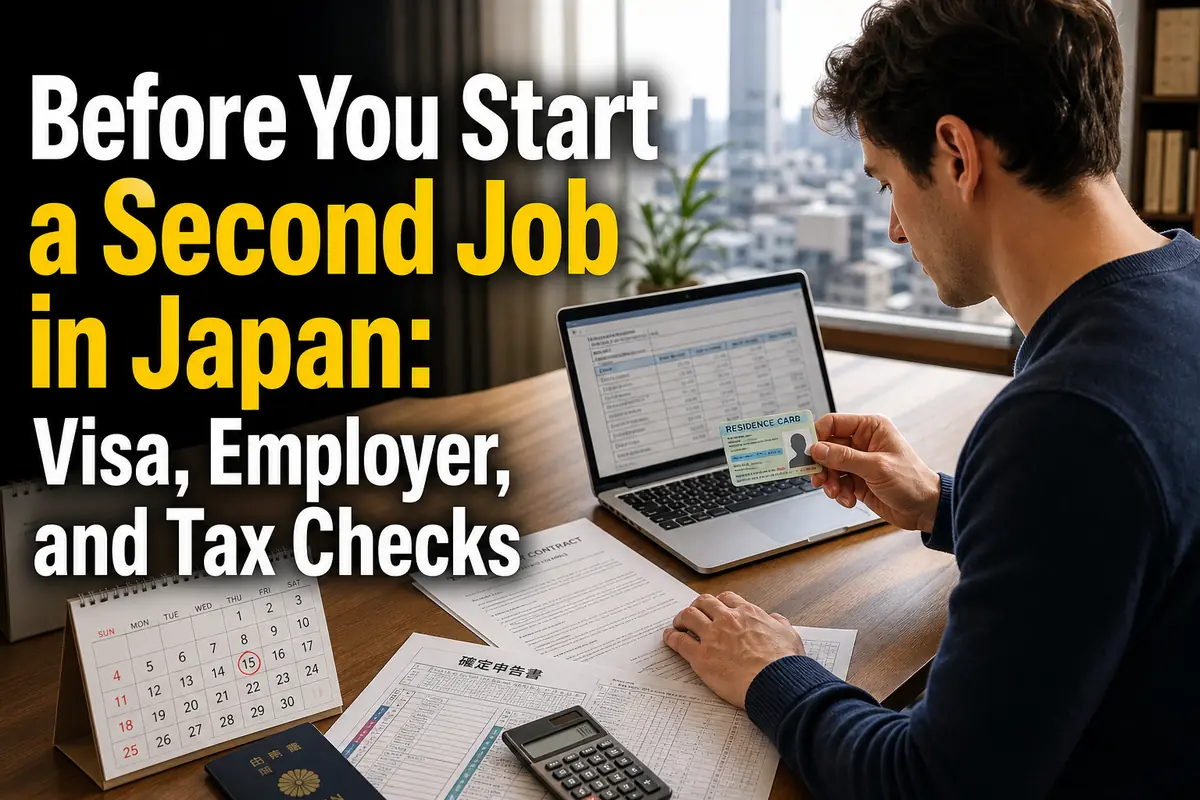
Before You Start a Second Job in Japan: The Three Checks Foreign Residents Must Make
Yes, many foreign residents can have a side job in Japan—but permission from one authority does not automatically satisfy the others. Before accepting work, check your residence status, your employer’s rules, and your tax obligations separately.
This matters whether the second income comes from another company, private lessons, delivery work, online sales, consulting, or freelance projects. The legal treatment depends on what you actually do, not simply on whether an app or contract calls it a “side hustle.”
The short version
- Immigration: Confirm that the activity falls within your current status of residence. Obtain permission before starting if it does not.
- Employer: Read your employment contract and work rules, then follow any notification or approval process.
- Tax: Keep records from the first payment. A second employer may not complete all necessary tax adjustments for you.
- Working hours: If both positions are employment, hours across employers may need to be considered together.
This guide reflects official information available as of August 2026. Immigration and tax outcomes depend on individual facts, so use it as a preparation checklist rather than final legal or tax advice.
First check: does your residence status allow the work?
The name of your residence status and the actual duties of the side job are the starting points. Your residence card alone does not answer every case.
Japan’s Immigration Services Agency divides statuses of residence into activity-based statuses and status-based residence categories. The difference is crucial for side work.
Status-based residents usually have broad freedom to work
People holding one of the following statuses are generally not restricted to a particular occupational field by their status of residence:
- Permanent Resident
- Spouse or Child of Japanese National
- Spouse or Child of Permanent Resident
- Long-Term Resident
That immigration freedom does not cancel an employer’s rules, professional licensing requirements, tax duties, or other laws. A permanent resident who wants to provide a regulated professional service, for example, may still need the relevant qualification.
Work-status holders must compare the duties, not just the industry
Activity-based work statuses permit defined types of work. Common examples include Engineer/Specialist in Humanities/International Services, Instructor, Skilled Labor, Nursing Care, and Highly Skilled Professional.
A second contract may already fit your permitted field. For example, an employee whose authorized activity includes translation may be able to perform similar translation for another organization. By contrast, restaurant serving, warehouse shifts, or delivery work may fall outside that person’s authorized professional activities.
There is no reliable rule that “a few hours” or “a small payment” makes outside work acceptable. If paid activity falls outside your authorized scope, you generally need prior permission to engage in an activity other than that permitted under your status of residence.
If the duties are within the same field but the classification is unclear, ask the Immigration Services Agency before accepting the assignment. A Certificate of Authorized Employment may also help confirm the work activities you are permitted to perform, although whether it is useful depends on the case.
Students and dependent family members need permission to work
Student and Dependent statuses do not provide general permission for paid work. A person must normally receive permission for activities outside the permitted status before starting.
Comprehensive permission commonly allows eligible students or dependents to work within a stated limit, often up to 28 hours per week. For eligible students, a different daily limit may apply during long school vacations defined by the educational institution.
Important limits include:
- Check the permission recorded on your residence card or passport rather than assuming you have it.
- The hour limit covers the combined total when you have more than one job.
- Adult-entertainment-related work is prohibited under this permission, including certain supporting jobs at such businesses.
- Student work must not interfere with the activity underlying Student status.
- Individual permission may be necessary when the proposed work does not fit comprehensive permission.
A family member’s permission does not transfer to a spouse or child. Each person needs the appropriate status and permission for their own paid activity.
“Freelance” and overseas clients are not automatic exceptions
Immigration reviews the substance of the activity. Payment through a foreign platform, an overseas bank account, or a contractor agreement does not by itself place work outside Japanese immigration rules.
Before taking a freelance assignment, write down:
- the service you will provide;
- where and how you will perform it;
- who the client is;
- how often you will work;
- the expected hours and payment;
- whether the activity matches your current status.
This description is more useful when asking Immigration than saying only that you plan to “freelance online.”
ここがポイント: A company’s approval cannot expand your immigration permission, and immigration permission cannot override your company’s valid workplace rules. Clear all applicable checks before doing the work.
Second check: what does your employer require?
Japanese law does not make every side job automatically acceptable under every employment contract. The Ministry of Health, Labour and Welfare promotes clearer access to secondary work, but each employer may maintain rules addressing legitimate business and health concerns.
Its current model work rules state that employees may work for other organizations outside their main working hours. They also give examples of when an employer may prohibit or restrict the activity:
- it interferes with the employee’s ability to perform the main job;
- confidential information could be disclosed;
- it harms the employer’s reputation or trust;
- it competes against the employer’s interests.
These are model provisions, not a replacement for your company’s actual rules. Your employer may require advance notification, approval, disclosure of working hours, or periodic updates.
Read three documents before discussing the job
Check:
- your employment contract or working-conditions notice;
- the company’s rules of employment, known as shūgyō kisoku;
- any separate side-job, confidentiality, information-security, or conflict-of-interest policy.
Look for Japanese terms such as fukugyō (副業), kengyō (兼業), todokede (届出, notification), and kyoka (許可, approval).
If the policy is unclear, ask HR in writing. Describe the work, employer or client, schedule, expected hours, and possible overlap with the company’s business. Do not send confidential client information unless the process requires it.
Working hours can become a safety issue
When a person works under employment contracts for more than one employer, Japan’s working-time rules can require hours to be considered across workplaces in certain circumstances. The practical calculation and responsibility can be complicated because each company needs accurate information about the other schedule.
This is one reason an employer may request details even when it does not object to the second job itself. Keep a single weekly record covering both workplaces, including overtime and late-night work.
Freelance hours are not automatically treated in the same way as employee working hours. However, calling someone a contractor does not settle the issue: authorities may look at actual control, instructions, working conditions, and economic reality.
Public employees and regulated professions require extra care
National and local public employees may face stricter statutory restrictions and approval procedures. Doctors, lawyers, licensed transport workers, financial professionals, and other regulated occupations may also have professional or sector-specific duties.
In these cases, a general private-sector side-job policy is not enough. Confirm the rule with the employing authority, regulator, or professional body before accepting payment.
Third check: how will the additional income be taxed?
Start record-keeping immediately, because the tax result depends on the type of income and your total annual figures. “Side income” is not a single tax category.
A second salary and freelance income are handled differently
If another company hires you as an employee, it will normally issue a withholding slip called a gensen chōshūhyō. Your main employer usually performs the year-end adjustment for the primary salary, but that process may not settle tax on all other income.
Independent work may be classified as business income or miscellaneous income depending on its nature, continuity, scale, and surrounding facts. The label chosen by a platform or client is not conclusive.
Keep the following records:
- contracts, invoices, and payment statements;
- bank and platform transaction records;
- withholding slips from every employer;
- receipts for costs directly connected to independent work;
- dates, business purpose, and personal-use portions of shared expenses;
- foreign-currency payment details and the conversion method used.
Employees generally receive a statutory employment-income deduction rather than deducting ordinary job expenses one by one. Independent-income calculations follow different rules, so do not mix the two methods.
The ¥200,000 rule is often misunderstood
The National Tax Agency states that many wage earners must file a final income tax return when income outside employment and retirement income exceeds ¥200,000. For people with two or more salaries, the test can involve the secondary salary and other income not covered by the main year-end adjustment.
This is not a universal tax-free allowance.
- The threshold generally concerns income, which may differ from gross sales or payments.
- Different filing rules apply when total salary exceeds ¥20 million, income is not subject to Japanese withholding, or other conditions apply.
- If you file an income tax return for another reason, you generally include the relevant income rather than omitting it because it is below ¥200,000.
- A person who does not need a national income tax return may still need to report income for local inhabitant tax.
The ordinary national filing period is generally from February 16 to March 15 of the following year, subject to weekends, holidays, and annual announcements. Check the National Tax Agency’s page for the relevant tax year instead of relying on an old calendar.
Resident tax is a separate check
Municipal and prefectural inhabitant tax—usually called resident tax—is based mainly on the previous year’s income. Municipal filing requirements matter even when the national ¥200,000 exception means an employee does not have to submit an income tax return.
Local procedures vary. Osaka City, for example, tells employees with other categories of income to file a municipal and prefectural tax declaration, while noting separately when an income tax return is required. If you submit a national income tax return containing the income, the information is ordinarily shared for resident-tax calculation, so a duplicate municipal return is generally unnecessary.
Ask the municipality where you were registered on January 1 of the relevant year:
- whether a resident-tax declaration is required;
- which form or online service to use;
- how to report expenses and withholding;
- how the tax will be collected;
- what to do if you move or leave Japan.
Side income can also affect income-based public charges or benefits. Osaka City notes that declared income may be used for matters including National Health Insurance premiums, care insurance, childcare charges, and public-housing rent. The exact effect depends on your household and municipality.
A safe order of action before you accept the work
The lowest-risk approach is to clear immigration first, employer rules second, and paperwork third—before performing any paid task.
Step 1: define the actual work
Prepare a short description covering duties, client or employer, workplace, hours, contract type, start date, and expected pay. Avoid vague labels such as “online business.”
Step 2: check your residence card and authorized activities
Identify your exact status of residence and any permission printed on the card. Compare the proposed duties with the Immigration Services Agency’s official status descriptions.
If the work may be outside the permitted scope, consult Immigration and apply before starting. Do not treat a pending application as permission.
Step 3: follow your workplace procedure
Review your contract and work rules. Submit the required notice or approval request with enough time for HR to assess working hours, conflicts, confidentiality, and health concerns.
Step 4: get the second arrangement in writing
For employment, confirm wages, hours, duties, location, contract period, payment date, and social-insurance handling. For freelance work, confirm the deliverable, fee, expenses, intellectual-property terms, cancellation conditions, and payment deadline.
Step 5: create a record system before the first payment
Use separate folders or accounting categories for salary documents, invoices, expenses, and tax withheld. Record gross amounts rather than only the money that reaches your bank account.
Step 6: review the position when circumstances change
Recheck the rules if:
- your duties or client change;
- the work becomes regular or significantly larger;
- you change your main employer;
- you renew or change your status of residence;
- you stop studying or take leave from school;
- your weekly hours increase;
- you move to another municipality or plan to leave Japan.
Common mistakes that can cause real problems
Most avoidable problems begin when someone treats one approval as approval for everything.
Starting work while immigration permission is pending
An application receipt is not authorization to begin outside activity. Wait for the decision unless the Immigration Services Agency confirms that your existing permission already covers the work.
Assuming remote work for a foreign client does not count
The client’s location and payment currency do not answer whether your activity is permitted or taxable in Japan. Explain the complete arrangement to the appropriate authority.
Looking only at hours, not duties
The 28-hour permission commonly associated with Student and Dependent statuses does not turn every type of job into permitted work. Both the activity and the time limit matter.
Hiding the job from the main employer
Failure to follow a valid reporting process can create a workplace dispute even when immigration permits the activity. It also prevents employers from addressing combined hours and health risks.
Treating ¥200,000 as money that never needs reporting
The income tax filing exception has conditions and does not erase resident-tax obligations. It also does not mean that the first ¥200,000 is automatically excluded when a return must be filed.
Forgetting immigration notifications
Some activity-based status holders must notify the Immigration Services Agency after specified changes involving their affiliated organization, generally within the applicable deadline. A second contract, departure from an organization, or move to another one may trigger a notification depending on the status and arrangement. Check the notification page for your exact status rather than assuming that employer paperwork is enough.
What may vary by person
Two foreign residents doing the same weekend job can face different requirements. Their residence statuses, main contracts, household situations, and income types may not match.
Get individual confirmation when any of these apply:
- your status is Highly Skilled Professional, Specified Skilled Worker, Technical Intern Training, Designated Activities, or another status with special conditions;
- you are a student approaching graduation, on leave, or no longer attending classes;
- the side activity is self-employment, business management, or a substantial continuing enterprise;
- you will work for several clients or receive payment from abroad;
- you are a public employee or work in a regulated profession;
- you are a non-permanent resident for Japanese tax purposes or have overseas income;
- you will leave Japan before tax notices arrive;
- the second job changes your social-insurance or employment-insurance position.
For immigration questions, contact the Immigration Information Center or a qualified immigration lawyer or certified administrative procedures specialist. For taxes, use the National Tax Agency consultation service, a tax office, your municipality, or a licensed tax accountant. HR can explain company policy but should not be treated as the final authority on immigration or personal tax.
Final checklist
Do not begin with the question “Will anyone find out?” Begin with “Which rules apply, and what proof do I need?”
Before the first shift, invoice, lesson, or delivery, confirm that you can answer yes to each relevant item:
- My residence status or prior immigration permission covers the actual duties.
- I have checked the hour and activity limits written on my immigration permission.
- I have followed my employer’s notification or approval process.
- I can avoid conflicts, confidential-information risks, and unsafe combined hours.
- I have written terms for the second job or client project.
- I am saving gross-payment, withholding, and expense records.
- I know whether I may need both a national income tax return and a local resident-tax declaration.
- I will recheck the position if my work, employer, school enrollment, residence status, or municipality changes.
The most important next step is concrete: write a one-paragraph description of the proposed work and use that same description when checking with Immigration, HR, and the relevant tax authority. A clear description prevents three different decision-makers from answering three different versions of your question.
参照リンク
- Immigration Services Agency: Status of Residence
- Immigration Services Agency: List of Statuses of Residence
- Immigration Services Agency: Permission to Engage in Activity Other Than That Permitted
- Immigration Services Agency: Application Form for Permission to Engage in Other Activity
- Ministry of Health, Labour and Welfare: Side Jobs and Concurrent Employment
- Ministry of Health, Labour and Welfare: Model Rules of Employment
- National Tax Agency: Wage Earners Who Must File a Final Tax Return
- National Tax Agency: Final Tax Return
- National Tax Agency: Overview of Deduction for Employment Income
- Osaka City: Municipal and Prefectural Tax Declaration
- Shinjuku City: Resident’s Tax