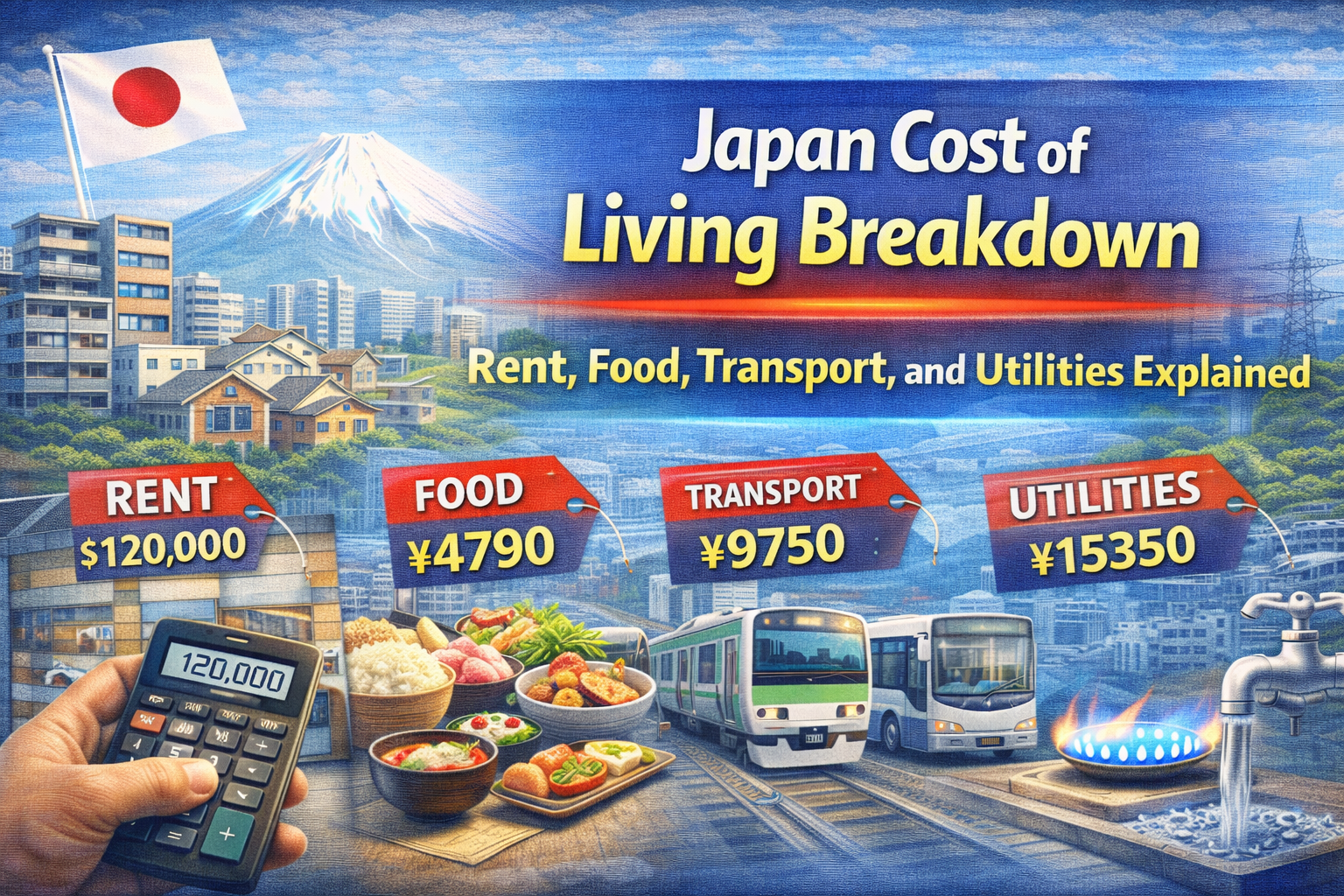
Japan Cost of Living Breakdown: Rent, Food, Transport, and Utilities Explained
For most foreigners living alone in Japan, a practical monthly budget is usually about ¥150,000 to ¥300,000 before savings, depending on city, housing type, commuting distance, and eating habits. Tokyo can sit at the upper end. A regional city, company dorm, student housing, or shared apartment can bring the number down.
The main point is simple: rent sets the floor, food and utilities move with your habits, and public transport is usually predictable once your route is fixed.
Quick guide:
- A student or very careful single resident may manage around ¥105,000 to ¥160,000 a month outside tuition, especially with subsidized or shared housing.
- A single worker in a regional city often needs more room in the budget, roughly ¥160,000 to ¥230,000.
- A single person renting privately in Tokyo should often plan closer to ¥220,000 to ¥350,000, especially before knowing their commute and utility use.
- As of April 20, 2026, recent price pressure matters most in food and energy-related bills, not only in rent.
This guide is for students, workers, long-term residents, and beginners planning everyday costs in Japan. It is not a rental contract guide or tax guide; it is a budget map for the costs you will see every month.
The Monthly Budget: What You Should Plan First
Start with the costs that repeat every month. One-time apartment fees, furniture, visa paperwork, flights, and moving costs are separate.
Here is a practical planning range for one adult:
| Monthly cost | Careful budget | Comfortable budget | What changes it most |
|---|---|---|---|
| Housing | ¥40,000-¥80,000 | ¥80,000-¥180,000+ | City, station distance, room size, private vs shared housing |
| Food | ¥30,000-¥45,000 | ¥50,000-¥90,000+ | Cooking, convenience stores, eating out, imported foods |
| Utilities | ¥10,000-¥18,000 | ¥18,000-¥30,000+ | Season, heating, air conditioning, all-electric apartments |
| Transport | ¥5,000-¥12,000 | ¥12,000-¥25,000+ | Commute length, rail operators, commuter pass coverage |
| Phone and internet | ¥3,000-¥8,000 | ¥8,000-¥12,000+ | SIM plan, home internet, contract term |
| Daily extras | ¥15,000-¥40,000 | ¥40,000-¥80,000+ | Clothes, medicine, hobbies, travel, household items |
These are planning ranges, not official national averages. Your first month can be much higher because deposits, furniture, bedding, cookware, registration trips, and setup fees often arrive together.
Key point: do not judge Japan only by rent listings. A cheaper apartment far from work can raise transport costs and take hours from your week.
Rent: The Biggest Fixed Cost
Rent is the cost that decides whether the rest of the budget feels tight. Food can be adjusted week by week. Train rides can be planned. Rent is locked in once you sign.
The official Study in Japan site, using JASSO student survey data, gives a useful lower reference point: average monthly housing for international students was listed at ¥41,000 nationally and ¥57,000 in Tokyo, with total average monthly living costs of ¥105,000 excluding study and research costs. That is helpful for students, but many workers renting privately will pay more.
Why rent varies so much
Two apartments with the same floor area can have very different rents because of:
- Distance from a major station
- Whether the building is new or old
- Train line convenience
- Room layout and storage
- Whether the apartment allows foreign tenants, pets, instruments, or two-person occupancy
- Whether it is furnished, short-term, shared, company housing, or a standard private lease
The Statistics Bureau’s 2023 Housing and Land Survey includes rent tables by prefecture, major city, tenure, and household type. That matters because Japan does not have one rent market. Tokyo wards, Osaka, Fukuoka, Sapporo, rural towns, and company dorms can behave like different worlds.
Practical rent planning
For a first budget, use these working assumptions:
- Shared house, dorm, or student housing: often the cheapest way to start.
- Regional private studio: usually easier to keep under control than central Tokyo.
- Tokyo private apartment near a useful station: budget carefully before signing.
- Short-term furnished housing: convenient, but usually costs more per month.
Also remember that monthly rent is not the full housing cost. Management fees, guarantor company fees, renewal fees, insurance, cleaning fees, and key replacement fees may appear depending on the contract.
Food: The Cost That Moves Every Week
Food is where small habits become real money. Cooking rice, buying supermarket vegetables, and carrying lunch can keep costs steady. Convenience-store meals, cafe drinks, imported snacks, and frequent restaurants can double the weekly spend quickly.
Official retail price examples on the Study in Japan site, based on Japan’s Retail Price Survey for December 2025, show everyday prices such as:
- Rice, 5 kg: ¥4,979
- Milk, 1,000 ml: ¥267
- Eggs, 10 eggs: ¥313
- Cabbage, 1 kg: ¥184
- Hamburger: ¥248
- Toilet paper, 1,000 m: ¥830
These are national price examples, not a promise at your local shop. Still, they show why rice, basic vegetables, eggs, noodles, tofu, and supermarket discounts matter for a budget.
Why food feels more expensive now
The Statistics Bureau reported that Japan’s 2025 consumer price index rose 3.2% from the previous year. Food rose 6.8%, much faster than the all-items average. That is why people who cooked cheaply before may still feel their grocery bill rising.
For newcomers, the practical response is not complicated:
- Use supermarkets for staples and convenience stores for emergencies.
- Learn discount times at your local supermarket.
- Compare local produce with imported goods before building a weekly menu.
- Budget separately for social meals, because restaurants and drinking parties can distort your food total.
Transport: Predictable, But Route-Specific
Japan’s public transport is reliable, but the fare depends on distance and operator. A trip that crosses between railway companies can cost more than a similar-distance trip on one network.
Tokyo Metro gives a clear example. As of its current fare table, regular adult tickets are sold in distance bands from ¥180 to ¥330, while IC card fares are calculated in 1-yen units, such as ¥178 for 1-6 km and ¥324 for 28-40 km. That is for Tokyo Metro, not every railway in Japan.
Commuter passes matter
If you travel between the same home station and workplace or school almost every day, check a commuter pass. Many workers have commuting costs paid by their employer, but the rules depend on the company. Students may qualify for student commuter passes if their school and route meet operator rules.
Watch for these common transport costs:
- Daily commute
- Weekend trips outside your commuter pass area
- Bus rides from home to the station
- Bicycle parking near stations
- Last trains and occasional taxi use
- Airport transfers when moving or traveling
Transport is usually easier to control than rent. Once you know your route, you can calculate it before moving.
Utilities: Electricity, Gas, Water, and Seasonal Bills
Utilities change by season. Summer air conditioning and winter heating can push the bill up, especially in older apartments with weak insulation.
The main monthly utility categories are:
- Electricity
- Gas, if your apartment uses city gas or propane gas
- Water and sewerage
- Internet, if not included in rent
Gas and electricity plans vary by provider and region. Tokyo Gas, for example, has English guidance for foreign customers on gas and electricity plan changes, billing checks, due dates, and late payment interest. This matters because the contract holder, payment method, and plan type can affect what you can change online.
The 2026 electricity and gas bill support
One current change is important for 2026 budgets. Japan’s Ministry of Economy, Trade and Industry approved electricity and city gas bill support for January, February, and March 2026 usage, reflected in February, March, and April 2026 meter readings.
The approved discount amounts were:
- Low-voltage electricity: ¥4.5/kWh for January and February usage, then ¥1.5/kWh for March usage
- High-voltage electricity: ¥2.3/kWh, then ¥0.8/kWh
- City gas: ¥18.0/m³, then ¥6.0/m³
For ordinary households, the low-voltage electricity and city gas lines are usually the relevant ones. The support is reflected through participating utilities, not by residents filing a separate application in most normal household cases.
This also means you should not treat one subsidized bill as your normal annual utility cost. Check the next bills after the support period and compare usage, not only the yen total.
Regional Differences: Tokyo Is Not the Whole Country
Japan-wide averages can hide the decision that matters most: where you live.
A Tokyo apartment close to a major station may save commute time but raise rent. A regional city may offer lower rent but fewer late-night transport options. Rural living can reduce housing costs, yet a car, gasoline, parking, snow tires, or longer shopping trips may replace the savings.
Regional differences usually appear in:
- Rent levels
- Transport networks and commuter pass usefulness
- Gas type, especially city gas vs propane gas
- Water and sewerage billing by municipality
- Heating and cooling needs
- Car ownership costs outside big cities
If you are choosing between cities, compare a full month, not only apartment listings.
Common Budget Mistakes
The biggest mistakes are ordinary ones. They happen when newcomers budget from one number instead of a full month of life.
Avoid these traps:
- Comparing rent without including management fees and commute cost
- Forgetting that the first month includes setup purchases
- Assuming convenience-store food is cheap enough for every meal
- Ignoring winter heating and summer air conditioning
- Not checking whether gas is city gas or propane
- Thinking an IC card gives a large discount on every railway
- Forgetting renewal fees or contract-related housing costs
- Treating a subsidized utility bill as a normal bill
A good first budget should include a buffer. For the first three months, add at least ¥30,000 to ¥50,000 per month if you can. You may not spend it, but it protects you from furniture, bedding, medical visits, transport mistakes, and paperwork trips.
A Simple First-Month Budget Method
Before signing housing or accepting a school/work location, build your budget in this order:
- Put in the exact rent, management fee, and expected housing-related monthly fees.
- Calculate your commute using the actual stations and operators.
- Add a food budget based on how often you will cook.
- Add utilities with a seasonal buffer.
- Add phone, internet, insurance, and daily spending.
- Add a first-month setup fund separately.
This order works because it starts with the costs that are hardest to change. If the total is already too high after rent and commute, cheaper groceries will not fix the problem.
FAQ
Is Japan expensive for foreigners?
Japan can be expensive at move-in, but monthly life can be manageable if housing and commute are chosen carefully. Tokyo private housing is the main pressure point. Food and transport can be controlled more easily once you know local shops and routes.
Can a student live on ¥105,000 a month?
Some students can, especially with student housing, dorms, shared rooms, or regional locations. The Study in Japan figure is an average monthly living cost excluding study and research costs, so tuition, school fees, and first-month setup costs must be counted separately.
Are utilities included in rent?
Sometimes, especially in furnished monthly apartments, share houses, dorms, or short-term housing. In standard private rentals, electricity, gas, water, and internet are often separate. Always check the contract.
Should I choose the cheapest apartment?
Not automatically. A cheap apartment can become expensive if the commute is long, the building is poorly insulated, propane gas is costly, or you need taxis after last train. Compare the total monthly life cost.
Practical Takeaway
If you are moving to Japan in 2026, build your budget around four checks:
- Rent plus management fees
- Actual commute route and operator fares
- Food habits under higher grocery prices
- Utility bills after temporary electricity and gas support ends
The next number to watch is not only rent. It is the first normal month after setup, when the move-in purchases are over and the utility subsidy no longer makes the bill look smaller than usual.
References
- Study in Japan: Living Costs and Expenses
- Statistics Bureau of Japan: Consumer Price Index Japan 2025
- Ministry of Economy, Trade and Industry: Electricity and Gas Bill Support for 2026 Usage
- Tokyo Metro: Regular Tickets
- Tokyo Metro: Fares According to Age
- Tokyo Gas: Gas/Electricity Rate Plans and Changes for Foreign Customers
- Statistics Bureau of Japan: Housing and Land Survey
- e-Stat: 2023 Housing and Land Survey Rent Table