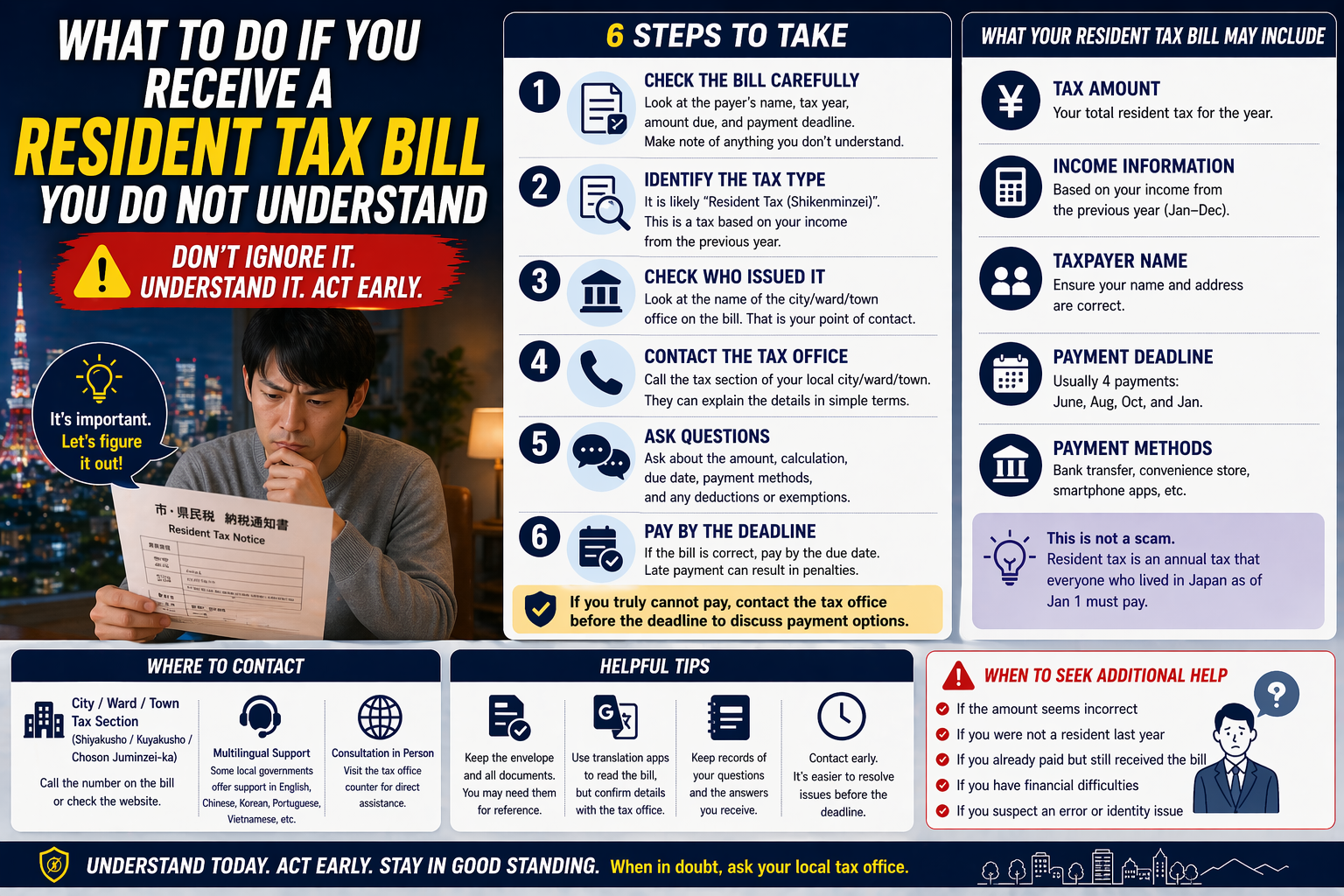
What to Do If You Receive a Resident Tax Bill You Do Not Understand
If a resident tax bill in Japan does not make sense to you, do not ignore it and do not assume it is a mistake. First, check three basics: which city or ward sent it, which income year it is based on, and whether it is a self-payment bill or payroll deduction notice. Then contact the municipal tax section before the payment deadline if anything still looks wrong.
This matters most for foreign workers, students with part-time income, freelancers, and anyone who changed jobs, moved, or plans to leave Japan. Resident tax often surprises people because it is usually based on the previous year’s income, not your current monthly cash flow.
- Resident tax is usually charged by the municipality where you were registered on January 1.
- A bill arriving in 2026 is generally based on your 2025 income.
- Employees often pay through salary deduction, but freelancers, job changers, and some part-time workers may receive payment slips directly.
- If you do nothing after a wrong assumption, you can still miss the deadline and face late charges.
ここがポイント: A confusing bill is usually not solved by waiting. Check the tax year, your January 1 municipality, and the payment method first. If one of those is wrong, the city office is the place to fix it.
Start with the three checks that solve most cases
A resident tax bill becomes easier to read once you stop treating it as one big number.
1. Check which municipality sent it
Resident tax is tied to the municipality where you were registered on January 1 of that tax year. That means you may receive a bill from a city where you no longer live.
This is one of the most common reasons people think the bill is wrong.
For example:
- You lived in Shinjuku on January 1, then moved to Yokohama in March.
- Your resident tax for that year can still be billed by Shinjuku.
- Moving later does not usually move that year’s bill to your new address.
2. Check which income year the bill uses
Resident tax is not the same as national income tax withheld from your salary each month. It is a local tax based on the income you earned in the previous calendar year.
So if your income was higher last year than it is now, the bill can still be high even if your current job pays less or you are unemployed now.
3. Check whether it is ordinary collection or special collection
There are two common payment patterns:
Special collection: your employer deducts resident tax from your salary, usually from June to the following May.Ordinary collection: the municipality sends you a notice and payment slips, often in four installments.
If you changed jobs, left a company, or your employer did not continue payroll deduction, you may suddenly receive direct payment slips even though you were used to seeing resident tax only on payslips.
What the bill is usually telling you
Once you know the municipality, year, and collection method, read the documents in this order.
Tax amount notice
This shows the annual tax amount and how the municipality calculated it from the previous year’s income and deductions.
If the amount feels too high, compare it with:
- your previous year’s payslips or annual withholding slip
- your final tax return, if you filed one
- changes to dependents, spouse status, social insurance, or other deductions
If one of those items is missing, the bill may still be explainable, but you need the city office to tell you which data they used.
Payment slips and deadlines
If you received payment slips, you are probably in ordinary collection. Many municipalities split the annual amount into four payments. The exact due dates vary by municipality, but June, August, October, and January are common.
Do not focus only on the total. Check whether one slip is already close to its deadline.
Past-year balance or separate notice
If you changed jobs or left a company, a separate notice may include unpaid resident tax from an earlier payroll-deduction period. That can make the envelope look larger than expected.
When the amount may be correct even if it feels wrong
Several situations confuse foreign residents because the timing feels unfair, even when the bill itself is normal.
- You started working in Japan last year and this is your first full resident tax bill.
- You moved after January 1 and expected the new city to handle everything.
- You left a job and payroll deduction stopped partway through the year.
- You had side income, freelance income, or overseas-related income that changed your tax base.
- You thought low current income meant low resident tax, even though the bill is based on the previous year.
As of April 2026, municipalities also continue to use updated payment systems in many areas, including eL-QR-based payment for eligible slips. That makes payment easier, but it does not mean every bill can be paid in every app or by every online method.
What to do if you think the bill is wrong
If the bill still looks wrong after the first checks, act before the deadline.
Contact the municipal tax section directly
Ask the city or ward tax section to explain:
- which year of income they used
- whether your employer reported salary correctly
- whether your tax return or year-end adjustment was reflected
- whether your dependents or deductions were counted
- whether the bill includes a prior-year unpaid amount
Bring or prepare:
- the tax notice or payment slip
- your residence card
- My Number documents if requested
- your previous year’s withholding slip (
gensen choshuhyo) - a copy of your final tax return, if you filed one
- recent payslips if you changed employers
If you need language help, check whether your municipality has English, easy Japanese, or multilingual tax guides. Nagoya City, for example, publishes multilingual explanations for both the resident tax notice and the payment slip.
If you started a new job, ask about switching back to payroll deduction
Some municipalities allow a switch from direct payment to salary deduction, but timing matters. Inagi City’s guidance says the company must submit the application and the switch cannot be done after the payment deadline.
So if your main problem is not the tax amount but the payment method, talk to your payroll department immediately.
What to do if the amount may be correct but you cannot pay smoothly
Do not wait until you miss the deadline.
Depending on the municipality and the type of slip, payment options may include:
- convenience stores
- banks or post offices
- direct debit
- online payment through the local tax payment site
- smartphone payment apps for eligible slips with barcodes or eL-QR
There are limits.
- Some online or app methods work only if the slip has eL-QR.
- Some methods do not issue a paper receipt.
- Back taxes or some collection types may not be eligible for direct debit or the same online methods.
If you are in financial difficulty because of illness, disaster, or another serious reason, contact the municipality early. Some cities explicitly tell residents to consult the tax office as soon as possible rather than simply miss the payment.
Special cases foreigners often miss
A few situations create extra trouble if you do not plan ahead.
You are leaving Japan
If you leave Japan before or during the payment period, resident tax does not automatically disappear. Municipalities commonly require you to either pay before departure or appoint a tax representative or tax manager in Japan.
This matters if you:
- received the bill already
- expect the bill to arrive after you leave
- still need tax certificates later for visa, school, childcare, or housing paperwork
You need proof for another procedure
A resident tax notice is not always the same as a tax certificate. If an employer, school, daycare, or immigration-related procedure asks for proof, you may need a separate taxation or tax payment certificate from the municipality.
Common mistakes to avoid
These mistakes cause more problems than the bill itself.
- Throwing the notice away because you think your employer handles everything
- Assuming a different city should bill you because you moved after January 1
- Confusing national income tax with local resident tax
- Waiting for the next month’s salary to “fix” the amount automatically
- Trying to switch to payroll deduction after the payment deadline
- Leaving Japan without arranging payment or a representative
A simple rule for 2026 bills
If you received a resident tax bill in 2026, start from this assumption: it is probably based on your 2025 income and the municipality where you were registered on January 1, 2026. That one sentence explains a large share of the confusion.
If the bill still does not match your records, the next move is practical, not theoretical: call or visit the tax section that issued it, bring the notice and your income documents, and ask them to explain the calculation line by line before the deadline passes.
参照リンク
- Minato City Living Guide: Resident Tax
- Shinjuku City: Resident’s Tax
- Chuo City: Taxes
- Inagi City FAQ: Switching to payroll deduction after receiving a resident tax notice
- Inagi City: Methods of Payment for Municipal Tax
- Tokyo Metropolitan Government Bureau of Taxation: Procedures for Metropolitan Tax Payment
- Nagoya City: Details about Municipal and Prefectural Residents Tax in multiple languages
- Nagoya City: Details about Municipal and Prefectural Residents Tax payment slips in multiple languages
- Machida City: Forest Environment Tax and the resident tax flat amount from FY2024
- Hikone City: Resident Tax (Municipal and Prefectural)
- Local Tax Payment Site (eLTAX): Payment methods for slips with eL-QR or eL number