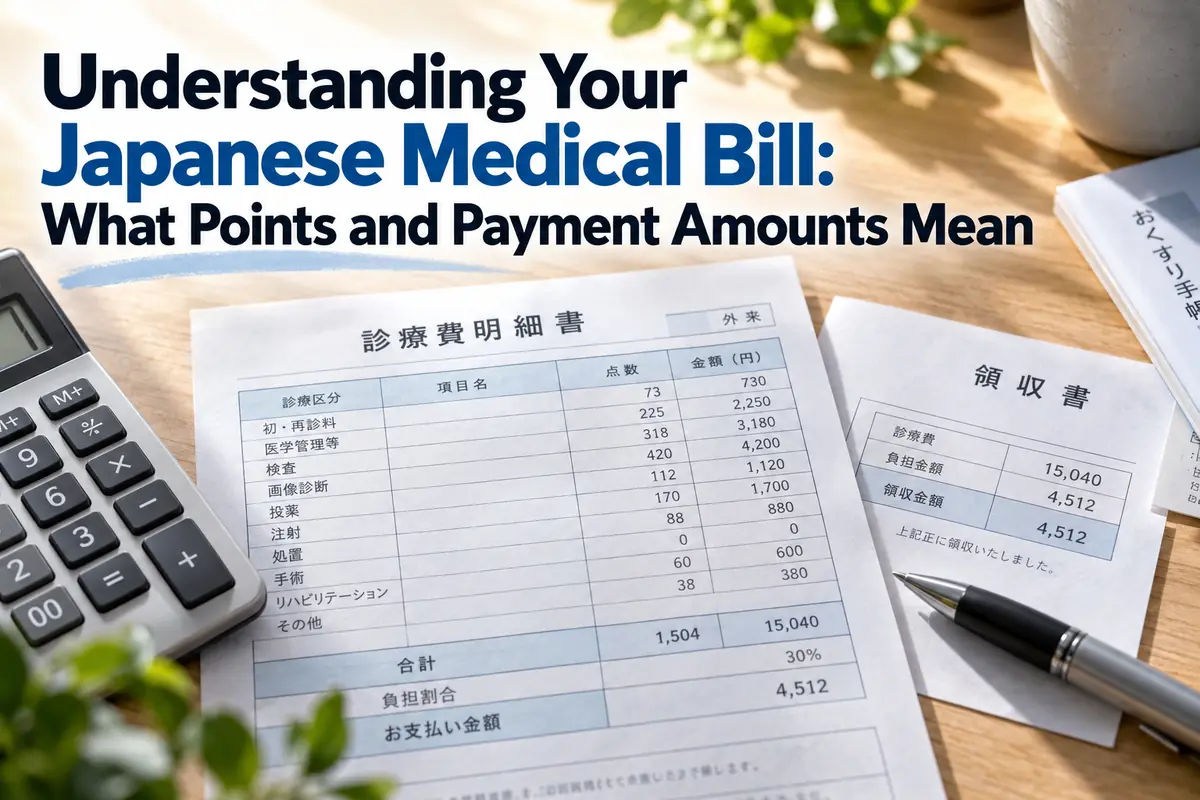
Understanding Your Japanese Medical Bill: What Points and Payment Amounts Mean
For care covered by Japanese public health insurance, one medical billing point equals ¥10. Multiply the total points by 10 to find the covered cost before insurance, then apply your copayment percentage. A typical insured adult under 70 pays 30% of that amount, plus any separately charged costs outside the ordinary insurance calculation.
The two papers you receive serve different purposes: the receipt shows what you paid, while the itemized statement explains which billable services made up the charge. Reading them together is the quickest way to check an unfamiliar bill.
This guide is for foreign residents, students, workers, and families using Japanese public health insurance. It also explains why visitors without that coverage cannot assume the same calculation applies.
- Find the total points and your copayment percentage first.
- Separate insurance-covered charges from amounts already listed in yen.
- Use the itemized statement to check individual services and medicines.
- Ask the billing desk about specific entries; ask your insurer about coverage and copayment eligibility.
Information checked on October 8, 2026. Document layouts vary by provider.
First, identify which document you are holding
A receipt proves payment; an itemized statement explains the billing calculation.
Look for these Japanese headings:
- 領収書/領収証 — ryōshūsho / ryōshūshō: receipt. Usually shows category totals, insurance-related amounts, separate charges, and the payment total.
- 診療明細書 — shinryō meisai-sho: itemized medical statement. Lists individual billing entries, points, and quantities or counts.
- 調剤明細書 — chōzai meisai-sho: itemized pharmacy statement. Explains dispensing-related charges and medicines.
The Ministry of Health, Labour and Welfare requires itemized statements to identify individual medical or dispensing fee entries, including relevant medicine and material names. A provider may combine this detail with the receipt, so you do not necessarily receive two separate sheets. Rules generally require free itemized statements at providers subject to the requirement, with specified exceptions; patients can also decline them. MHLW guidance on receipts and itemized statements
If you only have a category summary, ask:
診療明細書もいただけますか。
Shinryō meisai-sho mo itadakemasu ka?
Could I also have the itemized medical statement?
An itemized statement explains charges. It does not replace a doctor’s explanation of your diagnosis, test results, or treatment plan.
Calculate the insured portion before checking the final total
The basic calculation is total points × ¥10 × your copayment percentage.
Japan’s national fee rules set the ¥10 unit for covered medical, dental, and pharmacy care. It represents the full covered fee before the insurer pays its share. Official medical fee calculation rules
A simple worked example
Suppose a receipt shows 1,000 total points, and your copayment is 30%:
- 1,000 points × ¥10 = ¥10,000 in covered medical fees.
- ¥10,000 × 30% = ¥3,000 payable by you for that covered portion.
- Add any separately billed amounts outside this calculation.
For illustration, if the receipt also includes a hypothetical ¥2,000 non-covered charge, the total payment becomes ¥5,000. That ¥2,000 is an example, not a standard provider fee.
At a 20% copayment, the same 1,000 points would produce a ¥2,000 covered-care payment. At 10%, it would be ¥1,000, before other adjustments.
Why your calculator may differ by a few yen
Ordinary counter copayments are rounded to the nearest ¥10. For example, 1,001 points × ¥10 × 30% produces ¥3,003 before rounding, or ¥3,000 after rounding.
The Japan Health Insurance Association also explains that its later medical-expense notice can differ from the receipt because of rounding, public subsidies, or high-cost benefit reimbursements. A small difference does not automatically indicate a billing error. Association FAQ on medical-expense notices
Avoid rounding each line yourself. Start with the provider’s total covered points and ask how the final patient payment was calculated.
Check the percentage that applies to you
Thirty percent is common for working-age adults, but it is not everyone’s rate.
The main public-insurance copayment categories are:
- Before compulsory school age: generally 20%.
- From compulsory school age through age 69: generally 30%.
- Ages 70–74: generally 20%, or 30% for people in the higher-income category.
- Age 75 and over: generally 10%, 20%, or 30%, depending on income and the applicable elderly healthcare rules.
MHLW directs patients with questions about their percentage or payment-limit category to their insurer. For municipal National Health Insurance, that means the relevant city or ward insurance counter. MHLW copayment information and consultation contacts
Look for 負担割合 — futan wariai, meaning copayment percentage. A document may show 3割, 2割, or 1割: 30%, 20%, or 10%.
Families: a child’s actual payment may be lower
Local child medical-expense assistance can reduce what a family pays beyond the national insurance calculation. Eligibility and procedures depend on the municipality.
Bring the applicable subsidy certificate unless your municipality and the provider support its digital verification. MHLW specifically notes that families must continue carrying the certificate where either side does not support integration with My Number insurance verification. MHLW insurance-card FAQ
A small or zero payment therefore does not mean the treatment had no billed cost. Insurance and local assistance may have paid different portions.
Match the category totals to the treatment details
Category names show where the charge belongs; the itemized entries explain what was billed within that category.
Common labels include:
- 初・再診料 — sho-saishinryō: initial or repeat consultation fees.
- 医学管理等 — igaku kanri tō: medical management and related services.
- 検査 — kensa: laboratory and other tests.
- 画像診断 — gazō shindan: diagnostic imaging.
- 投薬 — tōyaku: medication-related charges.
- 注射 — chūsha: injections.
- 処置 — shochi: procedures.
- 手術 — shujutsu: surgery.
- 合計点数 — gōkei tensū: total points.
Osaka Prefecture publishes a medical-receipt guide explaining these categories and advises patients to ask the provider about the points actually charged. The labels are useful beyond Osaka, although receipt layouts differ. Osaka Prefecture’s medical-receipt guide
Check counts as well as names
On an itemized statement, look for 回数 — kaisū, meaning number of times, and 数量 — sūryō, meaning quantity.
A printed point figure may be a unit amount or an already calculated subtotal. Check the column headings before multiplying anything; otherwise you may count a charge twice.
Terms containing 加算 — kasan mean an additional fee under the billing rules. Such a line deserves an explanation if you do not recognize it, but its presence alone does not establish an error. Fee entries can reflect eligible management services or other billing conditions as well as a physical procedure.
For a specific entry, ask:
この項目は何の費用ですか。
Kono kōmoku wa nan no hiyō desu ka?
What is this charge for?
Point to the exact line. This gives the billing staff a much clearer question than asking why the whole bill is expensive.
Separate non-covered charges from the points calculation
Amounts outside ordinary insurance coverage can increase your payment without changing the covered point total.
Look for 保険外 — hoken-gai, meaning outside insurance coverage, or 自費 — jihi, meaning self-paid. Check whether the amount is already expressed in yen before doing any arithmetic.
Japan also has arrangements that allow certain separately paid services alongside covered care. MHLW lists examples such as additional room charges and specified patient-selected services under 選定療養 — sentei ryōyō. These amounts require separate checking rather than a blanket 30% calculation. MHLW explanation of combined insured and non-insured care
Why the pharmacy gives you another bill
An outside pharmacy bills separately for dispensing the prescription. Its total can include medicine charges and dispensing-related services, calculated under the pharmacy fee schedule.
Keep both sets of documents. Comparing a clinic receipt with a pharmacy receipt as though they were the same bill can make legitimate separate charges look duplicated.
Visitors without Japanese public insurance
The ¥10-per-point rule described here concerns covered care under Japanese public insurance. It does not guarantee the price charged to an uninsured visitor.
MHLW research on foreign patients without Japanese insurance eligibility documents providers using different per-point prices. Those historical findings establish that pricing varies; they should not be used as a current quotation. Ask the provider for its self-pay pricing and ask your travel insurer which documents it requires. MHLW survey of uninsured foreign-patient billing
A large bill needs a payment-limit check
For expensive covered treatment, your ordinary percentage may not be the final amount you bear.
The 高額療養費制度 — kōgaku ryōyōhi seido, or high-cost medical expense benefit system, limits eligible patient spending according to factors including age and income. A limit may affect the counter payment, or a later benefit payment may reduce the eventual burden.
MHLW’s current guidance includes changes effective from August 2026, with a further stage scheduled for August 2027. Older English guides may therefore contain limits that no longer apply. Use the official information for your treatment month and have your insurer confirm your category. MHLW high-cost medical expense guidance
Before planned expensive care, ask:
- Can the applicable limit be used at the counter?
- Do I need an application or additional eligibility information?
- Which separately charged expenses remain payable?
- Will payments to other providers require a later claim?
Keep receipts even when a limit has already been applied. They help you and the insurer distinguish the initial payment from any subsequent adjustment.
Prepare the right insurance documents before your next visit
Current eligibility documents help the provider apply the correct insurance billing from the start.
As of October 2026, MHLW instructs patients to present either a My Number Card registered for health-insurance use or a valid 資格確認書 — shikaku kakunin-sho, an insurance eligibility certificate. Traditional health insurance cards expired by December 1, 2025; the temporary handling arrangement for people who mistakenly brought an expired card ended July 31, 2026. MHLW’s current eligibility-verification guidance
People without a registered My Number insurance card are generally issued an eligibility certificate without an application under the current arrangements. Its form and expiry date depend on the insurer. MHLW eligibility-certificate guidance
If verification fails, tell reception that you are insured and ask about the alternative verification process. MHLW describes alternatives, including presenting the My Number Card together with the insurance-eligibility screen or downloaded PDF from Mynaportal. Do not assume that a failed card-reader check means you have lost coverage.
If the bill looks wrong, ask about one discrepancy at a time
The most useful first step is to identify whether the issue concerns a service, a percentage, or a separate charge.
Before leaving, check:
- Identity and date: Does the receipt belong to you and the correct visit?
- Copayment: Is the percentage consistent with your eligibility?
- Calculation: Do total points × ¥10 × your percentage broadly match the covered payment?
- Separate amounts: Are non-covered charges identified and explained?
- Payment: Does the receipt’s paid amount match what you actually paid?
Common mistakes are treating points as yen, applying 30% to every charge, multiplying a subtotal again, and assuming the itemized statement proves a second payment was collected.
Take service-entry questions to the provider’s billing desk. Take eligibility, copayment-category, and benefit questions to your insurer. Keep the receipt and itemized statement together, and ask for a corrected document if the provider confirms an error.
The most practical question is specific: “This line shows this number of points—what service does it cover?” Once that is clear, you can check whether the amount belongs in the covered calculation or should be handled separately.
参照リンク
- MHLW: Receipts and itemized medical statements
- MHLW: Official medical fee calculation rules
- Japan Health Insurance Association: Medical-expense notice FAQ
- MHLW: Copayment percentages and consultation contacts
- MHLW: My Number insurance-card FAQ
- Osaka Prefecture: Reading a medical receipt
- MHLW: Combined insured and non-insured care
- MHLW: Survey of uninsured foreign-patient billing
- MHLW: High-cost medical expense benefits
- MHLW: Current insurance eligibility verification
- MHLW: Insurance eligibility certificates