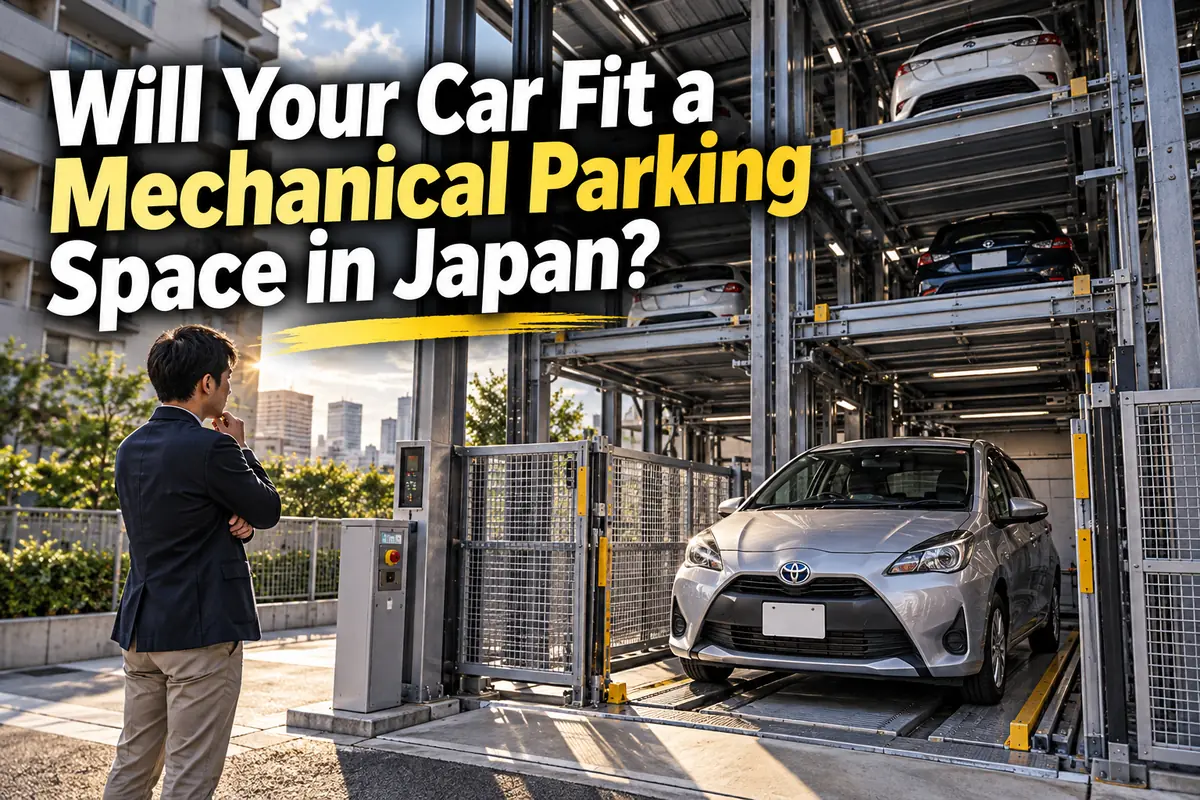
Will Your Car Fit a Mechanical Parking Space in Japan?
Your car must meet every limit for the specific parking space: length, width, height, weight, and any additional clearance requirements. A car that fits through the entrance can still be unsuitable for the machinery inside. Before signing a parking contract or buying a replacement car, ask the operator to confirm compatibility with your exact vehicle.
Mechanical parking also requires a different safety routine. Everyone must be out of the car and outside the machinery area before it moves. Never assume that sensors will detect a passenger, child, or person returning for a forgotten bag.
This guide is for foreign residents choosing apartment parking, families using a shared system, and drivers encountering mechanical parking at hotels or other facilities.
- Check the limits for your assigned space, not just the building’s entrance.
- Confirm accessories, tire dimensions, and ground clearance as well as basic vehicle size.
- Get a demonstration before operating a residential system yourself.
- Check retrieval hours and breakdown arrangements before relying on the space for daily travel.
What mechanical parking actually does
Mechanical parking moves your car into storage using powered platforms, lifts, or other machinery.
The Japanese term is 機械式駐車場 — kikai-shiki chūshajō, meaning mechanical parking. It differs from a parking building where you drive up ramps and leave the car in an ordinary marked bay.
The Ministry of Land, Infrastructure, Transport and Tourism (MLIT) describes several types:
- Two-level or multi-level systems: Cars sit on platforms that move to make a selected space accessible.
- Vertical circulation systems: Platforms circulate vertically to bring a car to the entrance.
- Elevator systems: A lift transfers the car between an entrance area and storage spaces.
These systems use limited land efficiently, including at apartment buildings. The practical trade-off is that getting your car back involves machinery rather than simply walking to it. The operating procedure depends on the installed equipment. MLIT’s illustrated handbook explains the main system types.
Check every limit before agreeing to a space
A vehicle is compatible only when it satisfies the complete specification for that space.
Start with the manufacturer’s specifications for your exact model and trim. Have your vehicle inspection certificate, 車検証 — shakenshō, available too. Ask the parking manager which documents and weight figures they require; do not assume that one vehicle-weight entry answers every equipment requirement.
Read the Japanese labels
These terms help you match a sign or contract to your car’s specifications:
- 全長 — zenchō: Overall length.
- 全幅 — zenpuku: Overall width.
- 全高 — zenkō: Overall height.
- 重量 — jūryō / 車重 — shajū: Weight / vehicle weight.
- 最低地上高 — saitei chijōkō: Minimum ground clearance.
- タイヤ外幅 — taiya sotohaba: Width across the outside edges of the tires.
Pay attention to units. A height limit of 1,550 mm means 1.55 m. A clearance requirement of 110 mm means 11 cm—and it is a minimum, while the main vehicle dimensions are usually maximums.
A real specification shows why height alone is insufficient
One N1 configuration in IHI Transport Machinery’s elevator-parking specification lists:
- Maximum length: 5,000 mm.
- Maximum width: 1,850 mm.
- Maximum height: 1,550 mm.
- Maximum vehicle weight: 1,900 kg.
- Maximum tire outer width: 1,830 mm.
- Minimum ground clearance: 110 mm.
These are product-specific figures, not a nationwide standard. The same document lists other configurations with different capacities.
For example, a hypothetical car measuring 4,700 mm long, 1,800 mm wide, and 1,600 mm high would fail the listed 1,550 mm height limit even though its length and width fit. Passing five checks does not cancel a failure on the sixth.
Accessories and modifications need a separate check
Tell the manager about anything that changes the car’s shape or clearance:
- Roof racks, roof boxes, and other roof-mounted equipment.
- Rear-mounted accessories or spare wheels.
- Lowered suspension, body kits, and low-hanging parts.
- Different wheels or tires.
Ask whether mirrors must be folded and how the facility measures width. Do not assume that folding mirrors makes an otherwise incompatible car acceptable.
“It is a small car” is not a compatibility check. Nor does “SUV spaces available” confirm that your assigned platform accepts your particular vehicle. Obtain approval for the exact model, equipment, and space.
Before renting an apartment space or changing cars
Confirm the car and the assigned platform together before committing money.
A parking agreement can be separate from an apartment lease. Ask the landlord, agent, or management company for the parking conditions rather than relying on a property advertisement saying that parking is available.
Bring enough information for a clear answer
Prepare:
- The exact vehicle model, year, and trim.
- Manufacturer specifications and, if available, the inspection certificate.
- Details of accessories or modifications.
- The assigned space number and its written limits.
A useful question is:
この車は、この区画に入庫できますか?
Kono kuruma wa, kono kukaku ni nyūko dekimasu ka?
“Can this car be parked in this specific space?”
Ask for written confirmation where possible. If the manager requires a supervised fit check, arrange it before finalizing the parking agreement or car purchase. A test should follow the manager’s procedure; it is not permission to try an uncertain vehicle yourself.
Check the cost of depending on the system
There is no single nationwide mechanical-parking fee. Obtain a quote for the actual space and clarify:
- Monthly rent and any deposit or initial charges.
- Charges for keys, access cards, or replacements.
- Whether a larger or taller space has a different fee.
- Cancellation notice and any vehicle-change procedure.
- What happens during maintenance or a breakdown, including whether alternative parking is provided and who pays.
The most consequential cost may be an unsuitable space. If your replacement car cannot use it, you may need a different contract or another parking location. Resolve compatibility before ordering the car.
Learn the operating sequence before using it alone
Use the instructions for the installed machine, because controls and entry procedures differ.
For a residential system, request a demonstration that covers both storing and retrieving the car. If the instructions are only in Japanese, ask the manager to explain the controls and emergency procedure before your first solo use.
Useful labels include:
- 入庫 — nyūko: Put the car into storage.
- 出庫 — shukko: Retrieve the car.
- 非常停止 — hijō teishi: Emergency stop.
- 運転中 — unten-chū: Operating.
- 使用禁止 — shiyō kinshi: Do not use.
Enter only when the equipment is ready
Wait until the machine has completed its movement and the facility indicates that entry is permitted. Follow the attendant or posted instructions for direction, alignment, stopping position, mirrors, and securing the car.
If you cannot understand a signal or position marker, stop and ask. Do not guess while driving onto a narrow platform.
Complete the passenger and belongings check
Remove belongings before the storage operation begins. Check every seat, including the rear seats, and confirm that all passengers are outside the machinery area.
MLIT’s user guidance emphasizes following operating instructions, checking that nobody remains inside, and watching the equipment during operation. Keep children away from the operating area and controls. Do not let another person wander back in while you operate the system.
Operate only after the area is clear
Use the designated controls from the required position. If a button must be held, do not wedge or tape it down. Keep watching the machinery so you can respond to danger.
Key point: Before the machine moves, confirm that nobody is in the car or machinery area. Sensors support this check; they do not replace it.
Never re-enter to collect a forgotten item once operation has begun. Stop using the system and ask the manager how to regain access safely.
Safety features do not remove the need for checks
Automatic operation can still be dangerous when someone remains inside or approaches moving equipment.
The Consumer Affairs Agency has investigated accidents involving both multi-level and elevator-type mechanical parking. Its investigation page includes reports and follow-up recommendations. These matter to residents because familiar, everyday use can still involve serious machinery hazards.
MLIT also publishes a short safety warning for users and managers. Its practical message includes keeping people clear, checking before operation, and avoiding improvised operation.
For families, decide where passengers will wait before parking. If you are the only adult with a young child, ask the manager to demonstrate a procedure that lets you supervise the child while completing the required checks. If the layout makes that impossible, discuss another space or parking arrangement.
For anyone needing assistance getting in or out of a car, ask about the actual boarding area, door-opening room, and available help. Vehicle compatibility alone does not establish that the facility meets your access needs.
Check retrieval hours and breakdown arrangements
A stored car is useful only if you can retrieve it when you need it.
Before relying on mechanical parking for work, school runs, or appointments, ask:
- Can residents retrieve cars at all hours?
- Is an attendant required, and when are they available?
- Can scheduled maintenance temporarily prevent retrieval?
- Who answers an out-of-hours fault call?
- What is the arrangement during a power failure or equipment outage?
These are facility questions, not rules that change uniformly by prefecture. Two buildings on the same street may have different equipment, contracts, and staffing.
If an alarm sounds, the machine stops unexpectedly, or something appears damaged, keep clear and contact the posted support number. Do not enter a pit, climb onto equipment, force a gate, or repeatedly restart the machine.
If someone is in immediate danger, use the emergency stop if it is safely accessible, alert staff, and call 119 for fire or ambulance assistance. Do not attempt a rescue inside moving machinery.
Common mistakes—and the better check
Most avoidable problems begin with an assumption about the car or the machine.
- Checking only height: Compare every listed limit, including weight, tire outer width, and clearance.
- Using specifications for a similar trim: Confirm the exact vehicle you will park.
- Assuming an accessory is harmless: Disclose anything that changes dimensions or clearance.
- Assuming all spaces accept the same cars: Check your assigned platform.
- Letting a passenger wait inside: Complete the passenger check before operation.
- Copying another resident’s shortcuts: Follow the equipment instructions and manager’s demonstration.
- Changing cars without contacting management: Get the new vehicle approved before using the space.
Current guidance and your next check
The sources checked on October 8, 2026 support equipment-specific limits and a clear-persons-before-operation safety routine; they do not establish one universal vehicle-size allowance.
MLIT’s safety page currently links its October 2014 revised guidelines and September 2016 handbook. These dates describe the published guidance, not a new rule introduced in 2026. The guidance also distinguishes parking facilities covered by the Parking Lot Act from private residential facilities, for which following the guidelines is recommended.
For your next apartment viewing or car purchase, obtain three things: the assigned space’s full specification, confirmation for your exact car, and an operating demonstration. Then save the fault contact number before your first use. Those checks answer both questions that matter: whether the car can be stored and whether you can use the system safely.
参照リンク
- MLIT: Mechanical parking safety measures
- MLIT: Mechanical parking safety handbook, September 2016
- IHI Transport Machinery: Elevator parking specifications
- MLIT: Safety handbook—user responsibilities
- Consumer Affairs Agency: Mechanical parking accident investigations
- MLIT and Consumer Affairs Agency: Mechanical parking safety warning