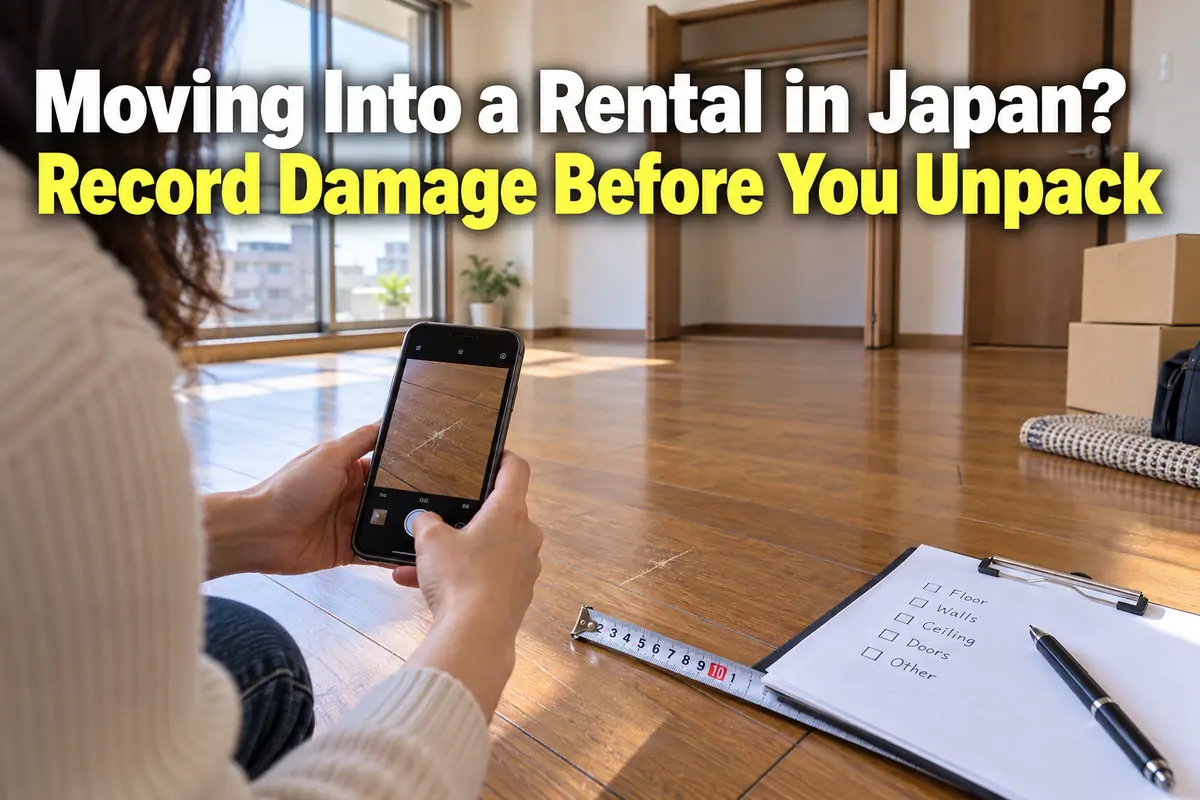
Moving Into a Rental in Japan? Record Damage Before You Unpack
Photograph existing damage, write down where it is, and send the record to your landlord or property manager as soon as you move in. Keep the original files and a copy of the message. Photos help show the condition of the apartment; the written report helps establish when you raised the issue.
This is useful for students, workers, and families renting in Japan, especially before furniture hides floors and walls. It can help you challenge charges for damage that was already there. It does not guarantee a full deposit refund or remove cleaning fees agreed in your contract.
Here is what to focus on:
- Record the empty apartment before unpacking or cleaning away evidence.
- Pair room-wide photos with close-ups and a written damage list.
- Submit the landlord’s condition form and keep proof of submission.
- Separate existing damage from repair requests and contractual cleaning charges.
The National Consumer Affairs Center of Japan has documented disputes involving old floor scratches and faulty equipment that tenants said existed before arrival. Its advice is to check and record the property’s condition when moving in. Read the consumer advisory.
Your deposit depends on more than whether the room looks clean
A condition record answers “Was this already here?”; your contract and the rules on tenant responsibility answer “Who pays?”
These Japanese terms help you find the relevant paperwork:
- 敷金 — shikikin: the security deposit.
- 原状回復 — genjō kaifuku: restoration obligations when returning the property.
- 特約 — tokuyaku: special contractual provisions.
- 入居時チェックリスト — nyūkyoji chekku risuto: a move-in checklist; the document’s exact title varies.
The Ministry of Land, Infrastructure, Transport and Tourism, or MLIT, distinguishes normal wear and aging from damage caused by careless use or other tenant responsibility. Restoration does not simply mean making an old apartment new again. Its English leaflet also explains that contractual provisions may assign housecleaning or air-conditioner cleaning costs to tenants. See MLIT’s English restoration guide.
That distinction matters when reviewing a deduction. A photograph of an old stain may help dispute a damage charge, while a separate cleaning charge needs to be checked against the contract.
ここがポイント: Record what existed at handover, but also check which costs you agreed to pay. Those are two different questions.
Ask about charges before treating the deposit as refundable cash
Find the clauses covering cleaning, restoration, and any fixed deduction. Ask for an explanation of unclear wording and keep it with the lease.
Do not assume that every clause is automatically enforceable—or that every unfavorable clause can be ignored. MLIT’s Q&A discusses limits on contractual provisions and the circumstances affecting cleaning clauses. Individual disputes need advice based on the actual agreement. MLIT’s restoration Q&A is a useful starting point.
A zero-deposit apartment still needs a condition record. Having no deposit to deduct from does not prevent a later claim for repair costs.
Inspect before furniture covers the evidence
The best practical starting point is the empty apartment, with the move-in form and your phone ready.
Ask the manager how to submit the checklist and what deadline applies. Do not assume every company allows the same number of days. If the utilities are not connected or an appliance cannot be tested, write “not tested” and arrange a follow-up rather than marking it as working.
MLIT provides multilingual rental materials, including an example condition checklist, on its support page for foreign tenants. You can use it to organize your own record if the manager has not supplied a form.
Floors, walls, and doors
Work through one room at a time. Check:
- Flooring scratches, dents, lifted edges, and discoloration.
- Wallpaper stains, tears, peeling seams, and existing holes.
- Tatami stains, fraying, or damaged edges.
- Door surfaces, handles, frames, and sliding tracks.
- Closet interiors and shelves, including places easily hidden by belongings.
Describe the location precisely. “Floor scratched” is difficult to match later. “Bedroom floor, beside the closet entrance, two parallel scratches” is more useful.
Kitchen, bathroom, and windows
Record visible chips, stains, mold, damaged seals, and signs of water leakage. Check beneath the sink without dismantling anything.
Where safe and permitted, test taps, drainage, doors, and windows. Note leaks, unusual operation, and parts that do not close properly. An odor needs a written description because a photograph cannot capture it.
If you find an active leak or another urgent problem, contact the manager immediately. Collecting evidence should not delay action needed to prevent further damage.
Equipment supplied with the apartment
Check the equipment listed in the lease or inventory. For each item, record whether it is present and whether you could test it.
A useful entry might read: “Air conditioner in bedroom: powers on, but cooling not confirmed.” That is more accurate than either “broken” or “working” when you have not completed a proper check.
Also record the keys and supplied remote controls you received. Keep the handover list with your inspection record.
Take photographs that someone else can understand
A useful photo set shows both the defect and its location.
For each issue, use this sequence:
- Room view: shows which room and wall or floor area you mean.
- Location view: includes a recognizable feature, such as a doorway or cabinet.
- Close-up: shows the scratch, stain, chip, or other defect clearly.
A ruler placed beside a mark can help show its size. Avoid attaching tape or labels to delicate surfaces.
For moving parts, a short video can supplement photographs. For example, it can show a sliding door sticking during normal operation. Do not force equipment or attempt repairs just to demonstrate a problem.
Keep originals and make a simple index
As a practical recordkeeping method, create a folder for the property and inspection date. Keep unedited original files, then make separate copies if you need arrows or labels.
Give each issue an identifier:
B01: bedroom floor scratch beside closet.K01: kitchen cabinet door chip.W01: bathroom seal discoloration.
Use the same identifiers in your checklist and message. Back up the folder somewhere you can access after changing phones or leaving Japan.
A timestamp is helpful context, but do not rely on it alone. Keep the submission message, uploaded files, and any reply together.
Send the record and ask for acknowledgment
A private photo collection is more useful when paired with a written report to the responsible manager.
Use the channel specified in your move-in instructions: a portal, email, app, or paper form. If you hand over the only paper original, retain a scan or photograph first.
You can adapt this message:
Subject: Move-in condition report — [building and room number]
I inspected the apartment on [date], after receiving the keys. Attached are the condition checklist and photographs of the issues found at handover.
Please confirm receipt and keep these documents with the property record. Item [identifier] also needs attention because [brief description]. Please advise how it will be handled.
Items marked “not tested” could not be checked because [reason]. I will send a follow-up after testing them.
Ask the manager to distinguish acknowledgment of existing damage from a promise to repair it. “Received” does not necessarily mean a repair has been scheduled.
If the discussion happens by telephone, follow up with a short written recap. Keep both your report and the response.
Keep reporting problems during the tenancy
An arrival record does not replace your responsibility to report later faults and care for the apartment.
For example, recording mold on arrival establishes its initial condition. It does not make it safe to ignore spreading mold or moisture. MLIT’s English guide warns that allowing stains or mold to expand can affect the tenant’s responsibility for costs; it recommends regular cleaning and ventilation.
When a problem changes, add a dated update and contact the manager. Ask before arranging repairs yourself. Preserve repair instructions and completion messages so the final record shows what happened after arrival, too.
Use the same record when you move out
The arrival photos become most useful when you can compare them with the same locations at departure.
Photograph the empty apartment again after removing belongings and cleaning. Bring the original checklist to the inspection and point out disputed items by identifier.
Before signing a document, check whether it records visible condition or also accepts charges. If you disagree, ask for the disagreement to be recorded and retain a copy. MLIT’s Q&A explains that the wording and circumstances of a signed inspection document matter.
For a disputed deduction, request:
- The location and description of the alleged damage.
- The repair scope, quantity, and price.
- The reason the cost is assigned to you.
- The relevant contract provision and how age or wear was considered.
Avoid relying on a blanket claim such as “old wallpaper is always free.” Different materials and repair items can be treated differently, and the cause of damage still matters.
Check your manager’s procedure, wherever you rent
The national guidance provides a common reference, but forms, submission methods, contract terms, and consultation services vary.
This guide is for ordinary residential rentals. University dormitories, employer housing, serviced apartments, and short stays may use different inspection and settlement procedures. Ask the housing provider which documents apply.
Official sources checked on October 8, 2026 include MLIT’s March 2023 English restoration leaflet and the consumer center’s move-in guidance. Use your current lease and handover instructions to confirm the deadline and contact details for your property.
If a dispute remains unresolved, contact a local consumer affairs center. The consumer center’s advisory identifies 188 as the nationwide number that directs callers to local consultation services. Do not assume English support is available through the telephone service; ask your municipality’s foreign-resident support desk about language assistance.
Before unpacking, complete three tasks: record the condition, submit the report, and save the acknowledgment. At move-out, those records give you something concrete to compare with the bill.