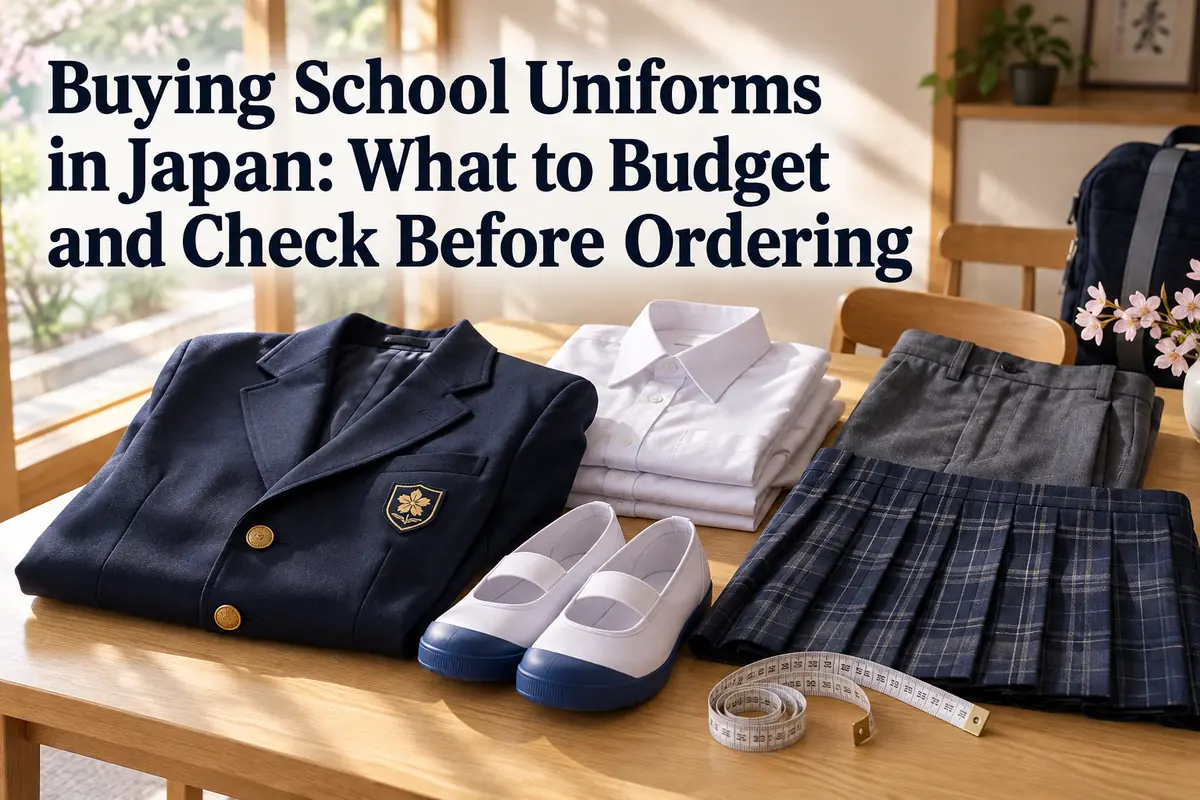
Buying School Uniforms in Japan: What to Budget and Check Before Ordering
There is no single school-uniform price or buying rule across Japan. Your child’s school determines which clothes are acceptable, and its current item list is the best starting point. Budget for more than the jacket: shirts, summer clothing, PE wear, shoes and required accessories can substantially increase the bill.
For a concrete example, Joshibi University of Art and Design’s affiliated junior and senior high school lists a blazer at ¥22,770 and a winter skirt at ¥17,600 in its April 2026 reference prices. Those two items alone total ¥40,370, before a blouse, summer clothing or PE kit. This is one private school’s price list, not a national average.
This guide is for foreign residents preparing for a child’s school entry, moving between schools or replacing clothing after a growth spurt. Information was checked on October 8, 2026; prices and assistance deadlines must be confirmed for your child’s entry year.
- Get the school’s latest required-item list before shopping.
- Compare the same items and quantities across approved sellers.
- Ask about hand-me-downs, uniform banks and financial assistance before paying.
- For April 2027 entry, do not reuse April 2026 order deadlines or voucher dates.
What actually determines the uniform bill?
The useful figure is the cost of everything your child needs to start attending, rather than the advertised price of a “uniform set.”
A seller’s set may cover only a jacket and trousers or skirt. Another package may include shirts, a tie and summer clothing. Comparing the two totals without checking their contents can be misleading.
A published price example
Joshibi’s school fee and uniform page gives these tax-inclusive reference prices as of April 2026:
- Blazer: ¥22,770.
- Winter skirt: ¥17,600; winter slacks: ¥23,100.
- Long-sleeved blouse: ¥4,290.
- Summer skirt: ¥17,050; summer slacks: ¥22,550.
- Short-sleeved blouse: ¥4,180.
- PE short-sleeved top: ¥3,960; PE shorts: ¥3,520.
- Tracksuit jacket: ¥5,610; tracksuit trousers: ¥4,730.
One blazer, winter skirt and long-sleeved blouse therefore total ¥44,660. Choosing winter slacks instead brings those three items to ¥50,160. These calculations are partial shopping examples, not the school’s complete compulsory purchase total.
The difference matters when budgeting: a clothing option may be allowed but cost more. The school also lists some items as optional while requiring the designated product if the student chooses to wear them. “Optional” can mean you may skip the item—not that any substitute is acceptable.
Build your own total in three parts
Ask the school or seller to separate the quotation into:
- Needed for the first school day: the approved outfit and any immediately required shoes, bag or PE items.
- Needed later: summer clothing or other items with a separate purchasing schedule.
- Useful extras: spare shirts, a second pair of trousers, optional knitwear or other replacements.
Then ask whether tax, alterations, name embroidery and delivery are included. Add a separate allowance for future repairs or size changes rather than assuming the initial purchase covers every year of attendance.
A lower initial bill may simply postpone a summer purchase. Conversely, buying every optional item at once can tie up money in clothing your child rarely uses.
Which rules are national, and which belong to the school?
Uniform requirements are school-specific; another school’s clothing list cannot tell you what your child must wear.
Japan’s Ministry of Education, Culture, Sports, Science and Technology—MEXT—explains that tuition and textbooks are free at public elementary and junior high schools, while families pay for school supplies and other expenses. Free public schooling does not mean every item needed for attendance is free. See its English school-entry guide.
For uniforms, Osaka City’s 2026 explanation of school clothing and recycling cites national guidance stating that selection and review ultimately fall within the principal’s authority, after hearing views from parents and other school stakeholders. The city also asks schools to review whether requirements remain reasonable and avoid excessive family costs.
That division explains why nearby schools can have different suppliers, permitted styles and reuse arrangements.
Terms you may see in school documents
- 制服 — seifuku: uniform.
- 標準服 — hyōjunfuku: standard school clothing; confirm exactly when it must be worn.
- 指定品 — shiteihin: a designated item or product.
- 採寸 — saisun: taking measurements or a fitting.
- 体操服 — taisōfuku: PE clothing.
- 上履き — uwabaki: indoor shoes.
- 任意購入 — nin’i kōnyū: optional purchase.
- 就学援助 — shūgaku enjo: schooling expense assistance.
Do not infer permission from the word “standard.” Ask whether the outfit is required daily, for ceremonies or only in specified situations.
Ask about clothing choices before choosing a package
Confirm whether the school permits trousers, skirts, different shirt styles or combinations, and whether those choices have different prices.
Kashiwa City provides a useful local example. Its May 2026 purchasing guidance says all municipal junior high schools offer both their traditional uniforms and the city-standard uniform, allowing students to choose according to preference. That is a Kashiwa arrangement, not a rule applying throughout Japan.
For religious dress, disability-related needs, sensory discomfort or difficulty finding a suitable size, discuss the specific problem with the school before ordering. Ask what alternatives it will accept and request the answer in writing so you can show it to the seller.
How to buy a new uniform without ordering the wrong items
Confirm the school and entry year first, then arrange a fitting using its current purchasing instructions.
A uniform that looks similar may have the wrong fabric, emblem or approved design. This is especially important for transfers and schools changing their uniforms.
Step 1: Obtain the current school list
Ask the school office for the entry information pack, uniform list and seller information. Check:
- Which items are compulsory and which are optional.
- Whether ordinary retail shirts, socks or shoes are acceptable.
- Whether more than one seller supplies approved products.
- The fitting and order deadlines.
- When payment is due and when clothing will be ready.
- Whether summer clothing is ordered separately.
You can ask: “Please mark the items my child must have on the first day.” That is often more useful than asking only for the total uniform price.
Step 2: Compare approved sellers on equal terms
Request a quotation for the same clothing choice, quantities and accessories from each seller you are considering.
For example, Shimoseya Junior High School’s April 2026 entry information lists three uniform sellers. One seller’s fitting deadline was February 11, 2026. This illustrates why families should check individual supplier instructions rather than assume that ordering shortly before the April ceremony is sufficient.
That date has passed and is not an April 2027 deadline.
Compare the service as well as the price:
- Are trouser hems or sleeve adjustments included?
- What happens if the measured size is wrong?
- Can an order be changed before production?
- Are exchanges allowed after embroidery or alterations?
- Can the seller supply individual replacements later?
A modest saving can disappear if alterations or a second delivery cost extra.
Step 3: Prepare for the fitting
Bring your child, the school’s instructions and any order form the school or seller has provided. Have the exact school name, entry year and contact details ready. If you plan to use an assistance voucher, check whether the shop accepts it and when you must present it.
There is no single nationwide document list for buying a uniform. Follow the seller’s requirements rather than assuming that a residence card or another identity document is always necessary.
At the fitting, ask the child to sit, raise their arms and move comfortably. Discuss growth adjustments with the fitter. Buying an excessively large size can make daily wear awkward even if it seems economical.
Before paying, keep a copy or photo of the order showing the items, sizes, total, promised delivery date and alteration terms.
Can you use hand-me-downs or buy secondhand?
Reuse can reduce the cost, but school approval, correct design and available sizes come before price.
Ask the school about sibling hand-me-downs, local exchanges, uniform banks and specialist secondhand shops. Do not rely on a general online listing’s school name alone.
Check the garment before accepting it
Confirm:
- It matches the design accepted for your child’s year group.
- Its emblem, buttons and other school-specific details are correct.
- It fits now and has enough fabric for any planned alterations.
- Zips, seams, hems and lining are usable.
- Old name labels can be removed or replaced appropriately.
A free jacket that needs substantial repair may be less useful than a reasonably priced garment that fits. Ask about repair costs before committing.
Uniform banks have different eligibility rules
Two municipal examples show why “there is a uniform bank” is not enough information:
- Kashiwa: its uniform bank page, updated June 17, 2026, limits recipients to families receiving schooling expense assistance. It accepts current-design uniforms from the city’s 21 municipal junior high schools, but excludes shirts and small accessories such as ties and ribbons.
- Musashimurayama: its March 2026 uniform bank notice identifies current students and transferring students as recipients, while excluding new entrants. Families needing replacements after a child outgrows a uniform are directed to the school.
Ask about eligibility, stock, charges, fitting and collection dates before removing a new purchase from your budget. A reuse scheme cannot provide a particular size unless someone has donated it.
Osaka City also reports that volunteers run clothing recycling at some schools. Availability therefore needs to be checked school by school.
What financial help is available?
Ask the municipal board of education about schooling expense assistance before placing a large order, because payment timing can matter as much as eligibility.
MEXT’s English guide explains that municipal education boards can provide help with school expenses when a need is established. It does not promise every family a uniform grant of the same amount.
Ask the relevant office:
- Can our household apply, and which documents are needed?
- Does assistance cover school-entry preparation or uniform purchases?
- Is help paid before purchase, reimbursed later or provided as a voucher?
- Must we use particular shops?
- What happens if we transfer or have already bought the clothing?
A dated example: Yokohama’s April 2026 entry voucher
Yokohama’s junior high entry preparation page describes a voucher worth up to ¥30,000 as part of entry preparation assistance for specified eligible households entering junior high school in April 2026.
The voucher had to be used at participating sellers. Its use deadline was March 31, 2026; the return deadline for specified cases where it could not be used was February 28, 2026. The city also states that unused value below ¥30,000 was not paid as change and a lost voucher could not be reissued.
Those deadlines are over. Families preparing for April 2027 must obtain the new entry-year notice rather than treat this example as an open application or a nationwide benefit.
The practical lesson is to check assistance before buying: the scheme may determine where you shop, what you bring and how much cash you need on the purchase date.
What has changed, and why does it affect buying decisions?
Recent local changes can expand clothing and supplier choices, but they do not make uniforms interchangeable across Japan.
Kashiwa introduced its city-standard blazer uniform in April 2025 as an additional option alongside existing uniforms. Its 2026 purchasing guidance confirms that families can choose between those options at municipal junior high schools.
Nagoya’s municipal junior high uniform page, updated September 18, 2026, publishes manufacturer and seller lists. It explicitly says that products handled and selling prices differ by shop and directs buyers to contact sellers.
For families, these examples create two separate questions:
- Which designs may my child wear? Ask the school.
- Where can I buy the accepted design at a suitable price? Compare the relevant sellers.
More shops may offer a useful choice, but savings are not guaranteed. And when a design changes, an older secondhand uniform may no longer be suitable for a new entrant. Check whether older designs remain permitted before accepting a hand-me-down.
What if your child transfers or the uniform will arrive late?
Contact the receiving school immediately and agree on temporary clothing before spending money in a rush.
For a transfer, ask whether the previous school’s uniform can be worn temporarily, whether a loan or reuse item is available, and which pieces genuinely need replacement. A city-standard design may help within a particular municipality, but moving to another city can still mean different requirements.
If delivery is delayed, send the school the seller’s expected delivery date and ask what your child should wear until then. Get the temporary arrangement confirmed rather than assuming a similar outfit will be accepted.
If language is a barrier, request written instructions, translation support or help from the municipality’s foreign-resident support service. A photo of the clothing list and an itemized quotation give the helper something concrete to check.
Common mistakes that increase the cost
Most avoidable spending starts with ordering before the rules, contents or deadlines are clear.
- Buying from an old list: confirm the entry year and accepted design.
- Comparing different packages: match items and quantities before comparing totals.
- Treating optional items as compulsory: ask what is needed immediately.
- Assuming any white shirt is allowed: check whether it must be a designated product.
- Expecting a uniform bank to supply a full outfit: eligibility, sizes and accessories may be limited.
- Buying before checking assistance: vouchers or advance payments may have specific procedures.
- Waiting until the entrance ceremony: fittings and production can have earlier deadlines.
- Forgetting exchanges and care: read alteration terms and washing labels before purchase or cleaning.
Before ordering, aim to have three things in hand: the school’s current required-item list, an itemized seller quotation and the relevant assistance information. For April 2027 entry, the next step is to ask the school when its new purchasing pack and fitting schedule will be issued.
参照リンク
- Joshibi affiliated junior and senior high school — School fees and uniform prices
- MEXT — English guide to entering Japanese schools
- Osaka City — Junior high uniform costs and recycling arrangements
- Kashiwa City — Guidance for families considering uniform purchases
- Shimoseya Junior High School — Uniform purchasing information
- Kashiwa City — Uniform bank
- Musashimurayama City — Uniform bank
- Yokohama City — Junior high school entry preparation assistance
- Nagoya City — Municipal junior high school uniforms and seller lists