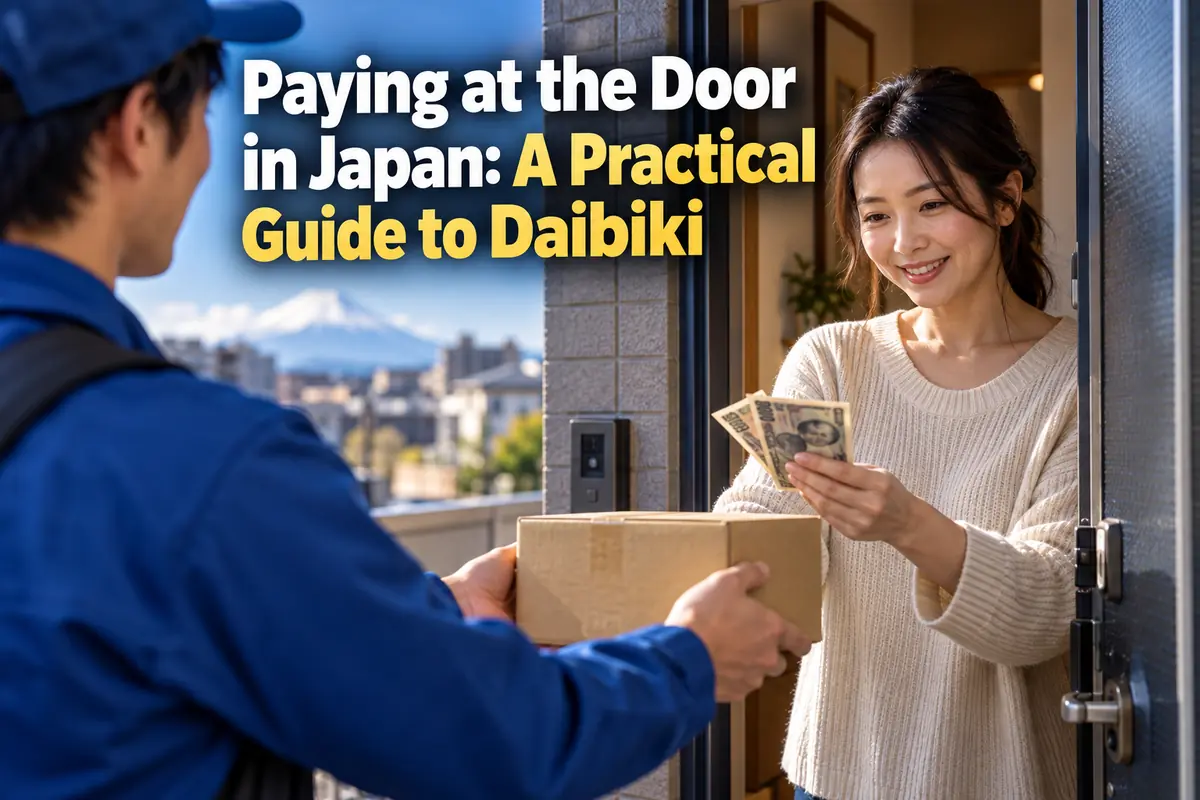
Paying at the Door in Japan: A Practical Guide to Daibiki
Daibiki means paying the delivery carrier when your online order arrives. Select it at checkout, check the full amount due, and arrange for someone to receive the parcel and pay. Prepare cash unless the shop explicitly confirms another payment method.
The important limit is that payment comes before you can open the parcel and inspect the product. Daibiki helps you avoid paying before shipment, but it does not guarantee that the seller or goods are trustworthy.
This guide is for foreign residents and families buying from Japanese online shops, especially when a checkout page offers unfamiliar payment options. Operator information was checked on October 8, 2026; your shop’s current checkout conditions determine what applies to your order.
- Check the total: goods, shipping, and any cash-on-delivery fee.
- Check how to pay: a carrier’s cashless services may not be enabled by your seller.
- Plan the handover: do not assume a delivery box or unattended delivery is available.
- Tell your household: nobody should pay for an order they cannot identify.
What daibiki means—and how it differs from chakubarai
Daibiki collects the order payment at delivery; chakubarai refers to paying the shipping charge on receipt.
The full Japanese name is 代金引換 (daikin hikikae), often shortened to 代引き or 代引 (daibiki). Japan Post describes it as collecting the amount specified by the sender in exchange for handing over the item, then transferring that money to the sender. See its cash-on-delivery explanation.
These labels are useful when reading a checkout screen or delivery notice:
- 代金引換 / 代引き — daikin hikikae / daibiki: payment collected when the parcel is delivered.
- 代引手数料 — daibiki tesūryō: cash-on-delivery handling fee.
- 送料 — sōryō: shipping charge.
- 着払い — chakubarai: shipping paid by the recipient.
- 現金のみ — genkin nomi: cash only.
- 再配達 — sa haitatsu: redelivery.
Do not treat “pay on arrival” as a complete description of the charge. A chakubarai parcel may require payment for shipping even though the goods were already paid for. A daibiki parcel has a collection amount set by the sender, which may include goods and other charges.
Japan Post specifically explains that a sender can include shipping in the cash-on-delivery collection amount. Its FAQ on daibiki and chakubarai helps clarify why the two labels are not interchangeable.
How much will you pay?
The amount to prepare is the shop’s final delivery collection total, rather than the product price alone.
Before submitting the order, look for three separate figures:
- The price of the goods, including the applicable tax.
- Shipping, including any destination or special-delivery surcharge shown by the shop.
- The daibiki fee charged to you.
Check whether the checkout total already includes all three. Do not add a fee twice simply because the shop displays it on a separate line.
A simple budgeting example
Suppose a shop shows the following illustrative figures, not a carrier tariff:
- Goods: ¥4,000
- Shipping: ¥600
- Daibiki fee: ¥400
- Total to collect at delivery: ¥5,000
You would prepare ¥5,000, not ¥4,000. If that shop waives shipping but keeps the daibiki fee, the amount becomes ¥4,400. “Free shipping” does not automatically mean free payment handling.
For a small purchase, compare the final total across the payment methods actually offered by the shop. An extra handling fee matters more on a ¥1,000 order than on a large household purchase.
Why a carrier’s fee page may not match your checkout
Carrier charges and the amount a retailer passes on to a buyer are different questions.
For example, Japan Post’s fee explanation separates postage, the cash-on-delivery charge, and the charge for transferring the collected money to the sender. These are service costs for sending the item; the retailer’s checkout tells you how much you will be asked to pay.
There is no single daibiki fee to apply to every Japanese online shop. Confirm whether a quoted fee is per order or per shipment, particularly if the retailer plans to send items separately.
Destination differences also matter. Check the retailer’s shipping conditions for your postcode, including any remote-island or other regional restrictions. These are shop and delivery-service conditions, rather than municipal payment rules.
Can you use a card or phone instead of cash?
Cashless payment is possible on some daibiki deliveries, but the seller must allow it for your shipment.
The term “cash on delivery” can be misleading in English: some Japanese services collect payment at the door using methods other than cash. However, the fact that a delivery company accepts a payment method somewhere in its business does not establish that it accepts it for your particular order.
Sagawa: check the seller’s payment setting
Sagawa’s current payment guide lists cash, credit cards, debit cards, and code payments for its e-collect cash-on-delivery service.
It also states two important limits: payment is cash only when the sender specifies cash-only collection, or when reception conditions prevent the payment terminal from being used. Even if you intend to pay electronically, a cash backup can avoid a failed handover.
Do not assume that every foreign-issued card, debit card, or phone wallet will work. Ask the shop about the specific method you plan to use.
Yamato: ask about your order, not just the carrier
Yamato’s Takkyubin Collect payment FAQ lists cash, credit cards, electronic money, and gift certificates, while warning that an online shop may not support payment methods other than cash.
That distinction is the deciding factor. A general carrier payment logo is less useful than a clear statement in the retailer’s daibiki instructions.
If the checkout is unclear, ask:
この注文の代引きは、現金のみですか?
Kono chūmon no daibiki wa, genkin nomi desu ka?
Is cash the only payment method for this cash-on-delivery order?
For another carrier or postal service, check that service’s own collection rules. Do not transfer Sagawa or Yamato payment options to a different operator.
How to order and receive the parcel
A smooth daibiki delivery depends on knowing the amount, being available, and matching the parcel to your order before paying.
Before placing the order
Use this checklist while the checkout page is still open:
- Confirm that 代金引換 is available for the goods and destination.
- Read the fee and accepted-payment instructions.
- Check the delivery name, full address, building name, room number, and contact number.
- Read the shop’s cancellation and return conditions.
- Save the confirmation showing the seller, items, total, and order number.
You select daibiki through the seller’s checkout. If it is not offered, ask the shop whether it is available before ordering; do not plan to change a prepaid order into daibiki by asking the driver at the door.
Before delivery day
Prepare the stated amount in yen if paying cash. Having the exact amount ready reduces the need for change, but check with the carrier if you need to pay using a large banknote.
If someone else will receive it, send them a short message with:
- The shop or expected sender name.
- The expected collection amount.
- The tracking number, once available.
- Permission to pay for this particular order.
Japan Post’s guidance on unfamiliar cash-on-delivery parcels advises checking with the intended recipient before accepting a family member’s parcel. This is especially useful in a shared household where several people shop online.
At the door
Compare the sender and requested amount with your order confirmation. If either is unfamiliar or the amount differs, pause and check before paying.
Once you have identified the delivery, make the agreed payment and keep the payment receipt with the order confirmation. Open and check the goods promptly after receipt, so you can contact the retailer within its stated complaint or return period.
The driver handles the delivery and collection. Questions about the wrong product, quality, or a refund normally need to go to the retailer.
What if you are out, or want another pickup location?
Daibiki requires an arrangement that allows the carrier to collect payment; ordinary unattended delivery settings may not apply.
Sagawa explicitly lists e-collect parcels among those requiring face-to-face handover in its delivery FAQ. Do not assume that a building’s parcel locker or your usual leave-at-door preference will work.
If you miss delivery:
- Read the missed-delivery notice and tracking information.
- Request redelivery using the carrier’s official channel.
- Choose a time when someone can receive and pay.
- Check the parcel’s collection or holding deadline.
There is no universal deadline to use for every carrier and parcel type. Follow the deadline given for your shipment, especially for chilled or frozen goods.
If you want a service-counter, post-office, or convenience-store pickup, confirm eligibility before relying on it. A pickup option available for a prepaid parcel may have different conditions for daibiki. If counter collection is approved, check which identification, notice, and payment method you need to bring.
For visitors staying at a hotel, ask the property before ordering. Do not assume reception staff will advance the money or accept a payment-required parcel for you.
Daibiki does not let you inspect the contents before paying
Paying at delivery confirms that a parcel has arrived, but it does not confirm that the contents match the listing.
The National Consumer Affairs Center of Japan explains in its warning about counterfeit goods sent by cash on delivery that buyers pay, receive the parcel, and only then open it. They cannot verify whether the goods are genuine before making that payment.
This matters when a seller presents daibiki as proof that buying from its website is safe. It is a collection method, not an authenticity check or a promise of a refund.
Before ordering from an unfamiliar shop, look for a clearly identified business, usable contact details, and understandable return conditions. Be cautious if the seller unexpectedly changes your chosen payment method to daibiki; the consumer center’s warning includes cases involving that change.
An unexpected parcel: check first, do not pay automatically
If neither you nor another household member ordered it, do not pay just because your name appears on the label.
The consumer center’s guidance on unordered daibiki parcels advises refusing receipt and payment when there is no known order. It also recommends agreeing on a household rule against accepting parcels whose purchaser cannot be identified.
If someone has already paid for an unfamiliar parcel, keep the label, receipt, packaging, and any relevant messages. Contact the sender to request a return or refund, and seek help from your local consumer affairs center if the matter cannot be resolved. Ask about available language assistance rather than assuming English support is offered everywhere.
A genuine order you no longer want is a different case
If you placed the order and have changed your mind, contact the seller about cancellation. Do not use missed delivery as a substitute for that conversation.
Check what the seller says about cancellation after dispatch, return shipping, and handling charges. Refusing a parcel does not by itself settle the purchase agreement or establish that no charges remain.
When is daibiki a useful choice?
Daibiki works best when you want to pay at delivery, accept the extra fee, and can arrange a payment handover.
It can be useful for a new resident who has cash available but cannot use the payment methods accepted by a particular shop. It can also suit a household that prefers to match payment to an expected delivery.
Another payment option may be easier if you are rarely home, rely on unattended delivery, or want to avoid an additional handling fee. Compare those practical differences before choosing.
Before your next order, confirm four things:
- Which parcel: the seller and expected sender name.
- How much: the full amount to collect, including fees.
- How to pay: the methods enabled for this order.
- Who receives it: someone who knows about the purchase and can pay.
Keep that information with the order confirmation. It gives you—and anyone answering the door—a clear basis for deciding whether to accept the delivery.
参照リンク
- Japan Post: What is cash on delivery?
- Japan Post: Cash on delivery and recipient-paid shipping
- Japan Post: Charges for cash on delivery
- Sagawa Express: Payment methods
- Yamato Transport: Payment methods for Takkyubin Collect
- Japan Post: Unfamiliar cash-on-delivery parcels
- Sagawa Express: Frequently asked questions
- National Consumer Affairs Center of Japan: Counterfeit goods and cash-on-delivery shopping
- National Consumer Affairs Center of Japan: Unordered cash-on-delivery parcels